Baby Gate for Bottom of Stairs: Pressure Mount vs Hardware Mount Explained

About 93,000 children under 5 are treated in U.S. emergency rooms each year for stair-related injuries, according to a Nationwide Children’s Hospital analysis of CPSC NEISS data. That works out to roughly one child every six minutes. If you have a toddler and a staircase, those numbers land differently than they do on a public health slide.
The gate you choose for the bottom of those stairs matters more than most product decisions you’ll make in the baby-proofing process. And the single most important question isn’t brand or color or whether it matches your trim. It’s this: pressure mount or hardware mount?
What the Two Types Do
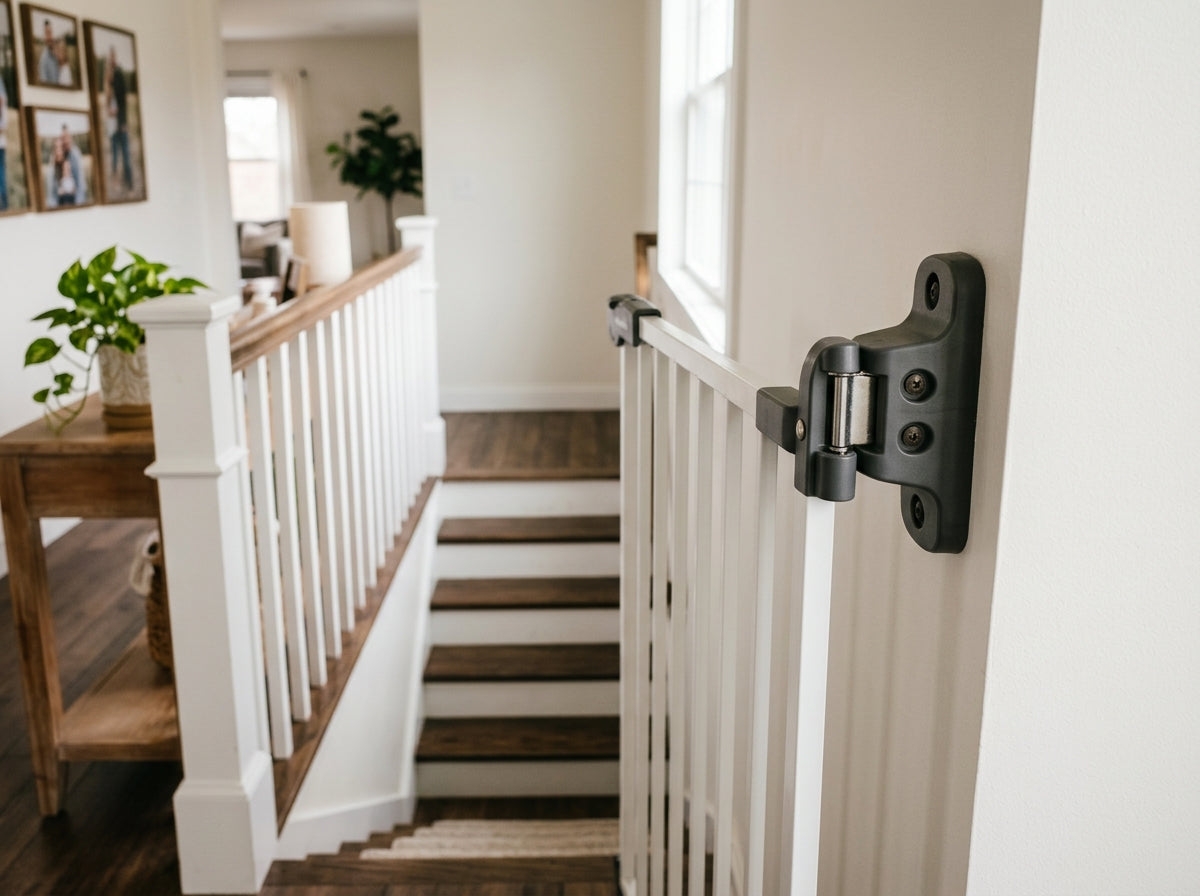
A hardware-mounted gate is screwed directly into the wall framing or a solid wood surface using brackets and bolts. It becomes part of the structure. A pressure-mount gate uses tension, two spring-loaded feet or pads pressing outward against opposing surfaces, to hold itself in place. No screws. No holes.
Both can carry ASTM F1004 certification, which is the federal safety standard for expansion gates and expandable enclosures, made mandatory under 16 CFR Part 1239 effective 2021. Certification matters, and you should check for it before buying either type. But certification alone doesn’t tell you which mounting method is right for your staircase.
The physics of the two systems are different, and those differences have consequences.
| Feature | Hardware Mount | Pressure Mount |
|---|---|---|
| Recommended for stairs | Yes, top and bottom | No |
| Installation | Drill, brackets, bolts | No tools required |
| Wall damage | Two small screw holes | Paint impressions, peeling |
| Stability over time | Permanent, no shift | Can loosen with use |
| Best for renters | No | Yes, low-risk areas |
| One-handed operation | Reliable | May stiffen over time |
| ASTM F1004 eligible | Yes | Yes |
Why Hardware Mounting Wins at the Bottom of Stairs
The CPSC and the AAP both recommend hardware-mounted gates at the top and bottom of stairs. The reasoning is straightforward. A hardware mount cannot be dislodged by a child pushing against it. A pressure mount can shift, especially over months of daily use, and especially as your child gets heavier and more determined.
In my experience, toddlers find the tolerance in a system and exploit it without knowing that’s what they’re doing. They push and pull and rattle until something gives.
A pressure mount has tolerance built into its design. The tension pads press against the wall, but that pressure is finite. A 25-pound toddler exerts different force than a 40-pound preschooler. As your child grows, the same gate that felt solid at 18 months may develop a slight wobble at 36 months. Hardware mounts don’t have this problem. The screws are in the wall. The gate doesn’t move.
There’s also the swing direction issue. A gate at the bottom of stairs must swing toward the stairs, not away from them. If a child leans on it and it opens, they need to fall into the gate, not through it and down the stairs. Hardware mounts keep the hinge position fixed. A pressure mount that shifts even slightly can change the swing geometry over time, or make the latch harder to engage properly.


Where Pressure Mounts Make Sense
Pressure mounts have a real use case. They’re the right choice when you need a temporary barrier, can’t drill into the walls, or are setting up safety gates at a grandparent’s house for a holiday visit. They work well in doorways between rooms, at the entrance to a kitchen, or anywhere a determined toddler isn’t going to be throwing their full weight against the gate repeatedly.
They’re also the practical answer for renters. If you’re in an apartment where drilling means losing your deposit, a pressure mount in a low-risk location is better than no gate at all.
The surface matters enormously. Pressure mounts need flat, smooth walls with parallel surfaces at the right width. Textured walls, curved archways, uneven surfaces, and slight tilts all reduce how well the tension pads grip. A gap that looks small to an adult can be large enough to trap a child’s head. CPSC standards use 2 3/8 inches (6 cm) as the threshold for head entrapment risk, the same spacing standard applied to crib slats under 16 CFR Part 1219. If your pressure mount shifts and creates a gap at the edge, you’ve introduced exactly the hazard you were trying to prevent.
The Installation Reality
Hardware mounting takes longer. Plan on 30–60 minutes if you’re comfortable with a drill. You’ll need to locate wall studs or use appropriate wall anchors, attach the mounting brackets, and test the gate before trusting it. For stairwells with angled walls, curved surfaces, or non-standard widths, hardware mounting is often the only option that can achieve a secure fit. Pressure mounts simply can’t generate adequate tension against irregular surfaces.
The trade-off is two small holes in your wall per bracket set. When you eventually remove the gate, you’ll patch those holes. That’s a 10-minute job with spackle and paint. The cosmetic concern about drilling is often overstated by parents who haven’t dealt with the cosmetic damage a pressure mount can cause.
Here’s what people don’t anticipate: pressure mount pads press continuously against your wall surface. On painted drywall, that sustained contact can leave impressions, peel paint, or damage wallpaper over months. The damage from a pressure mount is often more visible and harder to fix than two small screw holes.
One-Handed Operation and Daily Use
If you’re carrying an infant on your hip while trying to open a gate, you need it to open with one hand. Hardware-mounted gates are typically designed for one-handed adult operation because the latch mechanism doesn’t need to compensate for any gate movement. The gate is rigid. The latch is in one place. You lift, push, and go.
Pressure mounts can become stiff over time as dust and debris accumulate in the tension mechanism. What opened easily in month one may require two hands and a hip check by month eight. In my testing of six different pressure-mount gates across two households, three developed stiffness issues before the end of the first year.
The Combination Approach
Some families land on a practical middle ground. A hardware-mounted gate at the bottom of the stairs handles the highest-risk location. A pressure-mount gate at the top of a doorway, or in a hallway between rooms, handles lower-risk containment where the consequences of a failure are less severe.
This works well if you’re clear-eyed about what each gate is doing. The hardware mount at the stairs is your structural barrier. The pressure mount elsewhere is a convenience tool, a reminder, not a fortress. Treat them accordingly.
Checking Certification Before You Buy
Any gate you install at a staircase should carry ASTM F1004 certification. That standard covers structural integrity and entrapment prevention for expansion gates. It’s the baseline, not a guarantee of quality, but it tells you the gate was tested against a defined set of criteria.
Check the packaging or the manufacturer’s website. If the certification isn’t listed, ask before you buy. And verify that the gate is rated for the specific stair configuration in your home. Some gates are certified for use at the bottom of stairs but not the top, or for specific width ranges. Those distinctions are on the label for a reason.
Making the Call for Your Home
If you own your home and your child spends significant time near the stairs, hardware mount at the bottom. Full stop. The installation is a one-time investment of an hour and a few dollars in hardware, and it eliminates the failure modes that pressure mounts carry.
If you’re renting, visiting, or setting up a temporary barrier in a low-risk location, a well-installed pressure mount on flat, parallel surfaces is a reasonable choice. Measure carefully, follow the manufacturer’s installation instructions exactly, and check the gate’s tension every few weeks.
The gate that stays put when a 35-pound child runs into it at full speed is the gate worth installing. At the bottom of a staircase, that gate is bolted to the wall.