
Baby Playpen Buying Guide: Playpens vs Play Yards vs Baby Fences
Playpens vs Play Yards vs Baby Fences
The names matter less than you’d think. Whether the box says "playpen," "play yard," or "baby fence," what you’re buying is contained, supervised space for a child who has recently discovered that the world is large and full of interesting hazards. The terminology is marketing. The safety requirements are not.
This guide will help you figure out which type of containment product fits your home, your child’s age, and the specific problem you’re trying to solve, then tell you what to look for before you buy.
The Terminology Problem (and Why It Matters)
Walk through any baby gear retailer and you’ll see these three terms used almost interchangeably. They’re not the same thing, and conflating them can lead you to buy a product that doesn’t meet the standard relevant to your use case.
Play yards are the freestanding, folding enclosures with fabric mesh sides and a padded floor. Think Graco Pack 'n Play. They’re self-contained units, typically 28–30 inches tall, designed for infants and young toddlers. Many include a bassinet insert for newborns and a changing table attachment. Play yards are governed by ASTM F406, the safety standard for non-full-size cribs and play yards, made mandatory under 16 CFR Part 1221. That regulatory hook matters: it means CPSC has enforcement authority, and manufacturers must certify compliance.
Baby fences (also called play yards in some marketing, confusingly) are modular panel systems, usually made of plastic or metal, that you configure into whatever shape fits your space. They don’t have a floor. They’re not intended for sleep. They’re meant to create a larger roaming zone, typically for older babies and toddlers who need more room to pull up, cruise, and explore. These fall under a different standard entirely: ASTM F1004, the federal safety standard for expansion gates and expandable enclosures, made mandatory under 16 CFR Part 1239, effective 2021.
Playpens is the legacy term. It’s mostly used to describe older-style products with rigid sides, or informally to describe any of the above. When a brand calls something a "playpen" today, check which standard it certifies to. That tells you what it is.
What Problem Are You Solving?
Before you compare products, get specific about your situation.
Here’s how I think about matching product type to need:
You need a safe sleep surface away from home. Buy a play yard certified to ASTM F406. Many play yards include a bassinet mode for infants under a certain weight (check the specific product’s limit, usually around 15 lbs). The firm, flat floor of a compliant play yard is a safe sleep surface. A modular baby fence with no floor is not.
You need a contained zone for a crawling or cruising baby while you’re in the same room. Either a play yard or a modular fence works, depending on how much space you want to give them. Play yards are smaller and more portable. Fences give more room but require floor space and assembly.
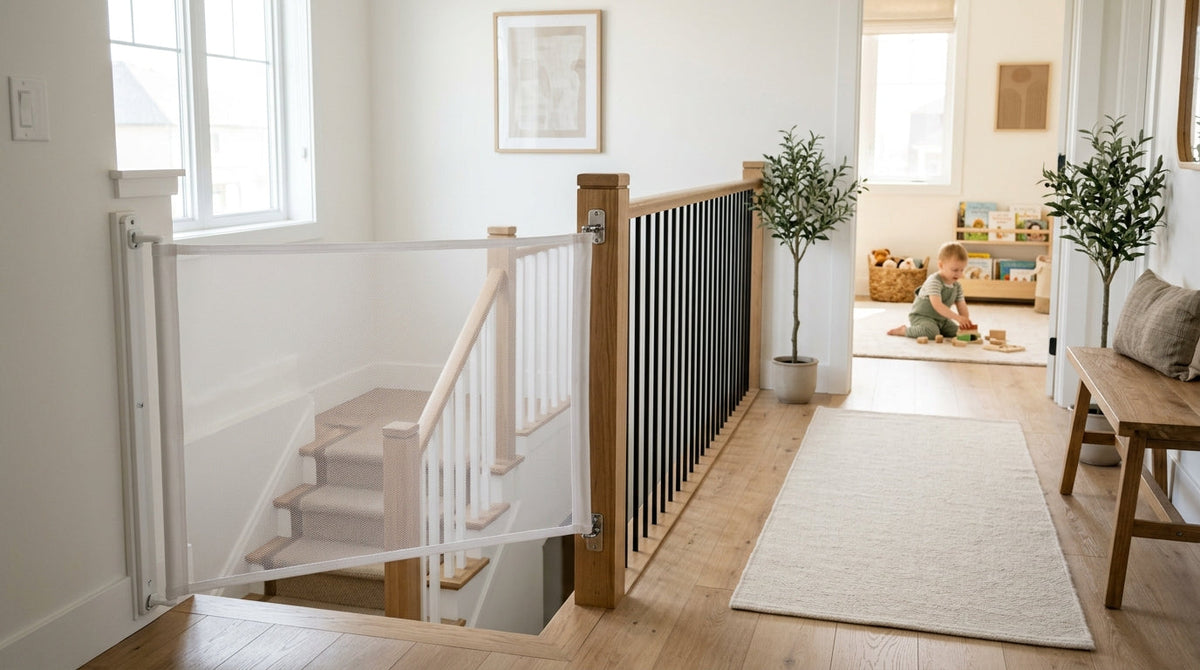
You need to block a specific area, like a fireplace or a staircase. That’s a gate, not a play yard or fence. Gates are their own category with their own standards. For stairs specifically, you want a hardware-mounted gate, not a pressure-mounted one.
You need something that travels. Play yards fold flat and come with carry bags. Modular fence panels don’t. If you’re a family that moves between houses, a play yard wins on portability every time.
In my experience, modular fences work best for giving a mobile child a generous, safe zone inside a larger room, for example, to allow cooking in an adjacent kitchen without a toddler underfoot.
Play Yard Safety Standards: What Certification Means
When a play yard carries ASTM F406 certification, it has been tested against specific requirements for structural integrity, mesh opening size, side height, and hardware. The standard is designed to prevent entrapment, suffocation, and collapse.
The mesh is one of the most important elements. Openings must be small enough that a child’s head, neck, or limb can’t become trapped. Fabric mesh sides also eliminate the footholds that rigid-sided older playpens created, which children used to climb out. If you’re looking at a vintage playpen at a garage sale, walk away. Pre-1970s playpens with wide mesh openings or accordion-style folding sides have caused strangulation deaths. The standard exists because children died.
For the bassinet insert, the weight limit is firm. It’s not a suggestion. When my younger daughter outgrew the bassinet mode of our play yard at around 4 months, I moved her to the main floor even though she wasn’t rolling yet. The limit is there because the elevated insert isn’t designed to hold a larger, more active child.
One thing the standard does not regulate: what you put inside the play yard. No bumpers, no pillows, no soft toys for infants. The same safe sleep rules that apply to a crib apply here. A certified play yard floor is safe. Adding soft objects to it is not.
| Feature | Play Yard | Modular Fence |
|---|---|---|
| Safe for sleep | Yes (ASTM F406) | No |
| Portable | Yes, folds flat | No |
| Interior space | Small, fixed | Large, configurable |
| Newborn use | Yes, with bassinet | No |
| Best age range | Newborn to 12 months | 10 months and up |
| Outdoor use | Yes | Limited |
| Safety standard | ASTM F406 | ASTM F1004 |
Modular Baby Fence Safety Standards: What to Check
Modular fences certified to ASTM F1004 have been tested for panel strength, latch security, and the force required to push panels out. The standard requires panels to resist a meaningful horizontal push-out force and individual slat testing to prevent a child from forcing through gaps.
What the standard doesn’t tell you: how tall to buy. Most modular fences come in 24-inch or 30-inch panel heights. For a young toddler who’s just walking, 24 inches is often fine. For an athletic 2-year-old, it may not be. In my experience, active climbers can clear 24-inch panels by 22 months using stacking toys as steps, making 30-inch panels a safer choice.
Panel count determines your enclosure size. A standard 6-panel square gives you roughly 9–10 square feet of interior space. An 8-panel square gives you closer to 18 square feet. Most manufacturers publish the square footage for their standard configurations. For a child who’s walking, bigger is better. Cramped spaces frustrate toddlers and increase the chance they’ll work on escaping.
What to look for when buying:
- ASTM F1004 certification mark on the box or product listing
- Latch design that requires two simultaneous actions to open (so a toddler can’t figure it out)
- No sharp edges or pinch points between panels
- Panels that connect securely without flex at the joints
- A door panel if you want easy adult access without disassembling a section
What to avoid:
- Uncertified sets sold as "decorative" or "room dividers" that have no safety rating
- Panels with large decorative cutouts that create footholds or finger traps
- Very cheap sets where the panel connectors feel loose out of the box. They won’t get tighter with use.
The Gate Question: When a Fence Isn’t the Right Tool
Modular fences are not stair gates. I want to be direct about this because I’ve seen parents use a modular fence panel to block a staircase opening. It’s not built for that application, and it’s not tested for it.
Approximately 93,000 children under 5 are treated in U.S. emergency rooms each year for stair-related injuries (Nationwide Children’s analysis of CPSC NEISS data). Stairs are a real hazard. They require a hardware-mounted gate that’s anchored to wall studs, tested for the specific forces a falling child generates.
If your home has stairs, buy a dedicated stair gate. Use your modular fence for room containment, not stair blocking.
Play Yards vs. Baby Fences: A Direct Comparison
Here’s where I’ll be blunt about the tradeoffs.
Play yards win on:
- Portability. They fold, they travel, they set up in under two minutes once you’ve done it a few times.
- Sleep safety. A certified play yard is a legitimate sleep surface. A modular fence is not.
- Newborn versatility. The bassinet insert makes a play yard useful from day one.
- Outdoor use. Most play yards work on grass, patios, or in a hotel room.
Modular fences win on:
- Space. A fence gives a walking toddler room to move.
- Configurability. You can make it square, rectangular, or irregular to fit your room.
- Longevity. A toddler who’s outgrown a play yard can still use a fence enclosure for another year or more.
- Integration. You can attach a fence to a wall or piece of furniture to create a larger safe zone.
Many families end up with both. The play yard handles the first year, including travel and naps. The modular fence takes over around 10–14 months when the child is mobile and the play yard starts feeling like a cage.
What I’d Buy Right Now
I’ve installed and lived with products in both categories across two kids and several years of testing. Here’s what I’d tell a friend who called me today.
For a newborn through 12 months: Get a play yard with a bassinet insert. Look for one with a removable, washable mattress pad, a side that zips or folds for easy access, and wheels for moving between rooms. Confirm ASTM F406 certification. Don’t buy used unless you can verify the model number hasn’t been recalled. The CPSC recall database is searchable and free.
For a mobile baby or toddler (10 months and up): Add a modular fence. Thirty-inch panels if you have any reason to think your child will be a climber. Eight panels minimum for a child who’s walking. Look for ASTM F1004 certification, a latch that requires two actions to open, and connectors that feel solid, not wobbly.
For travel specifically: A compact play yard is worth the investment even if you have a larger one at home. Some travel-specific models fold smaller than a standard play yard and weigh under 15 lbs. If you visit grandparents or stay in hotels regularly, a dedicated travel unit pays for itself in peace of mind.
Before You Buy: Quick Safety Checklist
Used, Secondhand, and Hand-Me-Down Products
The short version: be careful.
Play yards wear out in ways that aren’t always visible. The mesh can develop small tears that create entrapment points. The floor pad can compress unevenly. The locking mechanisms on folding models can weaken. Before accepting a secondhand play yard, check the CPSC recall database for the model number. If you can’t find the model number, don’t use it for sleep.
Modular fences are generally safer to buy secondhand because they don’t have sleep-surface implications. But check every connector and latch. If any panel has a crack, replace the whole set or skip it. A cracked panel won’t hold under the force of a determined toddler.
Never use a vintage playpen with accordion-fold mesh sides or large diamond-pattern mesh openings. These designs predate modern safety standards and have caused strangulation deaths. The product may look fine. It is not fine.
Setting Up for Real Use
A few things I’ve learned from living with these products:
Place the play yard or fence away from furniture a child could use as a climbing aid. Children are creative and motivated, in my experience, a 16-month-old can drag a board book to the enclosure edge and use it as a step.
Don’t leave a child in a play yard or fence enclosure unsupervised for extended periods. These products are for short-term containment while you’re present in the home, not for childcare substitution.
Check hardware monthly. Connectors loosen, latches wear, mesh develops stress points. A five-minute check every few weeks is worth it.
If you’re using a play yard outdoors, keep it out of direct sun. The mesh sides trap heat faster than you’d expect, and a dark-colored floor pad can get hot enough to matter on a warm day.
The right containment product doesn’t replace supervision. It buys you the time to answer the door, stir the pot, or use the bathroom without a small person following you into danger. Used correctly, with the right product for the right age and situation, it’s one of the more practical pieces of baby gear you’ll own.