

Six months is a strange inflection point. Your baby is still immobile enough that you feel like you have time. You don’t.
Most parents start babyproofing when they see their child moving, which means they’re already behind. The window between "rolling occasionally" and "across the room in thirty seconds" is shorter than anyone warns you about. By the time crawling starts, usually somewhere between seven and ten months, the hazards you meant to address have been sitting there, accessible, for weeks.
The goal of this article is to get you ahead of that curve. Not panicked. Just prepared.
Why Six Months Is the Right Moment
At six months, your baby is building the strength and curiosity that will power crawling, pulling up, and cruising. They’re also developing the grip to grab, the reach to pull, and the motivation to explore everything within range. The cognitive leap comes before the locomotion.
In my experience, the cognitive leap comes before the locomotion. When my older daughter was about six months old, I put her on the playmat and walked to the kitchen. I came back to find she’d rolled herself to the edge of the mat and was straining toward the electrical cord from the baby monitor. She wasn’t crawling. She didn’t need to be. Reach and roll got her close enough.
You’re not babyproofing for who your child is today. You’re babyproofing for who they’ll be in eight weeks.
Start With the Floor, Then Work Up
Get down on your hands and knees in every room your baby will access. This sounds obvious. Almost no one does it thoroughly.
From floor level, you’ll see what your baby will see: electrical outlets, cords trailing from lamps and chargers, the gap under the couch where small objects collect, the edge of the coffee table at exactly eye height. You’ll also notice the things you’ve stopped seeing because they’ve been there so long.
Electrical outlets are the classic starting point, and low-profile sliding plate covers are worth the upgrade over the old plug-in caps. The plug-in style can be pulled out by a determined baby and become a choking hazard themselves. Sliding covers require a two-step motion that small fingers can’t easily replicate.
Cords are a separate problem. A cord is a tripping hazard for adults and a strangulation risk for infants. Gather, shorten, and route them out of reach. Cord management clips and cable boxes cost almost nothing and take fifteen minutes to install properly.

- Uncovered electrical outlet at floor level
- Lamp cord trailing across floor
- Coffee table corner at eye height
- Small objects under sofa edge
- Unanchored bookcase within reach
Furniture Anchoring Is Not Optional
CPSC reports one child death every two weeks from tip-overs involving furniture, TVs, or appliances. That number has been consistent for years, and it includes children who were simply pulling up on a dresser drawer or reaching for something on a shelf.
At six months, your baby isn’t pulling up yet. But in two to three months, they will be. Anchoring now, before the behavior starts, is the entire point.
Every dresser, bookcase, and wardrobe needs to be secured to a wall stud with an anti-tip strap. This includes furniture that feels heavy and stable. A six-drawer dresser can tip on a toddler pulling on an open drawer. Flat-screen TVs should be either wall-mounted or strapped to the furniture they sit on, which itself needs to be anchored.
Check that the straps are attached to studs, not just drywall. A strap screwed into drywall alone will pull free under load. Use a stud finder, or knock along the wall until you hear the tone change.


Baby Gates: Buy Them Before You Need Them
About 93,000 children under five are treated in U.S. emergency rooms each year for stair-related injuries, per a Nationwide Children’s Hospital analysis of CPSC NEISS data. Stairs are one of the most predictable hazards in the home, and a gate is a straightforward fix.
The complication is that not all gates are equal, and the wrong gate in the wrong location is a false sense of security.
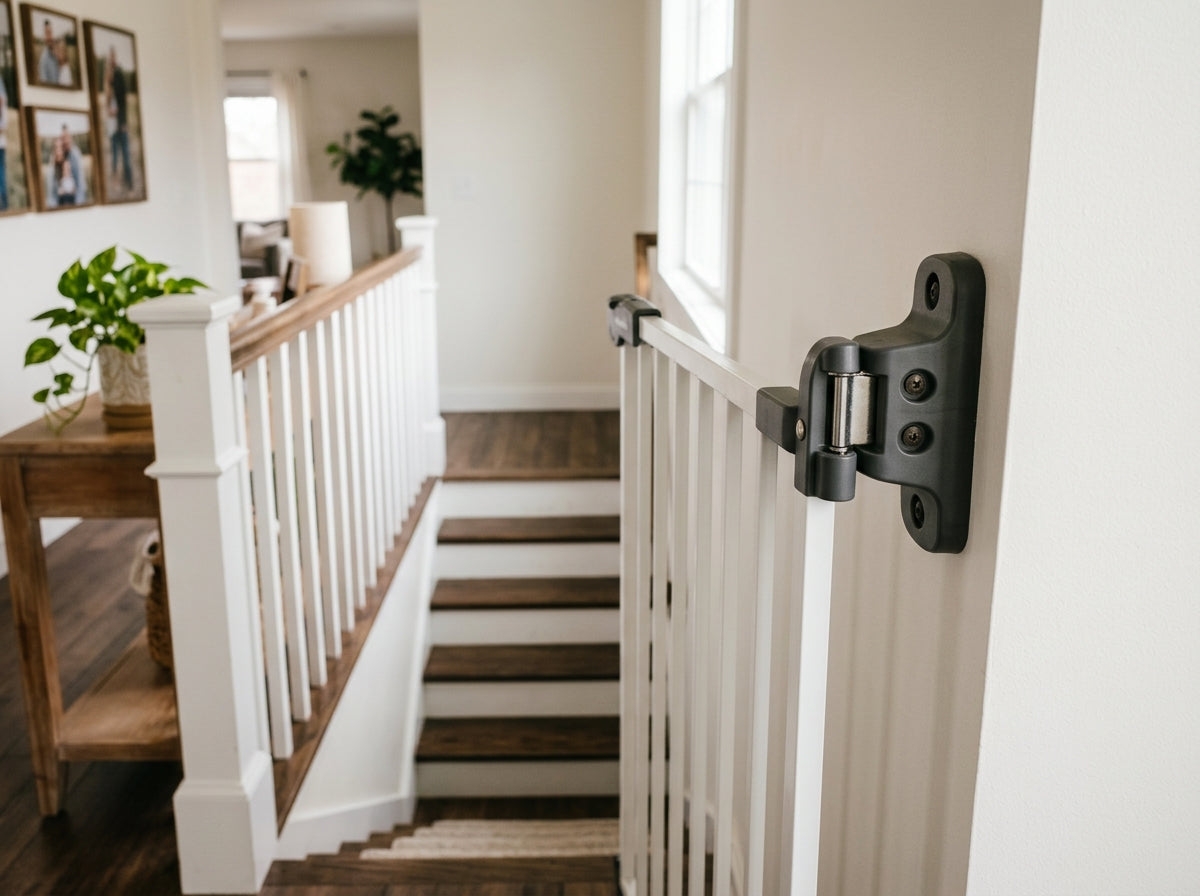
For the top of stairs, you need a hardware-mounted gate, full stop. Pressure-mounted gates are for doorways and room dividers, not stair tops. A baby leaning on a pressure-mounted gate at the top of the stairs can push it out of position. Hardware-mounted gates bolt into the wall or stair post and don’t move.
Look for gates that meet ASTM F1004, the federal safety standard for expansion gates and expandable enclosures, made mandatory under 16 CFR Part 1239 (effective 2021). That certification means the gate has been tested for the forces a child applies.
Buy and install the gates now, even if your baby isn’t mobile. Installation takes longer than expected, especially at the top of stairs where the wall angle and stair post require adapters. Do it on a weekend afternoon before you need it urgently.


Cabinet Locks and the Under-Sink Problem
In my experience, the under-sink cabinet is the highest priority. Cleaning products, dishwasher pods, drain openers, and medications are commonly stored there. Per CDC PROTECT data, unsupervised medication exposures send roughly 100 children under five to U.S. emergency departments every day. That figure covers medications specifically, and it’s driven largely by access to products stored within reach.
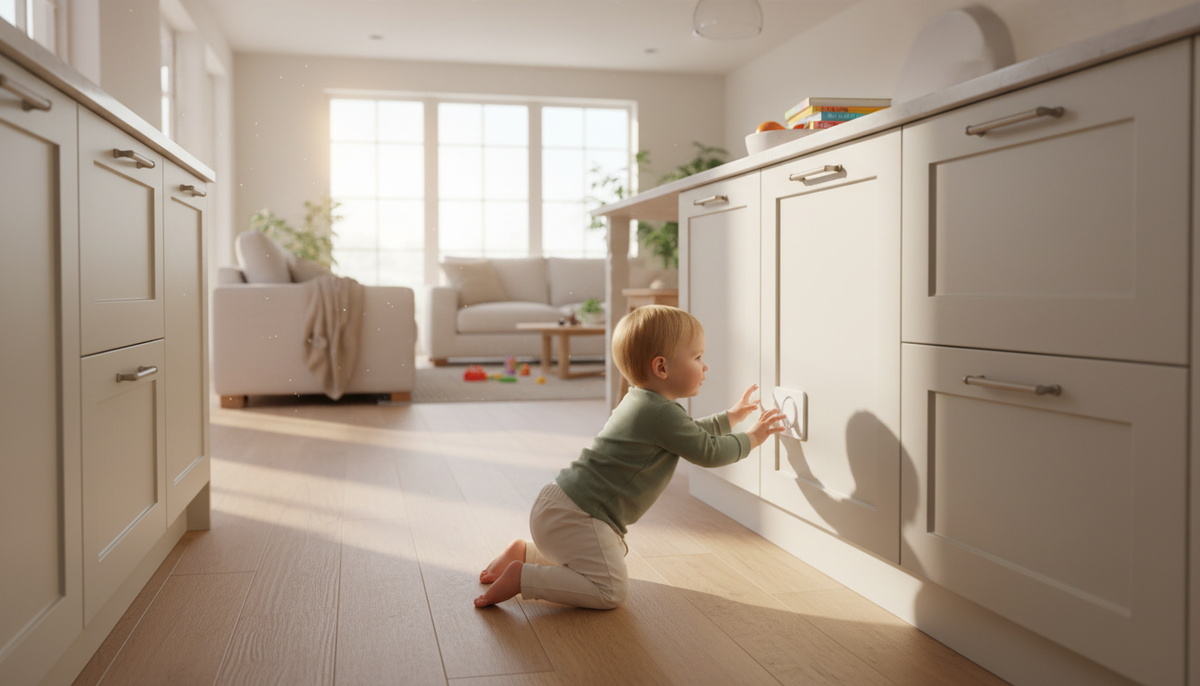
Magnetic cabinet locks are the most reliable option. They require a magnetic key to open and leave no external hardware visible. The tradeoff is installation: they require drilling, and the magnet key has to be kept accessible to adults but out of reach of children. Adhesive strap locks are faster to install but can fail on certain cabinet finishes, especially textured or painted wood. Screw-in hardware is more durable.
Move any medications, vitamins, cleaning products, and detergent pods to locked or high storage before your baby is mobile. This month, not next month.
Water Hazards Start Earlier Than You Think
Drowning is the leading cause of unintentional injury death in children ages 1–4 (CDC). A child can drown in as little as one to two inches of water (AAP), which means the hazard isn’t limited to pools and bathtubs.
At six months, your baby isn’t walking to the bathroom alone. But the habits you build now matter. Toilet locks are worth installing. Buckets used for mopping or cleaning should be emptied immediately after use and stored inverted. If you have a freestanding baby bathtub, never leave water sitting in it.
If you have a backyard pool, the fencing and gate latch requirements for your municipality should already be in place. If they’re not, this is the month to address it.
Smoke Alarms, CO Detectors, and the Basics
Three out of five home fire deaths occur in homes with no smoke alarms or non-functioning ones (NFPA). Walk through your home and test every smoke alarm. Replace batteries in any that chirp or fail the test. The NFPA recommends alarms on every level of the home, inside each bedroom, and outside each sleeping area. If your alarms are more than ten years old, replace them.
Carbon monoxide detectors belong on every level of the home, and near sleeping areas. CO poisoning kills more than 400 people each year and sends more than 100,000 to U.S. emergency rooms (CDC). CO is odorless and colorless, and infants are more vulnerable to it than adults because of their faster respiratory rate.
Check both while you’re doing the rest of your babyproofing. It takes twenty minutes and costs almost nothing.
Room-by-Room Babyproofing Checklist
The Room-by-Room Sweep
Once you’ve handled the structural items above, do a room-by-room pass with this framework:
Kitchen: Cabinet locks on all lower cabinets, especially under the sink. Oven knob covers or knob removal when not in use. Stove guard to prevent pot handle access. Move sharp utensils to upper drawers.
Bathrooms: Toilet lock installed. All medications and cleaning products moved to locked or high storage. Non-slip mat in the tub. Door handle cover or hook-and-eye latch to keep the door closed.
Living room: Furniture anchored. Cords managed. Outlet covers installed. Soft corner guards on coffee table and hearth edges. Small objects (remote controls, coins, batteries) off low surfaces.
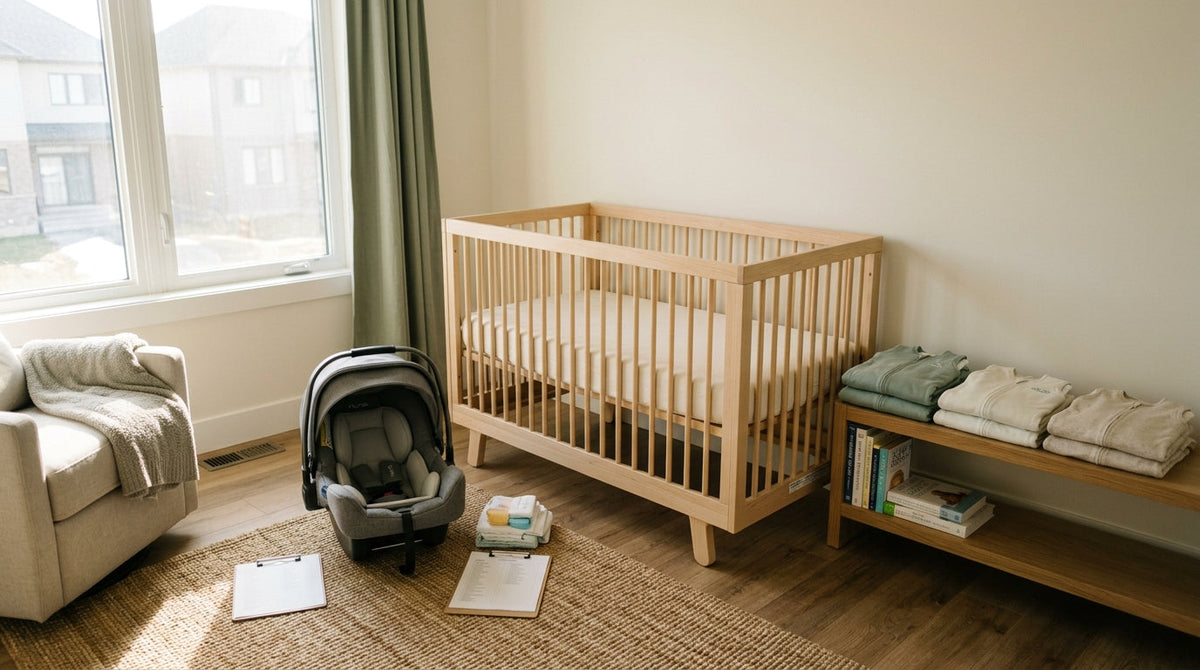
Nursery and bedrooms: Furniture anchored. Window stops or guards installed (windows should open no more than four inches). Blind cord wraps or cordless blinds. Baby monitor cord routed out of reach.
Stairs: Hardware-mounted gates at top and bottom.
One Last Thing About Timing
The instinct is to wait until you see the behavior before you address the hazard. That instinct is wrong for babyproofing. The hazard is there whether or not your baby can reach it yet, and the gap between "not yet mobile" and "pulling everything off the shelf" is measured in weeks, not months.
Do the sweep at six months. Update it at nine months when pulling up starts. Update it again at twelve months when cruising turns to walking. Babyproofing is a process, not a single afternoon, but the six-month pass is the one that sets the foundation for everything that follows.