
Baby Proofing for Minimalists: Less Stuff, Maximum Safety

Most baby proofing advice assumes you want to buy things. A cabinet full of magnetic locks, a hallway full of foam bumpers, outlet plates in every room. The minimalist parent looks at that list and feels a familiar tension: I want my child safe, but I don’t want my home to look like a padded cell.
Here’s what that tension misses. The safest baby proofing move you can make is usually subtraction, not addition. Remove the hazard entirely, and you don’t need a product to guard it.
That said, some things are non-negotiable. A few products belong in every home. The goal of this guide is to help you tell the difference.
Start by Removing, Not Installing
The AAP recommends environmental modification as the primary injury-prevention strategy, and that framing matters. It means your first move is a walk-through with fresh eyes, not a trip to the hardware store.
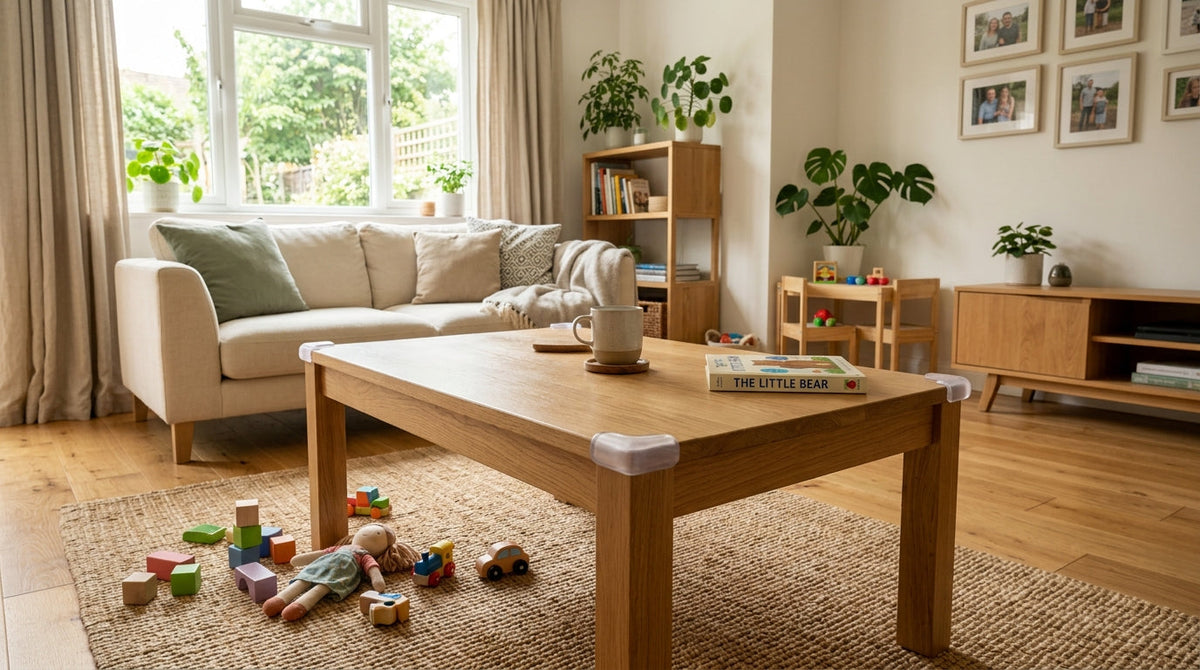
Get down to floor level. Crawl if you have to. What you’re looking for: small objects that fit through a toilet paper tube (choking hazards), cords at grabbing height, cleaning products stored under sinks, sharp corners at eye level, and anything that could topple if pulled.
In my experience, this audit needs to happen every time a child hits a new developmental milestone. When a child starts pulling to stand, it’s worth spending time on your knees in the living room, I once found a forgotten guitar pick wedged under the baseboard. Small. Hard. Exactly the wrong size.
Toxic substances deserve their own category here. Cleaning products, medications, vitamins, and laundry pods should not depend on a low cabinet lock alone. Store them up high and out of sight, ideally locked, somewhere a child cannot reach, period. A high locked cabinet, a locked closet, a relocated bin. Locks fail. In 2012, the CPSC recalled 900,000 Safety 1st Push 'N Snap cabinet locks after reports of children as young as 9 months opening them. Three of those children reached toxic cleaning products. Removal is more reliable than hardware.
Anchor Everything That Could Fall
This is the one place minimalists sometimes get complacent. Fewer furniture pieces means fewer tip-over risks, right? Mostly, but not entirely.
The CPSC is clear: dressers, bookshelves, and televisions must be anchored to wall studs regardless of how sparse your space is. One unsecured dresser is enough. Children climb, they pull, they use drawers as ladders. This is not a stylistic choice.
Anti-tip straps cost a few dollars, install in under ten minutes, and disappear behind the furniture. They are invisible and they work. If you have a television on a stand rather than wall-mounted, the stand needs to be anchored or the TV needs to move to the wall. Wall-mounting also eliminates the stand entirely, which is a real minimalist win.


Rethink Open Shelving as a Safety Tool
Low, open shelving stocked only with age-appropriate toys and books is one of the most underrated baby proofing strategies. It costs nothing if you already own the shelving. It works because it removes the need for cabinet locks on those surfaces entirely, and it gives your child a clear, consistent message about what is theirs.
In my experience, a low shelf stocked with a child’s own books and toys eliminates the motivation to access cabinets above it. When the interesting things are already accessible, a child has no reason to seek out locked storage.
Rotating toys seasonally keeps the environment fresh without adding volume. Pull out four or five items, store the rest. The shelf stays curated. The play space stays safe. And you’re not managing a lock on every surface.
Outlets: Consolidate Before You Cover
Tamper-resistant outlets are the cleanest solution. They have internal shutters that only open when equal pressure is applied to both slots simultaneously, which a child’s finger or a single inserted object cannot do. If you’re renovating or replacing outlets anyway, this is the upgrade worth making.
If you’re not renovating, standard outlet covers work. But before you buy a bag of them, walk through and count which outlets are accessible and in use. Consolidate electronics in adult-only zones. Use a power strip on a high shelf or behind furniture for device charging. You may find that half the outlets you were going to cover are already blocked by furniture or out of reach.
Fewer accessible outlets means fewer covers to lose, step on, or have a toddler remove and mouth.
Stair Gates Are Not Optional
This is the section where minimalism has to yield. About 93,000 children under 5 are treated in U.S. emergency rooms each year for stair-related injuries (Nationwide Children’s Hospital, CPSC NEISS data). That number doesn’t move based on your design preferences.
ASTM F1004 is the federal safety standard for expansion gates and expandable enclosures, made mandatory under 16 CFR Part 1239 (effective 2021). Look for gates that meet this standard.
At the top of stairs, use a hardware-mounted gate. Pressure-mounted gates can be pushed out under force and should only be used at the bottom of a staircase or as a room divider. One gate at the top of each staircase is the minimum. It does not need to be elaborate. It needs to be installed correctly and latched every time.
Hard Floors and Washable Rugs
Wall-to-wall carpet hides small objects. A marble, a button battery, a coin can disappear into carpet pile and stay there until a crawling baby finds it. Hard floors make hazard audits faster and more reliable. You can see what’s there.
Washable area rugs add softness and warmth without the visibility problem. They’re also easier to shake out, inspect, and replace. From a purely practical standpoint, hard floor plus rug is easier to keep safe than carpet throughout.
Water Safety Has No Minimalist Version
Drowning is the leading cause of unintentional injury death in children ages 1–4 (CDC). A child can drown in as little as one to two inches of water (AAP). These facts are not compatible with a relaxed approach to standing water in the home.
Toilet locks, non-slip surfaces in the tub, and active supervision during any water play are baseline requirements. Empty buckets, kiddie pools, and containers immediately after use. Do not leave water standing in the bathroom, laundry room, or anywhere else a toddler can access.
This category cannot be minimized. The hazard is too fast and too silent.
The Minimalist First Aid Kit
One well-stocked kit. One location. Poison Control posted visibly: 1-800-222-1222.
Your kit needs bandages, gauze, antiseptic, a digital thermometer, children’s acetaminophen, tweezers, and a cold pack. That’s it. You don’t need three kits in three rooms. You need one kit that everyone in the household knows how to find in the dark.
Post the Poison Control number on the inside of a cabinet door near the kitchen and near wherever you store medications. If you ever need it, you will not want to search your phone for it.
Monthly Audits Beat Permanent Products
The most effective minimalist baby proofing habit costs nothing. Once a month, or whenever your child hits a new milestone, get back on the floor and look again.
Crawling, pulling to stand, climbing, and opening doors each introduce a new set of risks. A space that was safe for a 9-month-old is not automatically safe for a 14-month-old who has discovered she can push a step stool to the counter. The environment needs to evolve with the child.
Set a recurring reminder. Do the walk-through. Move what needs moving. This approach catches hazards before they become incidents, and it does it without accumulating a closet full of products you’ll use for six months and then donate.
The goal is a home where the safe choice is also the obvious choice, for your child and for you. Most of the work to get there is rearrangement, not purchasing.