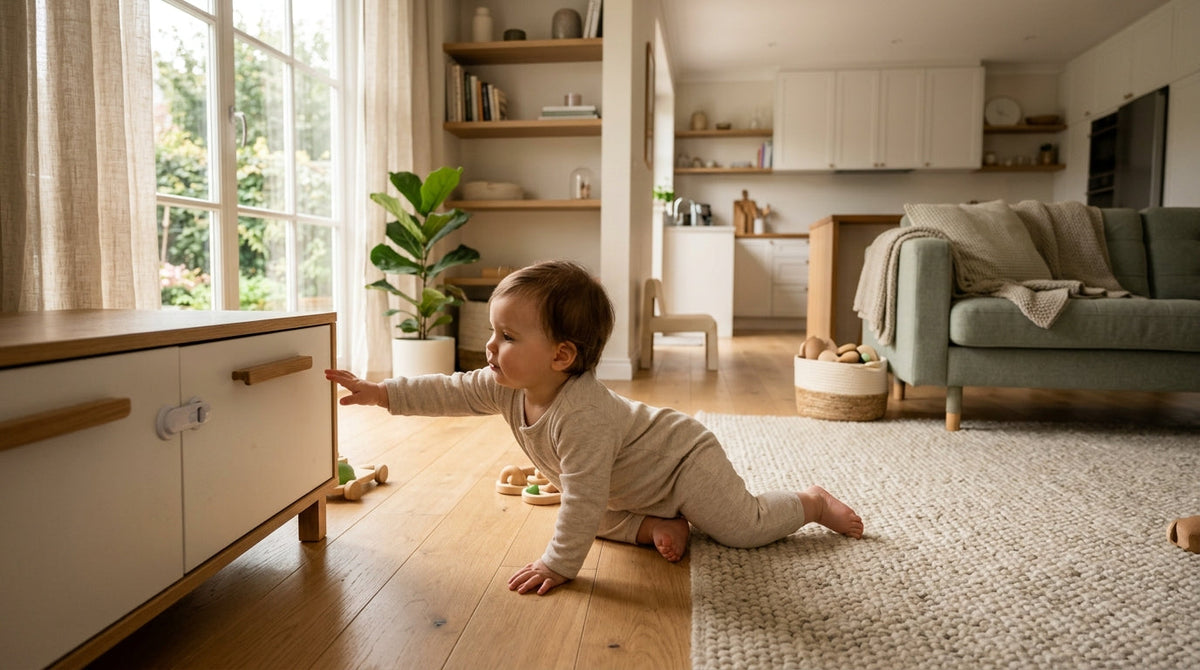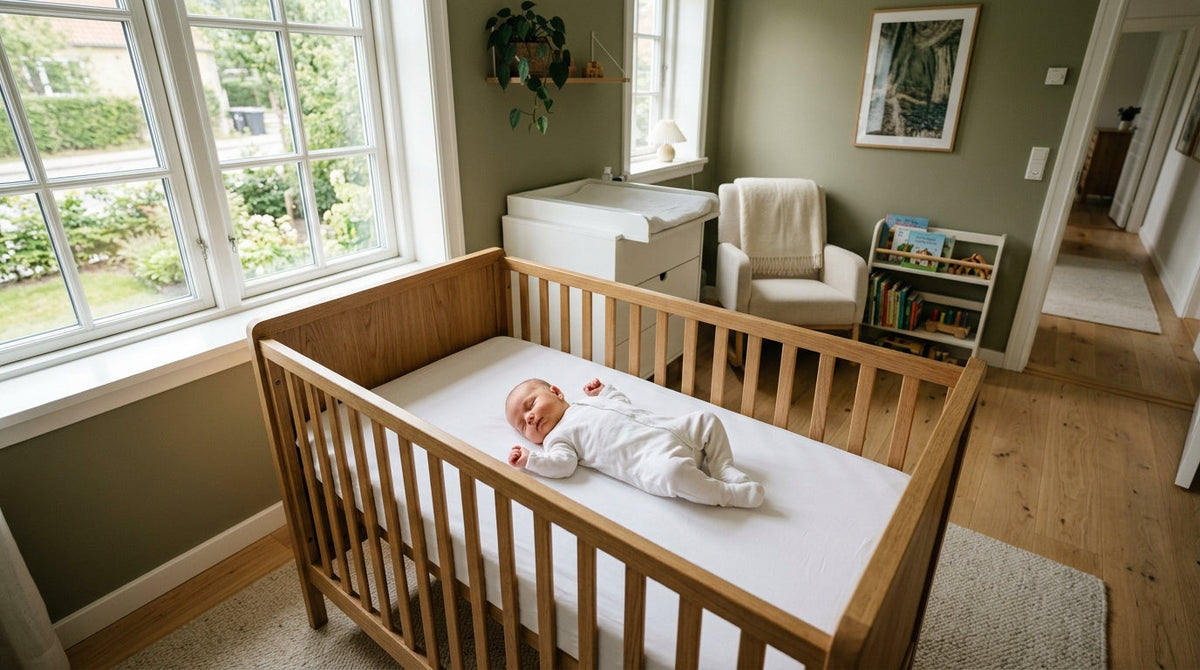
The baby-proofing you did at six months is already obsolete. That’s not a criticism. It’s just the math of toddler development: the same child who couldn’t reach the counter at nine months is now dragging a step stool toward it at twenty-two months, and the locks you installed during nap time last spring were designed for a different kid.
Upgrading your safety setup as your child grows is one of those tasks that’s easy to defer because nothing bad has happened yet. Don’t wait for the near-miss.
Why Your Original Setup Stops Working
Infant-stage baby proofing is mostly about containment and passive hazard removal. You cover outlets, gate off rooms, keep small objects off the floor. It works because young babies have limited mobility and zero problem-solving ability.
Toddlers are a different category of human. They climb. They test. They remember where you put the thing you took away. My older daughter defeated an adhesive cabinet strap lock at 26 months by pulling the cabinet door outward at an angle that popped the adhesive pad clean off the wall. I had installed that lock six months earlier and assumed it was fine. It wasn’t fine. The geometry of the problem had changed because she had changed.
The upgrades you need aren’t about buying more stuff. They’re about matching your safety measures to your child’s current capabilities, then staying one step ahead.
Gates: From Pressure-Mount to Hardware-Mount
If you’re still using pressure-mount gates at the top of stairs, swap them out now. Pressure-mount gates are designed for doorways and room dividers, not stair openings. A toddler who leans into a pressure-mount gate at the top of a flight of stairs can push it out of position. Hardware-mount gates screw directly into wall studs or a stair banister and don’t move.
Look for gates that meet ASTM F1004, the federal safety standard for expansion gates and expandable enclosures, made mandatory under 16 CFR Part 1239 (effective 2021). That standard exists for a reason. Gates that predate it or don’t carry certification are worth replacing.
At the bottom of stairs, a pressure-mount gate is acceptable. At the top, it is not. This is a non-negotiable upgrade.
Cabinet and Drawer Locks: Adhesive Is a Starting Point, Not an Endpoint
Adhesive strap locks are fine for low-traffic cabinets with light contents. They are not adequate for under-sink cabinets, cleaning supply storage, or any drawer a determined toddler has already opened once.
According to the CDC, approximately 300 children and teens (ages 0–19) are seen in U.S. emergency departments every day for medication-related poisoning. Cleaning products, dishwasher pods, and medications are the biggest culprits in toddler poisoning cases. If your under-sink cabinet has an adhesive lock on it, replace it with a screw-mounted magnetic lock or a dual-latch mechanism that requires two simultaneous actions to open.
My younger daughter emptied the under-sink cabinet in the time it took me to answer the doorbell. The adhesive lock had held for months. That day it didn’t. I switched to magnetic locks the same afternoon, the kind that require a magnetic key held to the outside of the cabinet to release. She has not opened one since.
For medicine cabinets specifically: move medications entirely out of reach, not just behind a lock. High shelves, locked boxes, or a dedicated locked cabinet are better options than a standard cabinet latch for anything that can cause serious harm if ingested.
Furniture Anchoring: The Upgrade Most Parents Skip
This one matters more as your child gets older, not less. Infants don’t climb dressers. Toddlers do.
According to the CPSC, a child dies every two weeks from furniture, TV, or appliance tip-overs. The victims are overwhelmingly toddlers and young children who climbed on or pulled at a piece of furniture. Dressers are the most common culprit because their drawers function as a ladder.
If you anchored your furniture when your child was an infant and haven’t checked it since, check it now. Anti-tip straps can loosen. Drywall anchors can pull if the strap has been tugged repeatedly. Ideally, your straps are going into wall studs. If they’re not, replace the drywall anchors with toggle bolts rated for the load, and make sure the strap itself is rated to hold at least several times the weight of the furniture piece.
Every dresser, bookcase, wardrobe, and TV stand in your home should be anchored. Not just the ones in your child’s room.
Water Hazards: Constant Vigilance, Better Barriers
Drowning is the leading cause of unintentional injury death in children ages 1–4 (CDC). And a child can drown in as little as one to two inches of water (AAP). That second fact is the one that surprises most parents. It means buckets, inflatable pools, bathtubs, and toilets are all hazards, not just backyard pools.
For families with pools, a four-sided isolation fence with a self-closing, self-latching gate is the standard. The latch should be on the pool side of the gate, out of a toddler’s reach. Door alarms on any house door that leads to the pool area add another layer.
Inside the house: empty buckets immediately after use, keep bathroom doors closed, and consider a toilet lock if you have a child under three. These feel like overkill until they don’t.
If you have a portable or inflatable pool, drain it after every use. A few inches of standing water left overnight is a hazard.
Climbing and Furniture Reconfiguration
Toddlers climb everything. The couch is a launch pad. The coffee table is a stage. The bookcase is a mountain.
Low bookshelves should be anchored (see above) and cleared of anything breakable on the lower two shelves. Coffee tables with sharp corners or glass tops are worth replacing or covering with corner guards and edge bumpers. This isn’t permanent. It’s a phase. But it’s a phase with real injury potential.
Reconfigure rooms with your child’s current climbing ability in mind. If she can get onto the couch, she can get onto the couch arm, and from there onto the windowsill. Walk through each room at toddler height, literally crouch down, and look for the route a climber would take. Then block the destination, not just the first step.
Window stops are worth installing on any window above the first floor. These limit how far a window can open, typically to four inches or less, without requiring you to remove them for adult use.
Outlet Covers: An Upgrade Worth Making
Standard plug-in outlet covers are better than nothing, but a determined toddler can remove them. Tamper-resistant outlets are significantly more reliable than standard plug-in covers. They have internal shutters that only open when equal pressure is applied to both slots simultaneously, which is exactly what a plug does and not what a small finger or a coin does.
Tamper-resistant outlets are required by the National Electrical Code in new construction, but many older homes don’t have them. Replacing standard outlets with tamper-resistant ones is a straightforward swap that costs a few dollars per outlet. An electrician can do your whole house in an afternoon, or a confident DIYer can handle individual outlets.
Outlet covers on power strips are also worth adding. Power strips tend to sit at floor level, which puts them directly in a toddler’s visual field.
Toddler Safety Upgrade Checklist
Smoke Alarms, CO Detectors, and the Safety Layer Beneath Everything
According to the NFPA, three out of five home fire deaths occur in homes with no smoke alarms or non-functioning ones. According to the CDC, CO poisoning kills more than 400 people each year and sends more than 100,000 to U.S. emergency rooms.
These aren’t toddler-specific hazards, but toddlerhood is a reasonable time to audit your alarms. Test every smoke alarm in your home. Replace any that are more than ten years old. Add a carbon monoxide detector on every level of your home and outside sleeping areas if you don’t already have them. Check batteries.
This is the safety layer that protects your whole family, not just your child. It takes twenty minutes and costs almost nothing if your alarms are already in place.
Reassess Every Few Months
The single most useful habit you can build is a quarterly walk-through of your home with fresh eyes. Your child’s capabilities change fast. What she couldn’t reach at 18 months, she can reach at 22 months. What she couldn’t open at 24 months, she’s figured out by 28 months.
Bring a notepad. Start at the front door and move room by room. Open every cabinet, test every lock, tug every anchor strap. Look at what’s on low shelves, what’s accessible on counters, what furniture has migrated away from the wall. It takes maybe 30 minutes and it will catch things you’ve stopped seeing because they’ve been there so long.
The goal isn’t a perfectly locked-down house. It’s a house that’s matched to the child who lives in it right now.