Baby Registry Checklist by Category: Room-by-Room Safety Essentials

Opening a baby registry can feel overwhelming: 400 items, zero context, and a due date closing in. The registry becomes a wish list. It should be a safety plan.
Room by room is the approach: start with space, not brand or price tier. Not by brand, not by price tier. By space. Because the hazards in a nursery are different from the hazards in a bathroom, and the things that will hurt your baby at three months are different from the things that will hurt them at fourteen months. A registry built around your home’s actual layout forces you to think ahead. It also means you’re not making panicked last-minute purchases the week before your due date, which is when installation corners get cut and product vetting gets skipped entirely.
Here’s what belongs on a room-by-room safety registry, and why.
The Nursery: Where Sleep Safety Comes First
The crib is the most consequential purchase you will make. About 3,500 infants die each year from sleep-related causes in the United States, and unintentional suffocation kills roughly 1,000 infants under age 1 each year (CDC). Most of those deaths are preventable with the right sleep environment.
The AAP is unambiguous: firm, flat sleep surface, no bumpers, no pillows, no loose blankets, no stuffed animals. The mattress must fit the crib frame with no more than two fingers of gap on any side. If you can fit more than two fingers between the mattress edge and the crib side, the mattress is too small. Fitted sheets only, pulled taut. That’s the entire crib setup.
In my experience, "breathable bumpers" don’t stay flat against the rail under repeated contact. I tested three models and none of them held position reliably. Mesh or "breathable" liners are not a safe alternative. The AAP advises against any bumper pads or related products that attach to crib slats or sides because of the risk of entrapment, suffocation, and strangulation, and padded bumpers are banned under federal law.
Registry essentials for the crib:
- A crib that meets current CPSC standards (no drop-side rails, slats no more than 2–3/8 inches apart)
- A firm, flat mattress with a JPMA certification seal
- Two to three fitted crib sheets, tight-fitting
- No bumpers, no positioners, no wedges
Beyond the crib, the dresser and changing table are the pieces most parents don’t think about until their baby becomes a toddler who climbs. Furniture tip-overs injure thousands of children every year, and heavy dressers are among the most common culprits. Every piece of furniture in the nursery that can tip needs an anti-tip strap anchored to a wall stud, not just drywall. Register for furniture straps at the same time you register for the furniture. They are not optional accessories.
Registry essentials for nursery furniture:
- Anti-tip furniture straps (one per dresser, one per bookshelf)
- A changing table with safety straps and raised edges on all four sides
- A stud finder (practical registry item, useful)
Nursery Lighting, Outlets, and Cord Management
Outlets are invisible hazards. CPSC-compliant outlet covers or sliding plate covers prevent finger insertion and should go on every outlet in the nursery before your baby comes home. The sliding plate style is preferable to plug-in caps because caps can be removed and become choking hazards themselves.
Cords are the other issue. Monitor cables, lamp cords, and blind cords all need to be managed before your baby can pull up to stand, which happens faster than you expect. Cord shorteners, cord clips, and cord wind-ups keep slack out of reach. Blind cords are a strangulation risk for infants. Replace them with cordless window coverings in any room where a baby sleeps or plays.
For lighting, a dimmer-compatible fixture or a separate low-wattage night light gives you enough visibility for nighttime feeds without flooding the room with light that disrupts sleep cycles. Position any night light away from the crib so it doesn’t cast shadows across your baby’s face, and check that it doesn’t generate heat at the surface. Some plug-in night lights run warm enough to be a concern near fabric.
Registry essentials for outlets and cords:
- Sliding plate outlet covers for all nursery outlets
- Cord shorteners or cord management clips
- Cordless window coverings, or cord wind-up devices for existing blinds
- Dimmer-compatible ceiling fixture or low-wattage night light
Baby Monitors: What to Look For
The monitor market is overwhelming and the safety stakes are real. For a nursery monitor, you want video with night vision, two-way audio, and a dedicated parent unit that operates on a closed, non-WiFi system. WiFi-connected monitors can be accessed by third parties if the network is compromised. A closed-system monitor eliminates that risk.
Temperature monitoring is a useful feature but secondary. The most important thing a monitor does is let you see and hear your baby clearly in the dark. Night vision quality varies significantly between models. Before you register for any monitor, look up recent reviews that specifically test night vision clarity at crib distance, not just in the product photos.
In my experience, closed-system monitors with dedicated parent units that run on battery are more practical for nighttime use than WiFi models that require a charged phone nearby.
Registry essentials for monitoring:
- Video monitor with night vision and two-way audio
- Dedicated parent unit (closed system preferred)
- Backup battery or charging dock for the parent unit


The Bathroom: Water Temperature and Drowning Prevention
Drowning is the leading cause of unintentional injury death in children ages 1–4 (CDC). A child can drown in as little as one to two inches of water (AAP). Those two facts together should shape every decision you make about bath time.
Start with water temperature. Set your water heater to 120°F (49°C) or below before your baby comes home. At 120°F, a full-thickness burn takes about five minutes of exposure. At 130°F (54°C), it takes thirty seconds. A bath thermometer lets you verify the water temperature before your baby goes in, every single time. Register for one. They cost under fifteen dollars and remove the guesswork from the hot-water-cold-water mix.
For the bath itself, a baby bathtub or insert that holds your infant in a reclined, supported position makes bathing easier, but it is not a safety device. Keep your baby within arm’s reach, with a hand on them, for the whole bath, and never step away, even for a moment. Look for a model with a non-slip surface and a drain plug that’s easy to open with one hand. You will always have one hand occupied.
Non-slip bath mats go on the floor outside the tub and inside it. Both. The floor mat is for you carrying a wet baby. The tub insert or mat is for when your baby starts sitting independently and the bath surface becomes a slip hazard.
Registry essentials for the bathroom:
- Bath thermometer
- Baby bathtub or infant bath insert with reclined support
- Non-slip tub mat
- Non-slip bath mat for the floor outside the tub
- Cabinet locks for under-sink storage (cleaning products, medications)
Stair Gates and Room Barriers
About 93,000 children under 5 are treated in U.S. emergency rooms each year for stair-related injuries (Nationwide Children’s analysis of CPSC NEISS data, 1999–2008). Gates are how you prevent most of those falls.
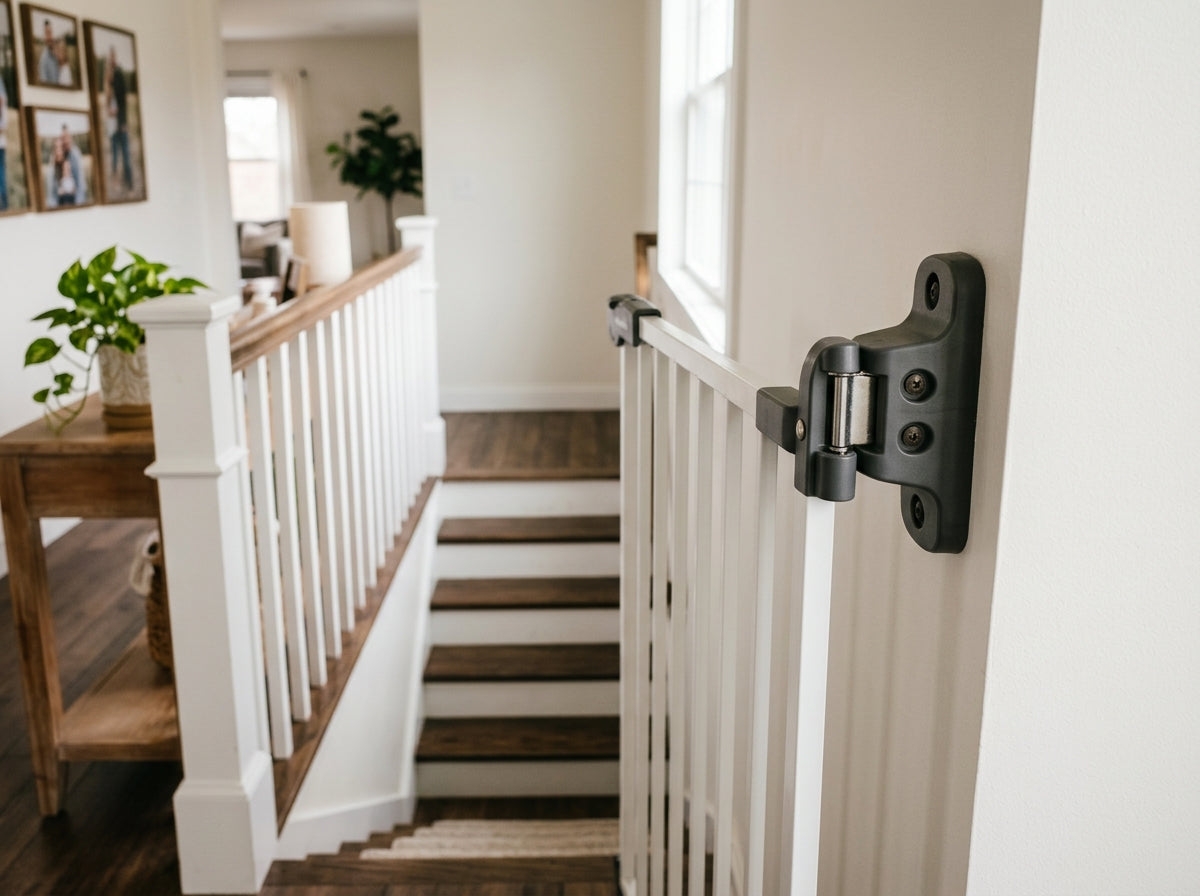
The rule is straightforward: pressure-mounted gates work for doorways and room dividers. They do not belong at the top of stairs. At the top of a staircase, you need a hardware-mounted gate anchored to wall studs or a solid newel post, because a pressure-mounted gate can be pushed out by a falling child’s weight. ASTM F1004 is the federal safety standard for expansion gates and expandable enclosures, made mandatory under 16 CFR Part 1239 (effective 2021). When you’re shopping, look for that certification.
Measure your openings before you register. Gate widths vary, and wide staircase openings may require an extension kit. Register for the extension at the same time as the gate. Also register for a hardware-mounted gate even if you don’t have stairs yet. If you visit family with stairs, or move, you’ll want one.
Registry essentials for gates:
- Hardware-mounted gate for top of stairs (with extension kit if needed)
- Pressure-mounted gate for doorways and room transitions
- Wall anchors and hardware appropriate for your wall type
The Kitchen: High Chairs, Cabinet Locks, and Hazard Storage
The kitchen is the room where the most categories of hazard converge. Sharp edges, hot surfaces, toxic cleaning products, small objects, and unstable furniture all share the same space.
For feeding, a high chair with a five-point harness and a wide, stable base is the standard. The five-point harness matters because a three-point harness allows a baby to slide forward and down. The base matters because a narrow-legged high chair tips when a toddler leans sideways, which they will. Look for a JPMA-certified model and check that the tray latches securely with one hand.
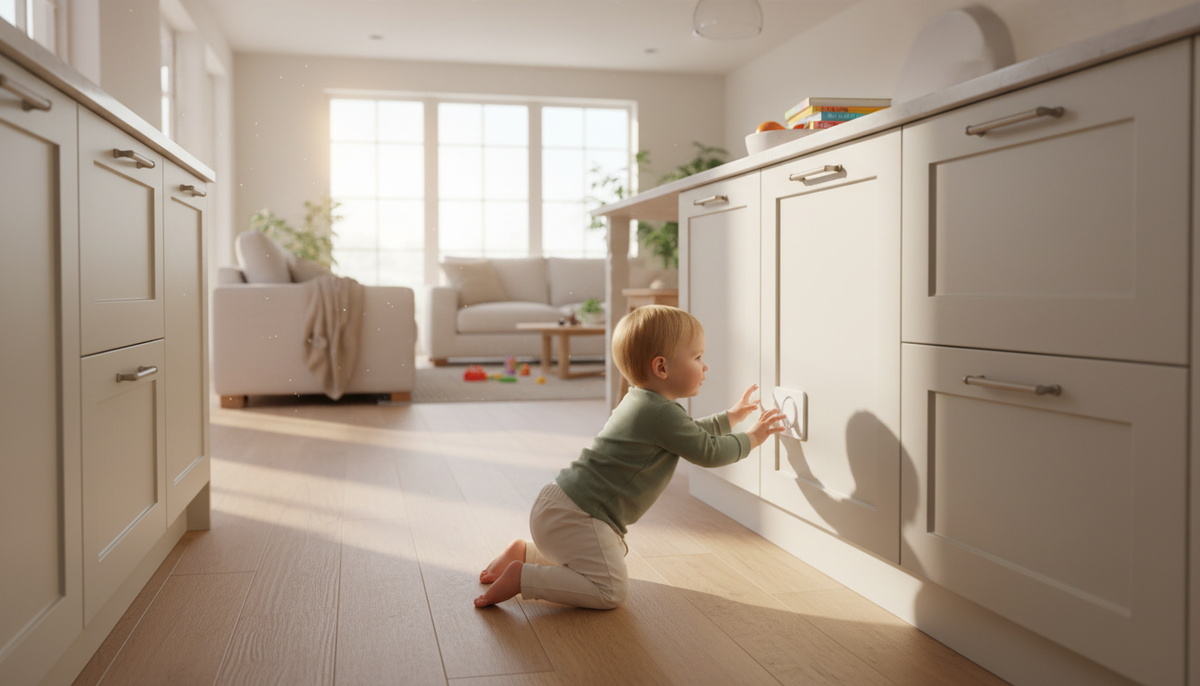
Cabinet locks are where I’ve seen the most variation in quality. A 2012 CPSC recall pulled 900,000 Safety 1st Push 'N Snap cabinet locks after reports of children as young as 9 months opening them. In my experience, adhesive strap locks can be defeated by toddlers as young as 26 months. Test every lock yourself before you trust it. Magnetic locks that require a separate key magnet to open are significantly harder for children to defeat than adhesive straps or push-button mechanisms.
Cleaning products, dishwasher pods, and medications should be stored in a locked cabinet, ideally up high and out of sight. Dishwasher pods are a particular concern because they’re brightly colored and look like toys. Keep them in a latched cabinet, not under the sink.
Registry essentials for the kitchen:
- High chair with five-point harness and wide base (JPMA-certified)
- Magnetic cabinet locks for under-sink and lower cabinets
- Appliance latches for oven and dishwasher
- Corner and edge guards for counters and islands at toddler head height
The Living Room: Flooring, Furniture, and Play Space Safety
Living rooms often receive less safety attention than nurseries, but your baby will spend significant time on the living room floor and pull up on every piece of furniture. But your baby will spend significant time on the living room floor, and then will pull up on every piece of furniture in it.
Firm, non-slip flooring reduces fall injury severity compared to hard surfaces with no cushioning. A play mat or foam tile area gives your baby a safe zone for tummy time and early movement. Low-pile or hard flooring is easier to keep clean and reduces dust mite exposure compared to thick carpeting. If you have thick carpet, a firm play mat on top still provides a defined, cleanable surface.
Every bookshelf, media console, and freestanding shelving unit needs an anti-tip strap. Televisions on stands need to be anchored as well. The TV anchor strap goes on the registry alongside the TV mount or stand.
Cord management matters here too. Entertainment centers accumulate cables. Keep them bundled and routed away from the floor, out of reach of a baby who will pull on anything that dangles.
Registry essentials for the living room:
- Foam play mat or interlocking foam tiles
- Anti-tip straps for all freestanding furniture
- TV anchor strap or wall mount
- Cord management clips or cable boxes for entertainment cables
- Corner and edge guards for coffee tables and hearths
Room-by-Room Registry Checklist
Smoke Alarms, CO Detectors, and Whole-Home Safety
Three out of five home fire deaths occur in homes with no smoke alarms or non-functioning ones (NFPA). Before your baby comes home, test every smoke alarm and replace any that are more than ten years old. Before your baby comes home, test every smoke alarm in your house and replace any that are more than ten years old. A combination smoke and CO detector on every level of the home is the standard. CO poisoning kills more than 400 people each year and sends more than 100,000 to U.S. emergency rooms (CDC).
These are whole-home items. Put them on the registry because new parents often act on registry lists more reliably than general home maintenance tasks.
Registry essentials for whole-home safety:
- Combination smoke and CO detectors for every level
- Fire escape ladder for upper-floor bedrooms
- First aid kit stocked for infants (including a nasal aspirator and infant thermometer)
- Baby-specific poison control number saved in your phone (1-800-222-1222)
The Car Seat: Your Most Regulated Registry Item
Car seat selection is the most regulated purchase on this list. Every infant car seat sold in the United States must meet federal safety standards. The question is fit: fit to your vehicle, fit to your child’s current weight and height, and fit to how you install it.
Rear-facing infant seats work for most newborns up to the seat’s weight limit, typically 30–35 pounds depending on the model. Convertible seats can be used rear-facing from birth and then transitioned forward-facing, which makes them a longer-term investment. Neither is universally better. The right choice depends on your vehicle’s back seat dimensions and whether you need to transfer the seat between cars.
Practice installation before your due date. More than once. An incorrectly installed car seat offers significantly less protection in a crash. Many fire stations and hospitals offer free car seat inspection by certified technicians. Register for the seat early enough that you have time to get it inspected.
Registry essentials for the car:
- Infant car seat or convertible car seat appropriate for your vehicle
- Car seat mirror for rear-facing visibility
- Seat protector mat (check that it’s compatible with your seat model)
Storage and Organization: Keeping Hazards Separated from Essentials
The last category is the one that ties everything together. How you store things determines what your baby can reach, and what they can reach determines what can hurt them.
Diapers, wipes, and clothing should be within arm’s reach of your changing area. Medications, vitamins, essential oils, and any supplement should be in a locked drawer or cabinet, not on an open shelf. Poisoning and choking are leading causes of unintentional injury in infants. The objects involved are usually things adults left within reach without thinking.
Small objects are the category most parents underestimate. Coins, button batteries, small toy parts, safety pins, hair ties. All of them are choking hazards. A storage system that keeps frequently used items accessible and everything else locked away is worth building before your baby comes home, not after the first close call.
Registry essentials for storage:
- Locked medicine cabinet or drawer with key
- Diaper caddy for bedside or changing table use
- Labeled bins for clothing by size (so outgrown items get stored, not left accessible)
- Cabinet latches for any storage that contains non-baby items
A registry built this way takes more thought than clicking through a store’s "top picks" list. When your baby comes home, the hazards you can control are already controlled. The ones you can’t anticipate are manageable because the foundation is solid.