Baby Registry Must-Haves 2026: Safety Items New Parents Overlook

Most baby registries look the same. A stroller, a bouncer, a white noise machine, a mountain of swaddles. And underneath all of it, a gap where the safety items should be.
That gap isn’t laziness. It’s a knowledge problem. Registry tools are built around what’s cute and what’s convenient, not what keeps a child alive during the window when they’re most vulnerable. The items below aren’t glamorous. Some of them cost less than a single swaddle set. But they’re the ones I’d put on a registry before I added anything else, and several of them I learned about the hard way.
A Safe Sleep Surface Is the Foundation, Not an Upgrade
About 3,500 infants die each year from sleep-related causes in the United States (CDC SUID data). A significant portion of those deaths are connected to sleep environment. The AAP is direct: infants should sleep on a firm, flat surface in a crib, bassinet, or play yard that meets current CPSC standards, alone, on their back, with nothing else in the sleep space. No bumpers. No pillows. No positioners. No blankets tucked around the sides.
Unintentional suffocation kills roughly 1,000 infants under age 1 each year in the United States (CDC). Many of those deaths involve soft bedding that well-meaning relatives added to the crib.
When I was pregnant with my older daughter, my mother-in-law offered us a beautiful vintage crib. I had to explain, as diplomatically as I could, that it didn’t meet current CPSC standards. The slat spacing was wrong, the mattress fit was loose, and there was no way to verify the paint. We bought a new JPMA-certified crib instead. It wasn’t sentimental. It was the right call.
Look for the JPMA certification seal when you’re choosing a crib or bassinet. It indicates the product has been tested against current voluntary safety standards. And skip the "heirloom" sleep furniture, no matter how beautiful it is.
Carbon Monoxide and Smoke Detectors Near the Nursery
Three out of five home fire deaths occur in homes with no smoke alarms or non-functioning ones (NFPA). CO poisoning kills more than 400 people each year and sends more than 100,000 to U.S. emergency rooms (CDC). These are predictable, preventable hazards, and disproportionately dangerous for infants, whose respiratory systems are less equipped to handle either threat.
Most parents have smoke detectors somewhere in their home. Fewer have one within 10 feet of the nursery door. Even fewer have a combination CO/smoke detector in that location. And almost nobody tests them monthly, which is what both the CPSC and NFPA recommend.
Add a combination detector to your registry. Test it the month the baby comes home. Set a recurring phone reminder so you don’t let it lapse.
Car Seat Installation, Done Right
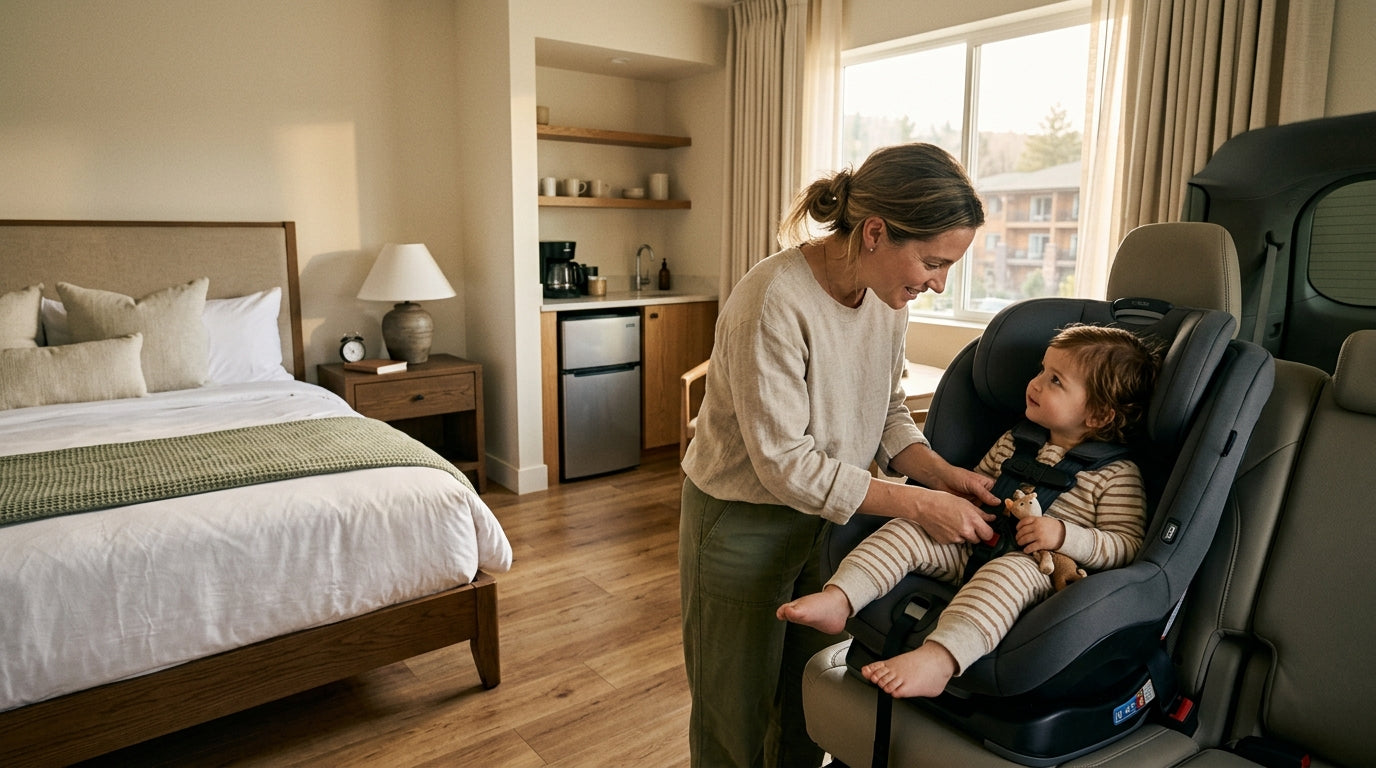
The car seat is the one item almost every parent puts on the registry. Incorrect installation is widespread. A seat that’s improperly installed offers significantly less protection than one that’s correctly secured.
Your car seat should be appropriate to your child’s current weight and height. For most newborns, that means a rear-facing infant seat or a convertible seat installed rear-facing. The CPSC provides installation guidance, and most fire stations and many hospitals offer free inspection appointments with certified Child Passenger Safety Technicians.
Book that inspection before the due date. Don’t wait until the baby is already here and you’re exhausted and running on three hours of sleep. I made this appointment at 34 weeks with my younger daughter and the technician found two issues with the installation I’d done myself. Both were fixable in ten minutes. Neither would have been obvious in an emergency.
Outlet Protection That Doesn’t Create a New Hazard
Babies become mobile faster than parents expect. Once they’re crawling and pulling to stand, outlets at floor level are exactly at eye and hand height. The CPSC recommends against standard plug-in outlet covers because a determined toddler can remove them, and the cover itself becomes a choking hazard.
The better options are tamper-resistant outlets (built-in shutters that require simultaneous pressure on both slots to open) or outlet plate covers that replace the standard plate entirely and require a tool or deliberate adult motion to remove. Tamper-resistant outlets are required by the National Electrical Code in new construction, but many older homes don’t have them.
Add outlet plates or request an electrician’s visit as a registry gift. It’s a one-time fix that covers every outlet in the home.


Cabinet Locks That Toddlers Can’t Defeat
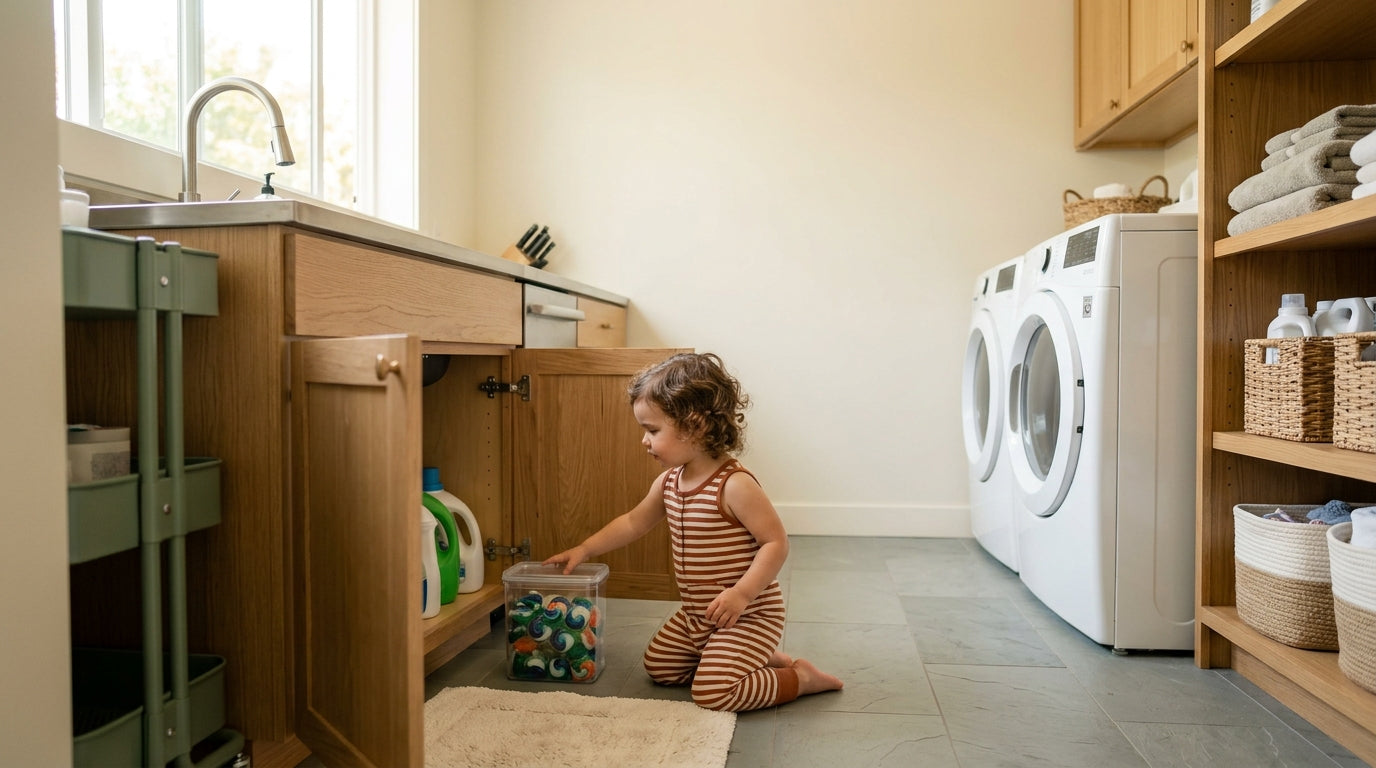
My older daughter opened a standard push-button cabinet lock at 26 months. I watched her do it. She had figured out the mechanism from watching me, and she popped it open in under five seconds. What was behind that cabinet was dishwasher pods, which are among the most dangerous household products for young children.
This is not an isolated story. CPSC recalled 900,000 Safety 1st Push 'N Snap cabinet locks in March 2012 after 140 children defeated them. Three of those children reached toxic cleaning products.
Magnetic cabinet locks are harder to defeat because the release mechanism is entirely hidden. A child can’t observe it, imitate it, or feel for it. You keep the magnetic key out of reach, and the cabinet stays locked. Install them on every cabinet containing cleaning products, medications, sharp objects, or anything else you wouldn’t hand a toddler directly.
Baby Gates That Meet Federal Standards
About 93,000 children under 5 are treated in U.S. emergency rooms each year for stair-related injuries (Nationwide Children’s analysis of CPSC NEISS data, 1999–2008). Gates are one of the most effective interventions available, though they’re commonly misused.
ASTM F1004 is the federal safety standard for expansion gates and expandable enclosures, made mandatory under 16 CFR Part 1239 (effective 2021). When you’re buying a gate, look for compliance with this standard. And understand the difference between pressure-mounted and hardware-mounted gates.
Pressure-mounted gates use tension against the door frame. They’re appropriate for doorways and room dividers where a fall through the gate would land on a flat surface. They are not appropriate for the top of stairs. A child who pushes hard enough against a pressure-mounted gate at a stair opening can dislodge it and fall.
Hardware-mounted gates are screwed directly into the wall or stair frame. They’re the only appropriate choice for the top of any staircase. Yes, they leave small holes in the wall. That’s fine. Walls are fixable.
Furniture Anchors Before Your Baby Pulls to Stand
Furniture tip-overs injure thousands of children annually. The risk accelerates sharply once babies start pulling themselves upright using whatever’s nearby, a dresser, a bookcase, a television on a low stand. All of these become hazards the moment a child uses them as a climbing assist.
Furniture anchor straps are inexpensive, widely available, and almost never appear on baby registries because people associate them with toddlers, not newborns. But the installation window is before the baby arrives, not after. You will not have time to anchor six pieces of furniture while managing a newly mobile infant.
Anchor every tall piece of furniture in the nursery and any room the baby will spend time in. The strap goes from the back of the furniture to a wall stud. Follow the weight ratings for the specific strap you buy, and make sure you’re hitting a stud, not just drywall.
A Room Thermometer for Sleep Temperature
The AAP identifies overheating as a modifiable risk factor for sleep-related infant death. The recommended sleep environment temperature is 68–72°F (20–22°C). Most parents gauge this by how warm they feel, which is unreliable. Adults and infants regulate temperature differently, and a room that feels comfortable to a parent can be too warm for a sleeping baby.
A simple digital room thermometer solves this. Many baby monitors now include one built in, which is convenient. But even a standalone thermometer on the dresser costs less than $15 and gives you an actual number instead of a guess.
Dress the baby for the room temperature, not for how you feel. A general guideline is one more layer than an adult would wear comfortably in the same space.
Cordless Window Coverings or Cord Management
Corded window blinds and shades are a strangulation hazard for infants and toddlers. The cords can form loops, and a child who gets a loop around their neck can lose consciousness in seconds.
The solution is straightforward: replace corded blinds in the nursery and any room the baby sleeps or plays in with cordless versions before the baby arrives. If replacement isn’t immediately possible, use cord wind-ups or tie-off devices to keep cords out of reach, and move any furniture the baby could climb away from windows.
This is one of the items I replaced before my younger daughter was born. It took one afternoon and cost less than I expected. The window covering industry has largely moved toward cordless designs, and the options are much better than they were even five years ago.
Infant First-Aid Kit Essentials
A First-Aid Kit Built for Infants
Most parents assemble a first-aid kit reactively. Something happens, they realize they don’t have what they need, and they order it at midnight. The better approach is to have it ready before you need it.
An infant-appropriate kit should include a rectal thermometer (the most accurate method for temperature readings in babies under 3 months, per the AAP), infant acetaminophen dosed for your baby’s weight, saline drops, a bulb syringe, gauze pads, and your pediatrician’s after-hours number written down somewhere you can find it without a phone.
Know the fever thresholds before you need them. For infants under 3 months, a rectal temperature of 100.4°F (38°C) or higher is a reason to call the pediatrician immediately, per AAP guidance.
A Baby Monitor That Does More Than Watch
A video monitor with two-way audio lets you respond to a waking baby without immediately entering the room. This matters for sleep training and for not disturbing a baby who’s settling back down on their own. Two-way communication means you can soothe with your voice before committing to a full wake-up.
The most useful feature for safety purposes is a built-in room temperature display. If the monitor shows the nursery temperature, you’re not relying on a separate thermometer or your own perception. You see the number, you adjust accordingly.
Look for monitors with encrypted connections if they’re Wi-Fi enabled. Baby monitor security is a real concern, and the better brands address it directly in their specs.
A Humidifier With Automatic Shut-Off
Dry air in a nursery can irritate an infant’s airways and disrupt sleep. A humidifier helps. But the type matters.
Steam humidifiers heat water to produce vapor, which means the unit itself gets hot enough to cause burns if a child contacts it or knocks it over. Ultrasonic humidifiers produce a cool mist without a heating element, which makes them the safer choice for a nursery.
Look for a model with automatic shut-off when the water reservoir is empty. This prevents the motor from running dry and overheating. Clean the reservoir weekly to prevent mold and bacterial growth, which can be aerosolized into the room if the unit runs dirty.
The items on this list won’t make your nursery look like a magazine spread. But they will cover the gaps that standard registries leave open. Start with the sleep surface, the car seat, and the detectors. Work through the rest before the baby becomes mobile. Most of these are one-time purchases that will serve you through the toddler years and beyond. The cost of the full list is a fraction of what most parents spend on gear they’ll use for six months and sell at a garage sale.