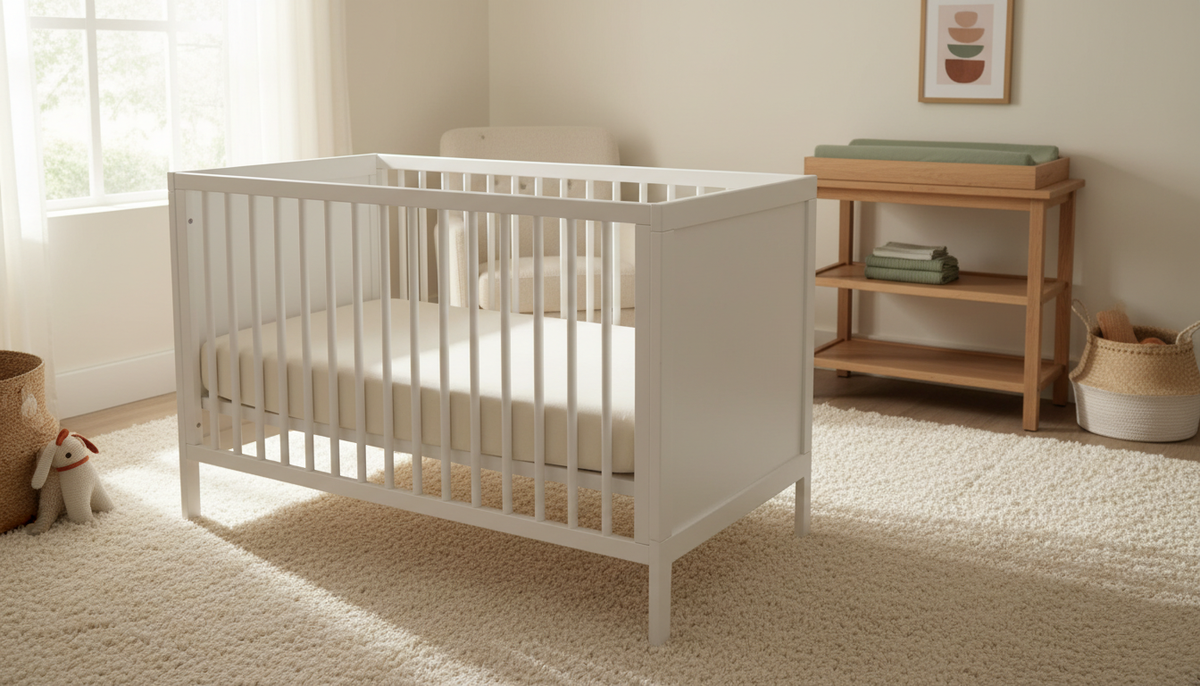

Bassinet vs Crib Safety: Which Is Better for Your Newborn

About 3,500 infants die each year from sleep-related causes in the United States, according to CDC SUID data. Most of those deaths happen in sleep environments that were unsafe in some way, which means the choice of where your baby sleeps matters from the very first night home. Bassinet or crib? It sounds like a simple question. It isn’t.
Both options can be safe. Both can be dangerous if used incorrectly. The right answer depends on your home, your habits, your baby’s developmental pace, and how honestly you can assess the tradeoffs.
In my experience, a "good enough" setup becomes a problem when a baby changes faster than your safety plan.
How Long Each Sleep Space Lasts
This is where most comparisons start, and for good reason. A bassinet is a short-term solution. Most have weight limits in the 15–20 pound range, and the more important cutoff is developmental: the moment your baby shows signs of rolling, the bassinet needs to go, regardless of weight. Per the CDC’s Learn the Signs. Act Early. milestones, most babies (75% or more) roll from tummy to back by 6 months. Some do it earlier. My older daughter showed rolling attempts at around 22 weeks, which meant her bassinet days were numbered before I’d expected.
A full-size crib, by contrast, takes a baby from birth through toddlerhood, typically to age 2–3 when you transition to a toddler bed. That’s a meaningful difference in value and in how much time you spend thinking about the sleep setup. If you buy a quality crib with a convertible design, you may not need to replace it for years.
The practical implication: a bassinet is not a replacement for a crib. It’s a bridge. Many families use both, starting with the bassinet in the bedroom and transitioning to the crib in the nursery around 4–6 months. That’s a reasonable approach, but it means budgeting for two pieces of equipment.
Safety Standards: What Both Must Meet
Neither option gets a pass on structural safety. Crib slats must be no more than 2 3/8 inches (6 cm) apart, per CPSC standard 16 CFR 1219. That threshold prevents head entrapment, and it applies whether you’re looking at a full-size crib or a bassinet with slatted sides. Check it yourself with a tape measure. Don’t assume a product is compliant because it’s on a store shelf.
Crib mattresses sold in the U.S. must meet the 2022 CPSC firmness standard (16 CFR 1241). This applies to full-size crib mattresses. Bassinet mattresses are covered under a separate CPSC rule for bassinets and cradles (16 CFR 1218), which also requires a firm, flat sleep surface. The key word in both cases is firm. If you press the center of the mattress and it doesn’t spring back immediately, it’s too soft.
The Safe Sleep for Babies Act (2022) bans padded crib bumpers and infant inclined sleep products with a sleep surface angle greater than 10 degrees. This matters for bassinets specifically, because inclined sleepers were frequently marketed as bassinet alternatives and some bassinet models had angled inserts. If you’re shopping for a bassinet now, verify the sleep surface is flat. If someone offers you a hand-me-down with a wedge or inclined insert, decline it.
Bassinet vs. Crib at a Glance
| Feature | Bassinet | Crib |
|---|---|---|
| Usable lifespan | Birth to ~6 months | Birth to age 2–3 |
| Weight limit | 15–20 lbs typical | 50+ lbs typical |
| Rolling cutoff | Yes, immediate stop | No rolling cutoff |
| Room-sharing ease | High, fits beside bed | Lower, nursery setup |
| Portability | Often portable | Stationary |
| Regulatory standard | CPSC 16 CFR 1218 | CPSC 16 CFR 1219/1241 |
| Long-term value | Low, short use window | High, convertible options |
The Room-Sharing Advantage of Bassinets
The AAP recommends room-sharing without bed-sharing for at least the first 6 months. Bassinets make this easy. They fit beside a bed, they’re compact, and you can check on your baby or respond to nighttime feeds without walking down a hallway at 2 a.m.
That proximity matters for more than convenience. Room-sharing is associated with reduced SIDS risk, and the AAP’s recommendation is grounded in that evidence. A crib in a separate nursery doesn’t make room-sharing impossible, but it makes it harder to sustain through sleep deprivation. With my younger daughter, having the bassinet within arm’s reach in those first weeks changed how quickly I could respond when she stirred.
Bedside sleepers that attach to the side of the parents’ bed also keep your baby close. But they require secure, stable attachment to the bed frame and regular inspection. If the attachment mechanism loosens, the sleeper can separate from the bed or shift, creating a gap or an unstable surface. Check the connection every time you reassemble it, and every few days during regular use. The AAP has not recommended for or against bedside sleepers because they haven’t been studied enough; if you use one, choose a model that meets the federal bedside sleeper standard, and never use an in-bed sleeper, nest, or pod placed on the adult mattress.


Mattress Fit: The Gap Problem
This is the detail that catches parents off guard. Bassinet mattresses and crib mattresses are not interchangeable. They’re different sizes, and using the wrong one leaves gaps at the edges where a baby’s head or limbs can become trapped.
The rule is simple: the mattress must be the size the manufacturer specifies for that specific product. No substitutions. A mattress that fits a standard full-size crib (approximately 28 x 52 inches) will not fit a bassinet. A bassinet mattress will leave dangerous gaps in a full-size crib. In my experience, aftermarket mattresses marketed as "universal" often left a finger-width gap on at least one side. That’s enough to matter.
For a bassinet or play yard, use only the mattress or pad that came with it, or a replacement the manufacturer sells for that exact model, and never add a second mattress or extra padding. For a full-size crib, measure the interior and choose a mattress that fits snugly, with no gap wider than two fingers at any edge.
Portable Bassinets and Play Yard Attachments
Travel bassinets and play yards with bassinet attachments have real appeal. They’re compact, they move between rooms, and some fold flat for travel. But portability introduces assembly risk.
A bassinet that isn’t fully locked into position can collapse. Play yard bassinet attachments that aren’t properly seated in their brackets can shift or detach. Before every use, run through the manufacturer’s assembly checklist. Check that all locking mechanisms are engaged. If the product has wheels, every wheel should have a locking mechanism, and every lock should be engaged when the bassinet is stationary. In my testing, some wheeled models have one wheel’s lock noticeably stiffer than the others, requiring deliberate force to engage. A tired parent at 3 a.m. might not push hard enough.
If a portable bassinet shows any sign of structural wear, bent hardware, torn fabric at stress points, or a frame that doesn’t lock solidly, stop using it. These products are not designed to be repaired.
The Drop-Side Crib Issue
If you’re considering a hand-me-down crib, this is non-negotiable: drop-side cribs manufactured before 2011 are prohibited under CPSC regulations. The drop-side mechanism created entrapment and collapse risks that led to infant deaths. The CPSC banned them, and no amount of "it looks fine" changes the structural risk.
Before accepting any used crib, check the manufacture date on the label (usually on a sticker inside the crib frame). Then search the CPSC recall database at cpsc.gov for the brand and model. Hardware failures, broken slats, and recalled components don’t always look broken. A crib can pass a visual inspection and still have a compromised joint.
If the crib predates 2011, or if you can’t verify its manufacture date and recall status, don’t use it.
Placement and Environmental Hazards
Where you put the sleep space matters as much as which one you choose. Both bassinets and cribs should be placed away from windows, away from window blind cords and curtain strings, and away from furniture a growing child could use as a climbing aid. Cord strangulation is a real and documented risk, and it doesn’t require a long cord. A loop within reach is enough.
For bassinets specifically: keep them away from table edges and other furniture. A bassinet on wheels that rolls into contact with a table leg can tip or shift. For cribs: the AAP recommends lowering the mattress before your baby can sit up on their own, and setting it at its lowest position before your baby learns to pull up to stand, which for many babies is well before 12 months. Per the CDC’s Learn the Signs. Act Early. milestones, most children (75% or more) pull up to stand and walk while holding onto furniture by 1 year. That transition happens faster than most parents expect.
Safe Sleep Environment Checklist
Ongoing Safety Checks for Both
Neither a bassinet nor a crib is a set-it-and-forget-it purchase. Both require regular inspection.
For bassinets, check weekly:
- All fabric attachment points for fraying or tearing
- Frame joints and locking mechanisms for looseness
- Mattress fit (it should not shift when you press the edges)
- Wheel locks for full engagement
For cribs, check monthly and after any reassembly:
- All screws and bolts for tightness (use the manufacturer’s hardware, not substitutes)
- Slats for cracking, splintering, or looseness
- Mattress height setting for the baby’s current developmental stage
- The mattress itself for firmness and fit
Unintentional suffocation kills approximately 1,000 infants under age 1 each year in the United States, according to CDC data. Soft objects, pillows, blankets, and bumper pads contribute to that number. Neither a bassinet nor a crib should contain anything except the mattress, a fitted sheet in the correct size, and your baby. No positioners. No rolled towels. No sleep wedges. The sleep surface should be firm and flat, and the baby should be placed on their back every time.
Making the Decision
There’s no universal right answer between a bassinet and a crib. Bassinets offer real advantages in the newborn period, particularly for room-sharing and nighttime response. Cribs offer longevity, more robust structural standards, and a stable sleep environment that grows with your child.
Many families use both. If you do, plan the transition before you need it. Don’t wait until your baby is actively rolling to move them to the crib. Make the switch when rolling becomes a consistent possibility, not after it becomes a nightly occurrence. Set up the crib, get your baby used to it for naps first, and make sure the environment around it is clear of hazards before it becomes the primary sleep space. A little planning at 4 months is easier than a scramble at 5.