Common Baby Injuries at Home: Statistics and How to Prevent Each One
Statistics and How to Prevent Each One
Every year, parents bring their children home from the hospital and immediately begin making decisions they don’t fully understand yet. Which cabinet needs a lock? Is the staircase dangerous? How worried should I be about the bathtub? The answers matter more than most of us realize until something goes wrong.
This is a data-driven look at the injuries most likely to happen inside your home, what the numbers say, and what prevention looks like in practice. Not theory. Not worst-case catastrophizing. Just the real risks, ranked by what sends children to emergency rooms and what kills them.
Sleep: The Danger That Happens While You’re Watching
The crib feels like the safest place in the house. It’s designed for babies. It has rails. You put them in it and walk away feeling like you’ve done something right.
About 3,500 infants die each year from sleep-related causes in the United States (CDC SUID data). That number includes SIDS, suffocation, and entrapment, and it hasn’t dropped as fast as it should because soft bedding, inclined sleepers, and crib bumpers stayed on the market long after the evidence against them was clear.
Unintentional suffocation kills roughly 1,000 infants under age 1 each year in the United States (CDC). The mechanism is almost always the same: a soft surface, a rolled blanket, a bumper pad, or a product that tilts the baby’s airway. The Safe Sleep for Babies Act (2022) bans padded crib bumpers and infant inclined sleep products with a sleep surface angle greater than 10°F, but products already in homes aren’t recalled automatically. If you have an older Rock 'n Play or a padded bumper set from a hand-me-down crib, it needs to go now.
The AAP’s safe sleep guidance is simple: firm, flat surface, alone, on their back, nothing else in the sleep space. Crib slats must be no more than 2 3/8 inches (6 cm) apart (CPSC standard, 16 CFR 1219) to prevent head entrapment. Check any secondhand crib against that measurement before you use it.
Falls: Stairs Are the Biggest Culprit
Falls are the leading cause of nonfatal injury for children under five. Stairs are where most of the serious ones happen.
About 93,000 children under 5 are treated in U.S. emergency rooms each year for stair-related injuries (Nationwide Children’s analysis of CPSC NEISS data, 1999–2008). Roughly one child every six minutes. The injuries range from minor bruises to skull fractures, and the youngest children, those under 12 months, are disproportionately represented because they’re carried on stairs by tired adults.
The single most common mistake is using a pressure-mounted gate at the top of a staircase. Pressure-mounted gates are for doorways and room dividers. At the top of stairs, you need a hardware-mounted gate, screwed into the wall studs. ASTM F1004 is the federal safety standard for expansion gates and expandable enclosures, made mandatory under 16 CFR Part 1239 (effective 2021). Look for that certification on the box.
Beyond stairs, window falls kill and injure children every year. Window screens are not fall protection. They’re designed to keep insects out, not to support the weight of a toddler leaning against them. Install window stops that limit openings to 4 inches or less.
Drowning: The Quiet Emergency
Drowning is the leading cause of unintentional injury death in children ages 1–4 (CDC). Not one of the leading causes. The leading cause. It surpasses car crashes for that age group, and it happens in seconds, without the sounds parents expect.
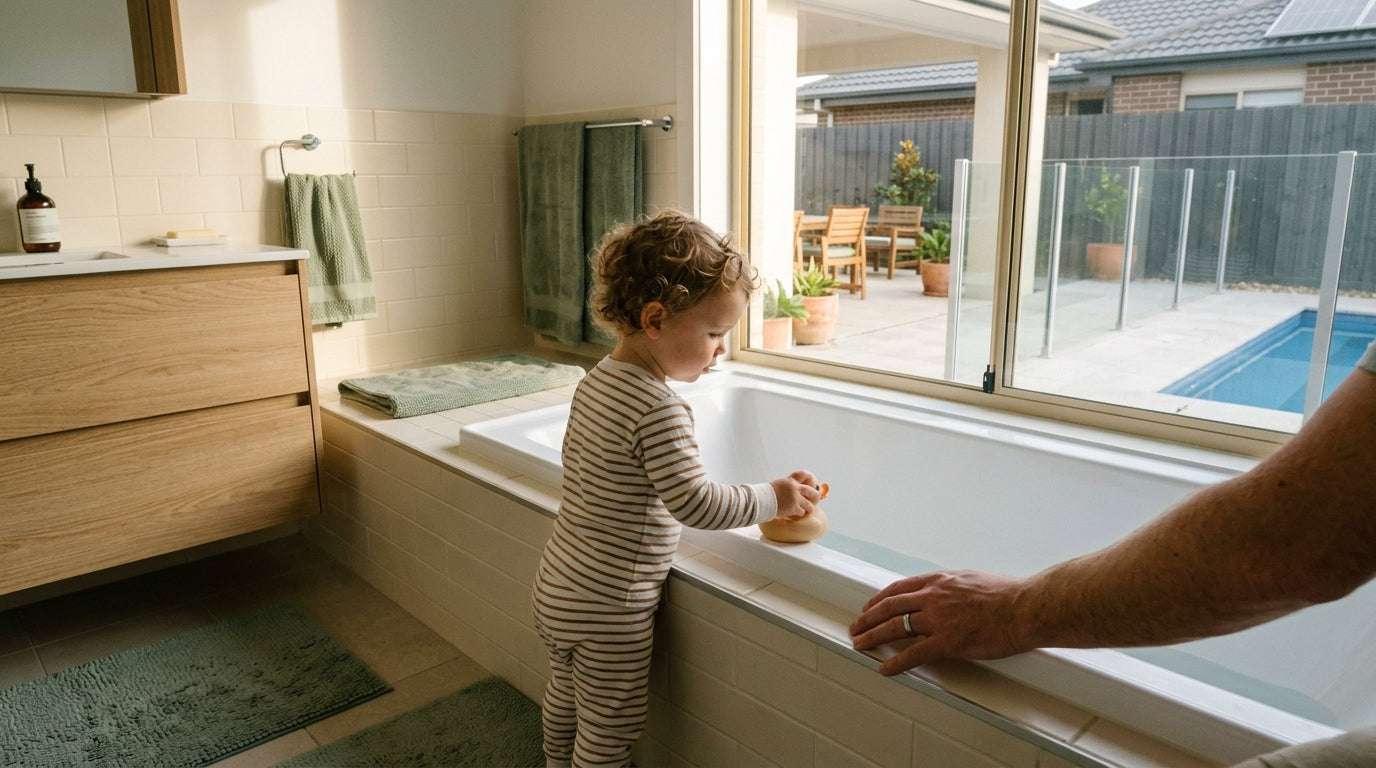
A child can drown in as little as one to two inches of water (AAP). That means buckets, dog bowls, toilets, and bathtubs with an inch of standing water all present real risk.
The prevention rules are strict because the margin for error is zero. Empty all standing water immediately after use. Install a toilet lock if you have a child under two. For backyard pools, four-sided isolation fencing with a self-closing, self-latching gate is the standard. Supervision means eyes on the child, not phone in hand nearby.
Furniture Tip-Overs: The Hidden Structural Risk
A child dies every two weeks from furniture, TV, or appliance tip-overs (CPSC). The victims are almost always toddlers, and the furniture is almost always a dresser or a television, often both at once when a child climbs the dresser to reach the TV.
Anti-tip straps cost a few dollars and take 20 minutes to install. The critical failure mode is anchoring into drywall instead of a stud, or using the wrong hardware for the wall material. Use a stud finder. Use the right screws. Test it by yanking hard on the top drawer after installation.
Televisions should be mounted to the wall or placed on a low, stable surface with the TV pushed back as far as possible. A flat-screen TV on top of a dresser, even with a strap on the dresser, is still a risk if the TV itself isn’t secured.
Poisoning: Medications Are the Primary Threat
Each year, an estimated 60,000+ children under five are treated in U.S. emergency departments for unintentional poisoning (CPSC). Medications are the single largest category within that number.
Per CDC PROTECT data, unsupervised medication exposures send roughly 100 children under five to U.S. emergency departments every day. The exposures happen fast, usually while the caregiver is still in the house, often within minutes of the medication being set down. Grandparents’ purses and pill organizers are a significant source because they’re left accessible and contain multiple medications in quantities that can cause serious harm.
Lock medications up. Not in a high cabinet. Locked. Child-resistant packaging is not childproof, and a determined three-year-old with five minutes can open most of them. Store medications in a locked box or cabinet, including vitamins and supplements, which parents often treat as harmless but which can cause iron toxicity and other serious problems in overdose.
Cleaning products and chemicals belong in locked cabinets too. Under-sink cabinets are at toddler eye level and toddler reach. A basic magnetic cabinet lock takes five minutes to install and holds reliably if you attach it to the cabinet frame correctly.
Scalds and Burns: The Kitchen and the Bath
Burns are among the most painful and disfiguring injuries a child can sustain, and most of them are preventable with two changes.
First, the water heater. The AAP recommends setting the water heater to 120°F (49°C) or lower to prevent scalds. At 120°F (49°C), a serious scald takes about five minutes of exposure (CPSC). At 140°F (60°C), a third-degree burn can occur in just five seconds. Most water heaters ship from the factory set higher than 120°F. Check yours. Turn it down. It takes five minutes and costs nothing.
Second, gas fireplace glass. ANSI Z21.50–2014/CSA 2.22–2014 took effect January 1, 2015, requiring a protective barrier on new gas fireplaces whose glass can exceed 172°F. If your fireplace predates 2015, the glass can reach temperatures that cause contact burns in seconds. Aftermarket barriers are available and worth installing before your child becomes mobile.
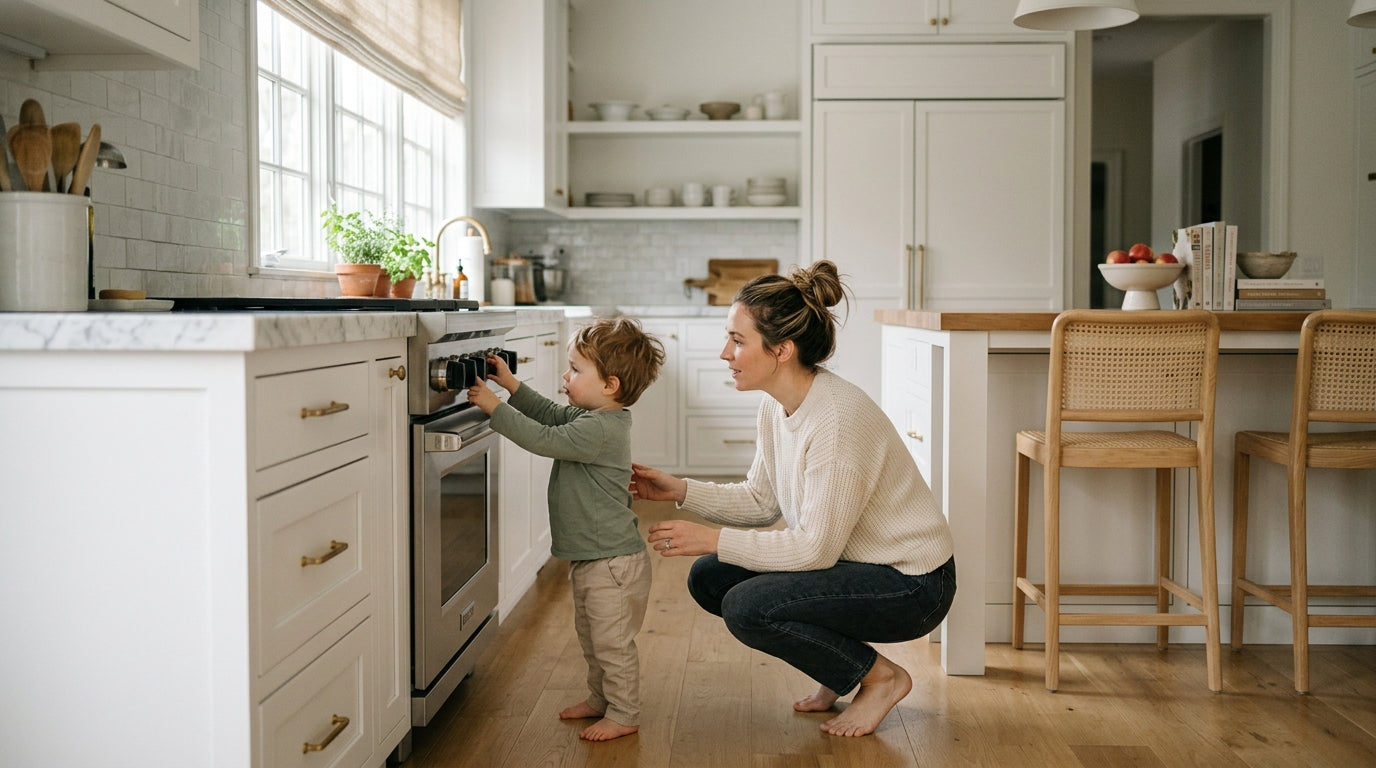
In the kitchen, use back burners when possible, turn pot handles inward, and keep children out of the cooking zone. A one-meter rule, where children stay at least three feet from the stove while cooking is happening, is easier to enforce than it sounds once you make it a consistent expectation.
Strangulation and Entrapment: Cords and Blind Strings
About 9 children under age 5 die each year from window-covering cord strangulation (CPSC GoCordless data). Per CPSC, nearly half of more than 200 corded-window-covering incidents involving children up to age 8 (2009–2021) resulted in a death. That lethality rate is what makes this hazard different from most others in the home. It doesn’t just injure. It kills at a high rate once contact is made.
In 2022, the CPSC adopted federal safety rules requiring most new residential window coverings to be cordless or have inaccessible cords (custom standard 16 CFR 1260 effective May 30, 2023). But millions of corded blinds are already in homes. If you have them, replace them with cordless versions or cut the cords and install cord wind-ups at minimum. Keep all window covering cords out of reach, which in practice means above 60 inches from the floor.
Home Safety Quick Checklist
Carbon Monoxide and Electrical Hazards
CO poisoning kills more than 400 people each year and sends more than 100,000 to U.S. emergency rooms (CDC). Children are more vulnerable than adults because their respiratory rates are higher and they absorb more CO per breath. The symptoms in young children, drowsiness, irritability, vomiting, are easy to misread as illness.
Install CO detectors on every level of the home and outside sleeping areas. Test them monthly. Replace them every 5–7 years.
On electrical outlets: since the 2008 National Electrical Code, tamper-resistant receptacles are required in all new residential 125V outlets (NEC §406.12). If your home is older, plug covers are a stopgap, but they can be removed by children over about 18 months. The better fix is replacing outlets with tamper-resistant versions, which have internal shutters that only open when equal pressure is applied to both slots simultaneously.
Where to Start If You’re Overwhelmed
You don’t have to do everything in a weekend. Start with the hazards that are most lethal and least visible: sleep environment, water heater temperature, corded window coverings, and furniture anchoring. Those four changes address the risks with the highest fatality rates and require the least ongoing vigilance once they’re done.
After that, work through the rest systematically. Lock medications. Install stair gates. Add CO detectors. The goal isn’t a perfect house. It’s a house where the most dangerous things have been addressed before your child reaches them.