Complete Baby Proofing Set: What Should Be in the Box?

Every year, parents spend hours researching individual baby-proofing products, buying them piecemeal, and then realizing they missed something important after a close call. A complete set, bought thoughtfully, is a better starting point. But "complete" means different things depending on what’s in the box.
The Foundational Three: Locks, Latches, and Outlet Covers
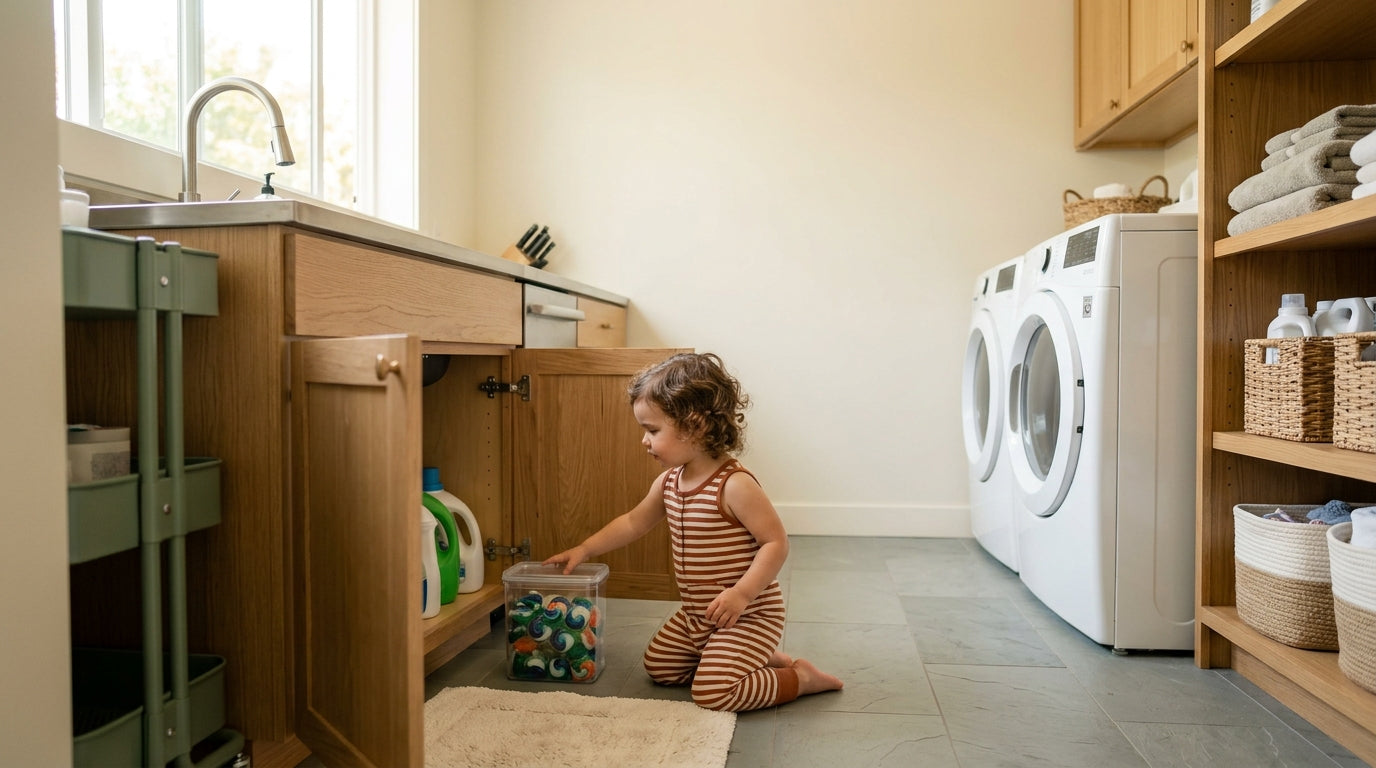
Cabinet locks and drawer latches are non-negotiable. Cleaning supplies, medications, vitamins, and sharp utensils all live in low cabinets and drawers that toddlers find irresistible. My younger daughter once emptied the entire under-sink cabinet in the time it took me to answer the doorbell. I came back to find dish soap, drain cleaner, and a sponge pile arranged on the kitchen floor. That was the day I stopped treating cabinet locks as optional.
A good kit includes both magnetic cabinet locks (which require a magnetic key to open) and adhesive strap latches for cabinets that don’t accommodate magnetic hardware. Magnetic locks are more secure. Strap latches are faster to install and work on oddly shaped furniture. You want both.
Outlet covers deserve more attention than most kits give them. Simple plastic plug inserts are easy for children to remove. My older daughter pulled one out at 22 months and handed it to me, apparently proud of herself. Look for tamper-resistant outlet covers that require simultaneous pressure on both sides to open. These are harder for small hands to defeat. Any kit worth buying should include this style rather than the basic plug-in type.
Safety Gates: Hardware-Mount Only for Stairs
About 93,000 children under 5 are treated in U.S. emergency rooms each year for stair-related injuries, per a Nationwide Children’s Hospital analysis of CPSC NEISS data. Gates are the primary intervention.
The AAP is clear that gates at the top of stairs must be hardware-mounted, not pressure-mounted. Pressure-mounted gates can be pushed out by a child leaning or falling against them. At the top of a staircase, that failure is catastrophic. Hardware-mounted gates are bolted into wall studs or a door frame, and they hold.
ASTM F1004 is the federal safety standard for expansion gates and expandable enclosures, made mandatory under 16 CFR Part 1239 (effective 2021). Any gate included in a kit should meet this standard. Check the packaging. If the kit includes a gate and doesn’t mention ASTM F1004 compliance, that’s a flag.
Pressure-mounted gates are fine for doorways between rooms at floor level, where a collapse is inconvenient but not dangerous. A complete kit should include at least one hardware-mount gate or clearly indicate which gates are appropriate for stairs versus room dividers.


Corner Guards and Edge Bumpers
The crawling and early walking stages produce a predictable pattern of head-height collisions. Coffee tables, fireplace hearths, low bookshelves, and entertainment centers are the main offenders. Corner guards and edge bumpers absorb impact and round off the sharp geometry that causes lacerations.
Look for foam or silicone guards that are thick enough to matter. Thin vinyl corners compress too easily on hard impact. A good kit includes both corner pieces and continuous edge strips, since a table corner is dangerous but so is the full length of a hearth edge.
Adhesive quality varies. I’ve tested sets where the corners started peeling within two weeks on painted drywall. The best kits use 3M-grade adhesive or include a secondary mounting option. If you’re a renter, check whether the kit explicitly offers damage-free removal. Many modern kits now do.
Bathroom Safety: The Overlooked Zone
Bathrooms are high-risk rooms that basic kits often underserve. Toilet seat locks prevent drowning risk for infants and toddlers who can topple headfirst into a toilet bowl. Door knob covers or handle locks prevent children from entering the bathroom unsupervised. These two items together form a basic bathroom barrier.
Medication storage is the other bathroom hazard. Cabinet locks matter here just as much as in the kitchen. If your kit includes only enough locks for the kitchen, you’ll need to buy more.
A complete kit should include at least two toilet seat locks and door handle covers rated for bathroom doors. If it doesn’t, you’re buying supplemental products anyway.
Cord Management and Window Covering Safety
Blind cords and window covering cords are strangulation hazards for young children. Thousands of children are injured or killed by cord entanglement each year, and the risk is highest for children under 5 who can reach a cord while standing or climbing. A comprehensive kit should include cord wind-ups, cord shorteners, or cord cleats to keep cords out of reach.
Electrical cord management matters too. Loose cords behind televisions and along baseboards are tripping hazards and chewing hazards. Cord bundlers and cable covers are inexpensive and effective. They’re worth including in any starter kit.
Furniture Anchors: The Most Critical Item Most Kits Underweight
The CPSC recommends anchoring all tall, unstable furniture to wall studs. Dressers, bookcases, and televisions are the primary tip-over risks. A child climbing a dresser drawer, pulling on a bookshelf, or bumping a TV stand can bring hundreds of pounds of furniture down on themselves.
Furniture anchors are simple: a strap or bracket that attaches the furniture to a wall stud. They’re inexpensive. They’re also the item most often missing from budget kits or included in inadequate quantities. A kit that includes one or two anchors when most homes need six or more isn’t a complete kit.
When I set up my older daughter’s room, I anchored the dresser, the bookshelf, and the changing table. Three anchors, one room. Any kit claiming to cover a full home should include at least six, with hardware for stud mounting.
Door Safety: Pinch Guards, Holders, and Exterior Locks
Finger pinch injuries from doors are common and painful. Door pinch guards wrap around the door edge and prevent the door from closing completely, protecting small fingers from the hinge gap and the latch edge. Door holders keep doors open at a fixed angle. Both are worth including.
Exterior door locks and garage access locks address a different problem: unsupervised escape. Toddlers who can reach a door handle will use it. Door handle covers for interior rooms prevent children from locking themselves in bathrooms or bedrooms, which causes both injury risk and real parental panic. A complete kit addresses both the locking-in and the getting-out scenarios.
Kit Evaluation Checklist
Adjustable Safety Straps and Appliance Securing
Trash cans, pet food bowls, and small appliances are access points for choking hazards and toxic substances. Adjustable safety straps secure these items to cabinets or walls. They’re versatile and reusable, and they fill gaps that specific locks can’t.
A good kit includes at least four adjustable straps. Look for ones with a simple one-hand release for adults but enough resistance to stop a toddler.
What to Look for Before You Buy
Not all "complete" kits are complete. Look for products certified through the Juvenile Products Manufacturers Association (JPMA) certification program, which tests juvenile products against applicable ASTM standards. JPMA certification doesn’t guarantee a perfect product, but it’s a meaningful baseline for safety hardware.
A kit that checks most of these boxes is a real starting point. One that checks half of them is a partial kit sold as a complete one, and you’ll spend more money filling the gaps than you would have buying comprehensively from the start.