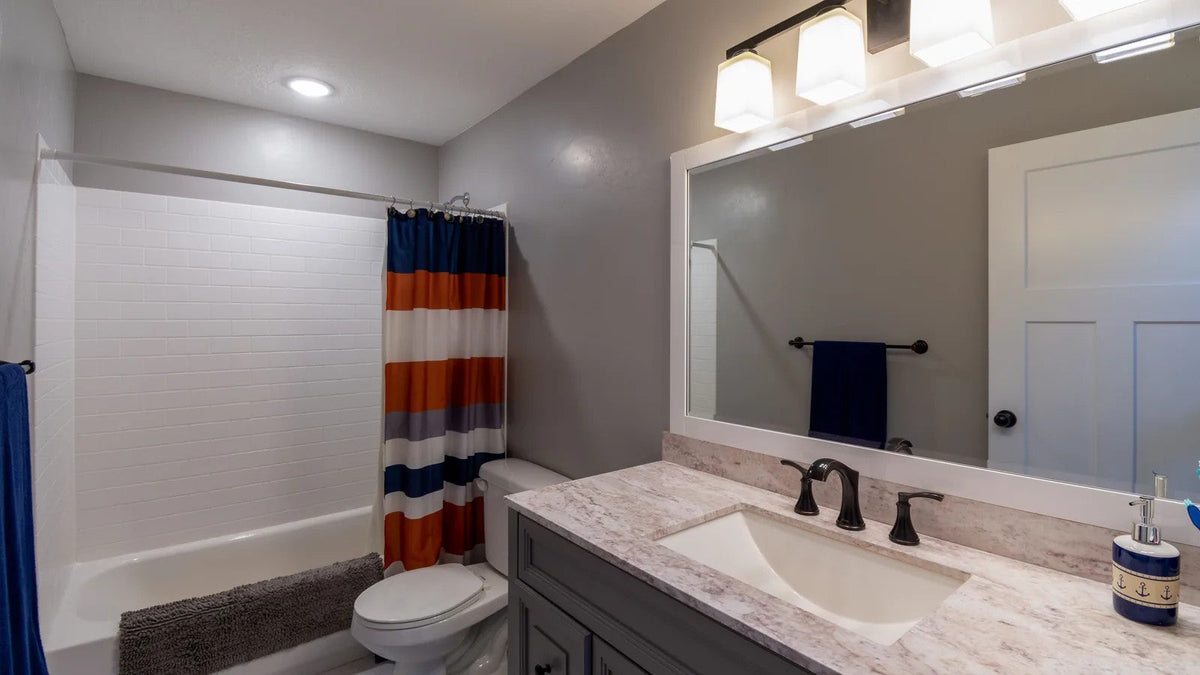

Faucet Locks and Tap Covers: Stopping a Toddler From Turning On Hot Water at the Sink or Tub
Baby Proof Me sells no faucet lock. Here is what the AAP and CPSC say about hot water at the tap: temperature first, a door latch, testing and habits, and what a cushioned faucet cover is really for.

Baby Proof Me sells no faucet lock, tap cover or anti-scald device. Its Adjustable Safety Strap Lock is made for cabinets and drawers, so it fits the vanity cabinet below the sink and not the tap. For a child proof bathroom faucet, the AAP and CPSC point to water temperature, hand-testing, a latched door and supervision. The AAP names a cushioned faucet cover for head bumps. A handle lock limits who can reach the handle and does nothing about water temperature. Among this guide’s sources, anti-scald devices appear only as a topic discussed at a 2025 CPSC meeting.
Child Proof Bathroom Faucet Layers and Who Names Each One
Each layer does one job. None of them replaces an adult in the room.
| Layer | What it does | Who names it |
|---|---|---|
| Water at 120°F (49°C) | Caps hottest tap temperature | AAP, CPSC |
| Hand-test before use | Checks water before contact | AAP, CPSC |
| Bathroom door latch | Keeps child out alone | AAP |
| Cushioned faucet cover | Cushions head bumps | AAP |
| Faucet handle lock | Limits who reaches handle | Neither, for scalds |
| Anti-scald device | Discussed for tub, sink faucets | 2025 CPSC meeting |
| Tap habits, supervision | Cold first, faucet off | AAP, CPSC |
| Vanity cabinet latch | Limits access under sink | AAP |
Start With Water Temperature at the Tap
CPSC Publication 5098 says the majority of injuries and deaths from tap water scalds are to the elderly and to children under the age of five. The AAP’s Bathing Your Newborn page adds that water temperature can fluctuate as it moves through your home’s pipes, and that even small changes can cause scalds. It says tap water that is too hot can quickly cause burns serious enough to require a hospital visit or even surgery. It also says hot water scalds are the top cause of burns among babies and young children.
Here is how fast it happens. CPSC gives these exposure times for third-degree burns in most adults: about 2 seconds at 150°F (66°C), about 6 seconds at 140°F (60°C), about 30 seconds at 130°F (54°C), and about 5 minutes at 120°F. Those are CPSC’s figures for most adults. They are not a safe time for a toddler, and 120°F water can still burn.
The AAP says to adjust the water heater so the hottest temperature at the faucet is no more than 120°F, "to prevent scald burns." CPSC urges all users to lower their water heaters to 120°F.
If you rent, you may not control the heater. CPSC says that if you live in an apartment, you should contact the building manager to discuss possible options for lowering your tap water temperature.
The AAP says to test the water with your wrist or elbow to check that it feels warm, not hot. CPSC says to always hand-test before using, especially when bathing infants and young children. CPSC also says never to take hot water temperature for granted.


Put a Latch on the Bathroom Door
Picture this: you’re folding laundry in the next room, and the bathroom door is shut with a latch above your toddler’s reach. The taps are in a room your child cannot enter alone.
That is the AAP’s simplest way to avoid bathroom injuries. Make the bathroom inaccessible unless an adult is with the child. One way is a latch on the door at adult height, so the child cannot get in when you are not around. The AAP adds one condition. Any lock on the bathroom door should be one that can be unlocked from the outside, in case a child locks himself in.
A door latch is the opening move in baby-proofing the bathroom, and it only helps on the days it gets latched.
For a toddler who can reach the taps, this door layer comes before any handle lock. A handle lock works on one fixture. A latched door covers the tub, the sink, the toilet and everything stored in the room.
Covers, Handle Locks and Anti-Scald Devices
These three products get lumped together, but they answer three different questions.
A baby safety tap cover is about bumps. In its bathroom safety tips, the AAP says to put a cushioned cover over the water faucet so a child will not be hurt if he bumps his head against it. It sits in the same list as no-slip strips on the tub bottom and a toilet lid lock. That is advice about bumps and falls. The AAP’s scald advice on the same page is about water temperature and testing, so a cushioned cover is not a scald layer.
A faucet lock for toddlers answers a different question: who can reach the handle. It limits access and does nothing about temperature. If an adult runs the hot water and gets distracted, the water is as hot as the heater allows. Neither the AAP nor CPSC pages behind this guide name a handle lock as scald protection. Treat one as an extra layer at most.
Anti-scald devices show up in one place among this guide’s sources. At a 2025 CPSC stakeholder meeting on child burns, participants discussed anti-scald devices installed on bathtub and kitchen sink faucets. That was a discussion. It was not a CPSC finding, rule or standard. Baby Proof Me does not sell one. With or without a device, the same advice applies: keep the hottest faucet temperature at no more than 120°F and test the water by hand, wrist or elbow before every bath.
The tub has its own set of layers, including spout covers and bath mats, and those belong to a full bath routine.
Daily Habits at the Tap
Habits cost nothing, and the AAP names several. Once a child is old enough to turn the faucets, teach him to start the cold water before the hot. No source here names a device for how to keep a toddler from turning on the bathtub hot tap. The AAP’s answers are the latched door above and this habit: make cold the first handle, every time.
The AAP’s Bathing Your Newborn page sets out rules for the water itself:
- Keep the faucet off while the baby is in the water.
- Never bathe a baby in running water.
- Do not use a sprayer attached to the faucet.
Its reason: water temperature can fluctuate as it moves through your home’s pipes.
Between baths, the AAP says never to leave water in the bathtub when it is not in use.
Picture this: the phone rings while the tub is filling. CPSC says leaving a child unsupervised in the bathroom, even for a second, could cause serious injuries, and that your presence at all times is the best defense. The AAP says never to leave a young child alone in the bath, even for a moment, because children can drown in only a few inches of water.
If the phone rings, the child comes with you, or the call waits.
Kitchen Faucet and Bathroom Sink Risks Raised at the 2025 CPSC Meeting
The 2025 CPSC meeting on child burns covered tap water as a cause of child burns. Participants said hot tap water can scald whether a child is bathing or just washing hands, and that children under 5 are particularly susceptible.
Participants also discussed anti-scald devices on bathtub and kitchen sink faucets. They discussed a scenario in which an infant bathing in a kitchen sink kicked the faucet and suddenly raised the water temperature. These were points raised in discussion, not CPSC findings.
For a baby proof kitchen faucet, the useful lesson from that scenario is that a handle can be moved by a small foot. The water heater setting is what limits the result. A bathroom door can take a latch. In a kitchen, the 120°F setting and your hand-test carry more of the load.
The same logic applies to a child proof bathroom sink faucet. Hand-test the water before little hands go under it, and teach the cold-first habit as soon as your child can turn the handle. Sinks need the same attention as the tub: the meeting discussion covered hand-washing as well as bathing.
Under the Sink: The Vanity Cabinet
The cabinet below the bathroom sink is where the Baby Proof Me strap lock belongs. The AAP says to keep toothpaste, soaps, shampoos and other frequently used items in a hard-to-reach cabinet equipped with a safety latch or locks. It says to store medicines and cosmetics high and out of reach in a locked cabinet.
The Adjustable Safety Strap Lock is a strap for cabinets and drawers. It applies with 3M adhesive and needs no drilling. Its product page says to allow 24 hours for the adhesive to bond for best results. It is a cabinet latch, so it does nothing for the faucet above it. It is not a substitute for adult supervision.

Questions Parents Ask
Set the water temperature first, then latch the door at adult height, then add the habits and cabinet latches as your toddler’s reach grows.