

Every balcony is a small, beautiful hazard. The view is lovely. The railing gaps are not.
If your child is walking, climbing, or anywhere close to either, the balcony needs work before they spend real time out there. This is one of those spaces where the risk is obvious but the fixes are underestimated. Most parents think about cabinet locks and outlet covers. Fewer think about what happens when a 22-month-old figures out that the horizontal rail is a ladder rung.
Why Balcony Safety Is Different From Indoor Proofing
Inside the house, a fall means a bruise or a trip to urgent care. On a balcony, the same fall can mean going over the edge. The height changes everything.
Standard residential railings are built to code for adults. Most local codes require a minimum railing height of 36–42 inches, which sounds like enough until you watch a determined toddler scale a horizontal rail in about four seconds. The gap between balusters is the other problem. Building codes typically allow up to 4 inches between vertical spindles. That’s enough space for a small child to get a head or torso through.
When my older daughter was around 28 months, she wedged herself between two deck balusters at my in-laws’ house in under a minute while the adults were setting up lunch. She wasn’t in danger, but she was stuck, and she thought it was hilarious. I did not.
The two interventions that solve these problems are balcony netting and rail spacers. They work differently, suit different railings, and are often used together.
Understanding Railing Gaps and the 4-Inch Rule
The 4-inch baluster gap standard exists to prevent children from getting their heads trapped. A child’s head can pass through any opening wider than 4 inches, and once through, the shoulders often prevent them from pulling back. That’s how entrapment injuries happen.
But 4 inches is also enough for a small body to slip through at certain angles, especially in older buildings where railings may have settled, warped, or simply weren’t built to current standards. Before you buy anything, measure your gaps. Use a rigid ruler or a 4-inch PVC coupling as a go/no-go gauge. If it passes through, you have a problem to fix.
Also check the bottom rail clearance. The space between the floor and the lowest horizontal rail should be no more than 4 inches as well. Children can roll, slide, or crawl under gaps that adults never notice.

- Baluster gaps wider than 4 inches
- Bottom rail clearance over 4 inches
- Horizontal rails act as ladder rungs
- Chair or planter near railing edge
Rail Spacers: The Right Fix for Vertical Baluster Gaps
Rail spacers (sometimes called baluster guards or railing inserts) are rigid panels or slotted inserts that mount between existing balusters to reduce the gap to a safe width. They come in acrylic, polycarbonate, aluminum, and powder-coated steel. Some clip directly onto the balusters. Others use tension or screw mounting.
For most standard wood or metal railings with vertical balusters, rigid spacers are the cleaner, more permanent solution. They don’t flex, they don’t sag, and they don’t give a climbing child any purchase. A child pushing against a rigid polycarbonate panel gets nowhere. That matters.
What to look for when buying:
- Panel material. Clear polycarbonate or acrylic preserves sightlines, which matters if you want to watch your child while they’re out there. Powder-coated aluminum is more durable for high-UV climates.
- Mounting system. Clip-on systems work for standard baluster profiles. If your railing is non-standard (round balusters, unusual spacing), measure carefully and contact the manufacturer before ordering.
- Gap coverage. The spacer should reduce the opening to 3 inches or less. Don’t assume "fits 4-inch gaps" means it closes them to 3.
- Load rating. The panel should be rated for lateral pressure. Children lean, push, and throw themselves at things. A panel that cracks under a 30-pound push isn’t a safety product.
Installation is usually a two-person job. One person holds the panel in position while the other secures the clips or fasteners. Work from one end to the other, checking alignment as you go. Don’t skip the top and bottom fasteners. Those are the ones that matter most under lateral load.


Balcony Netting: The Right Fix for Everything Else
Balcony safety netting works where rigid spacers can’t, including glass railings, cable railings, wide-spaced horizontal rails, and situations where the gap is at the bottom rather than between vertical balusters.
Netting is also the right choice when you need to cover the full height of the railing from floor to top rail, not just the gaps between spindles. On a horizontal-rail railing (the kind that looks like a fence), there are no vertical balusters to space. The rails themselves are the ladder. Netting covers the whole face.
What to look for in balcony netting:
- Mesh size. Look for mesh openings no larger than 1.75 inches (about 45mm). Smaller is safer. A child’s fingers can get caught in larger mesh, and smaller children can push limbs through openings you’d think were too small.
- Material. UV-stabilized polyethylene or nylon holds up outdoors. Untreated netting degrades in direct sun and loses tensile strength over one to two seasons. Check the UV rating before buying.
- Load rating. The netting and its attachment hardware should be rated for at least 50 pounds of lateral force distributed across the panel. Some manufacturers list this; others don’t. If they don’t list it, ask.
- Attachment method. Netting that ties to the railing with zip ties is not a safety product. Look for systems that use tensioned cable, stainless steel hardware, or purpose-built clamps. The attachment points are where the system fails first.
In my experience, a zip-tie-mounted net on an apartment balcony can bow out nearly 8 inches under hand pressure before the ties start pulling. A cable-tensioned system provides noticeably greater rigidity.
-
Measure the railing face
Measure full height and width, then add 6 inches on each side for attachment overlap. -
Anchor the top cable
Use stainless steel eye bolts or purpose-built rail clamps. Never use adhesive hooks. -
Thread and tension the net
Run the cable through the top hem, tension until taut, and secure both ends firmly. -
Repeat at the bottom and sides
Tension the bottom cable and both vertical edges so no section sags or pulls free. -
Test deflection by hand
Push firmly at multiple points. The net should not deflect more than 2 inches from the railing face. -
Inspect every season
UV exposure and temperature changes loosen hardware. Re-tension and replace worn fasteners annually.
Installing Netting Correctly
Measure the full height and width of the railing face, not just the opening. Add 6 inches on each side for overlap at the attachment points. Undersized netting creates gaps at the edges, which is exactly where a child will find them.
Anchor the top cable to the railing’s top rail using stainless steel eye bolts or purpose-built rail clamps, not adhesive hooks. Run the cable through the top hem of the netting, tension it until the net is taut, and secure the ends. Repeat at the bottom. Then tension the vertical edges.
The finished net should have no visible sag and no point where you can pull it more than 2 inches from the railing face with one hand. If you can, the tensioning is insufficient.
Check the hardware every season. UV exposure and temperature cycling loosen fasteners over time.
Balcony Safety Final Check
What Netting and Spacers Don’t Fix
Neither product addresses a railing that is structurally unsound. If your railing wobbles, flexes at the posts, or has corroded fasteners, fix the railing first. No netting or spacer system is rated to compensate for a railing that could fail under load.
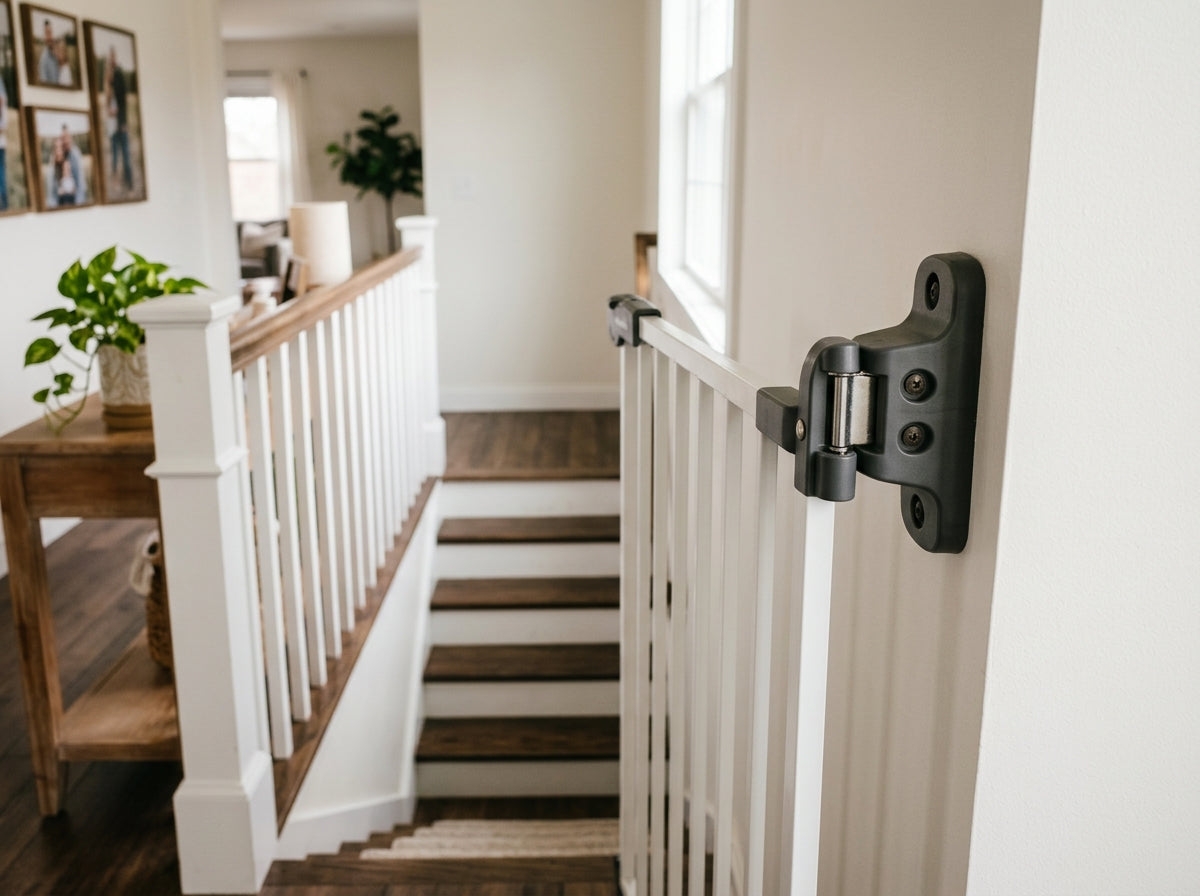
Neither product prevents climbing over the top rail. If your child is a climber, the balcony needs active supervision regardless of what you’ve installed below the top rail. Some parents add a secondary barrier at the door, a hardware-mounted gate that requires two-step operation, so the balcony is never casually accessible.
And neither product is a substitute for supervision. They reduce risk. They don’t eliminate it.
A Practical Checklist Before You Call It Done
Once your netting or spacers are installed, run through this before your child uses the space. Move any chairs, side tables, or storage bins away from the railing perimeter. A child who can’t climb the railing directly will absolutely climb the chair next to it.
The balcony can be a good space for kids. Fresh air, outdoor time, room to move. Getting the hardware right means you can relax out there instead of spending the whole time repositioning yourself between your toddler and the edge.