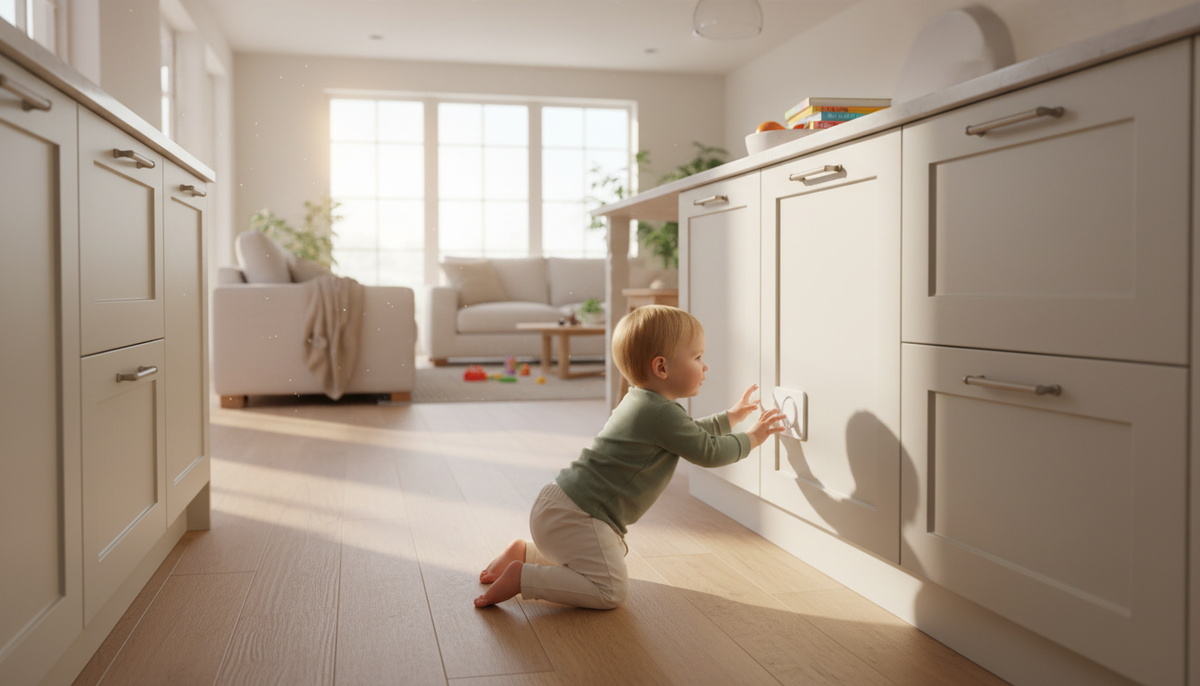


The kitchen is the most dangerous room in your house for a mobile child. Not the bathroom, not the garage. The kitchen. Open flames, boiling water, heavy appliances at grabbing height, and cabinets full of cleaners and sharp objects, all in the room where your child most wants to be because you’re there.
I learned this the hard way when my younger daughter, at about 14 months, emptied the entire cabinet under my kitchen sink in the time it took me to answer the front door. Dish soap, drain cleaner, a spare sponge, all of it on the floor. She hadn’t gotten into anything dangerous that time, but it was close enough to make me spend a full Saturday locking down every cabinet and drawer in that kitchen.
Here’s how to do it right.
Start with a Floor-Level Walk-Through
Before you buy a single product, get down on your hands and knees and look at your kitchen from your child’s eye level. You’ll see things you’ve stopped noticing: the gap under the stove where a toy, and a hand, can slide. The oven drawer that opens with almost no force. The refrigerator door that a 20-month-old can absolutely pull open.
Make a list as you go. Cabinets, drawers, appliances, the stove, the oven, the refrigerator, the dishwasher. Note which ones have hazardous contents and which ones are just inconvenient to have raided. That distinction matters when you’re choosing hardware, because not every lock needs to be the same.
Pay attention to pull-out trash cans, too. A kitchen trash can contains spoiled food, broken glass, and whatever cleaning product residue you wiped off the counter. It needs a lock or a cabinet.
Locking Cabinets: Which Hardware Holds
There are three main cabinet lock types worth considering: magnetic locks, spring-loaded latches, and adhesive strap locks. Each has a real use case and a real failure mode.
Magnetic locks are the most secure option for cabinets with hazardous contents. You mount a latch inside the cabinet and use a magnetic key to release it. There’s nothing visible from the outside, which means no prying fingers can find the mechanism. The downside is installation. You need a drill, and you need to mount the latch precisely so the magnet reaches it through the door. I’ve installed magnetic locks in two kitchens now, and the first time I had to remount two of them because I misjudged the door thickness.
Spring-loaded latches are faster to install and work reliably on most hinged cabinets. You press a tab to release them. Children under about 18 months usually can’t manage the tab. By 24–30 months, some kids figure them out. My older daughter defeated one at 26 months, which is why the under-sink cabinet got upgraded to a magnetic lock.
Adhesive strap locks work across a pair of knobs or handles, stretching between them so the doors can’t open more than an inch or two. They’re fast to install and require no tools. The problem is adhesive failure. On textured cabinet surfaces, in a kitchen with steam and grease, the adhesive can let go. I’ve had one fail within three months. Use them on low-risk cabinets, not the one with your cleaning products.
For drawers, the same spring-loaded latches work if the drawer has a face frame to mount against. If it doesn’t, adhesive strap locks are your main option. Magnetic drawer locks exist but are harder to position correctly because drawers have less depth to work with.
The cabinets that need the strongest locks, no exceptions:
- Under-sink cabinet (cleaning products, drain chemicals)
- Any cabinet storing knives, graters, or mandolines
- The cabinet where you keep medications (more on that below)
- Cabinets storing alcohol


-
Do a floor-level walk-through
Get on your hands and knees. List every cabinet, drawer, and appliance that poses a hazard at your child’s eye level. -
Lock the under-sink cabinet first
Install a magnetic lock on any cabinet holding cleaning products or drain chemicals. A spring latch is not sufficient here. -
Cover stove knobs and install a stove guard
Add knob covers immediately. Cook on back burners and turn all pot handles away from the front. -
Secure the knife drawer and sharp-object storage
Audit every drawer for loose blades, peelers, and box cutters. Consolidate into one latched drawer. -
Lock the oven and dishwasher
Use a latch-mounted oven lock and enable the dishwasher’s built-in child lock or add a strap lock. -
Move medications out of the kitchen
Store all medications in a locked box on a high shelf in a bedroom closet, away from kitchen humidity. -
Test everything at child height
Push every door and drawer. Try latches with one hand. Look for gaps you missed before calling the kitchen done.
The Stove: Your Highest-Priority Appliance
A child can reach the front burners of most ranges by around 18 months if they pull up on the oven door handle. Burns are among the most common kitchen injuries in young children, and hot surfaces don’t look dangerous the way a knife does.
Knob covers are the first line of defense. They fit over existing stove knobs and require an adult grip to operate. Most require you to press and turn simultaneously. They’re not foolproof, but they buy you time. Replace them if the plastic cracks or if the fit becomes loose.
Stove guards are clear or metal barriers that attach to the back of your cooktop and prevent a child from reaching pots on back burners. They also catch spills. The trade-off is that some guards interfere with large pots, and they require careful installation to stay stable.
The most important habit, though, is positional. Cook on back burners whenever possible. Turn pot handles toward the back or the side, never toward the front where a child can grab them. This costs nothing and works every time.
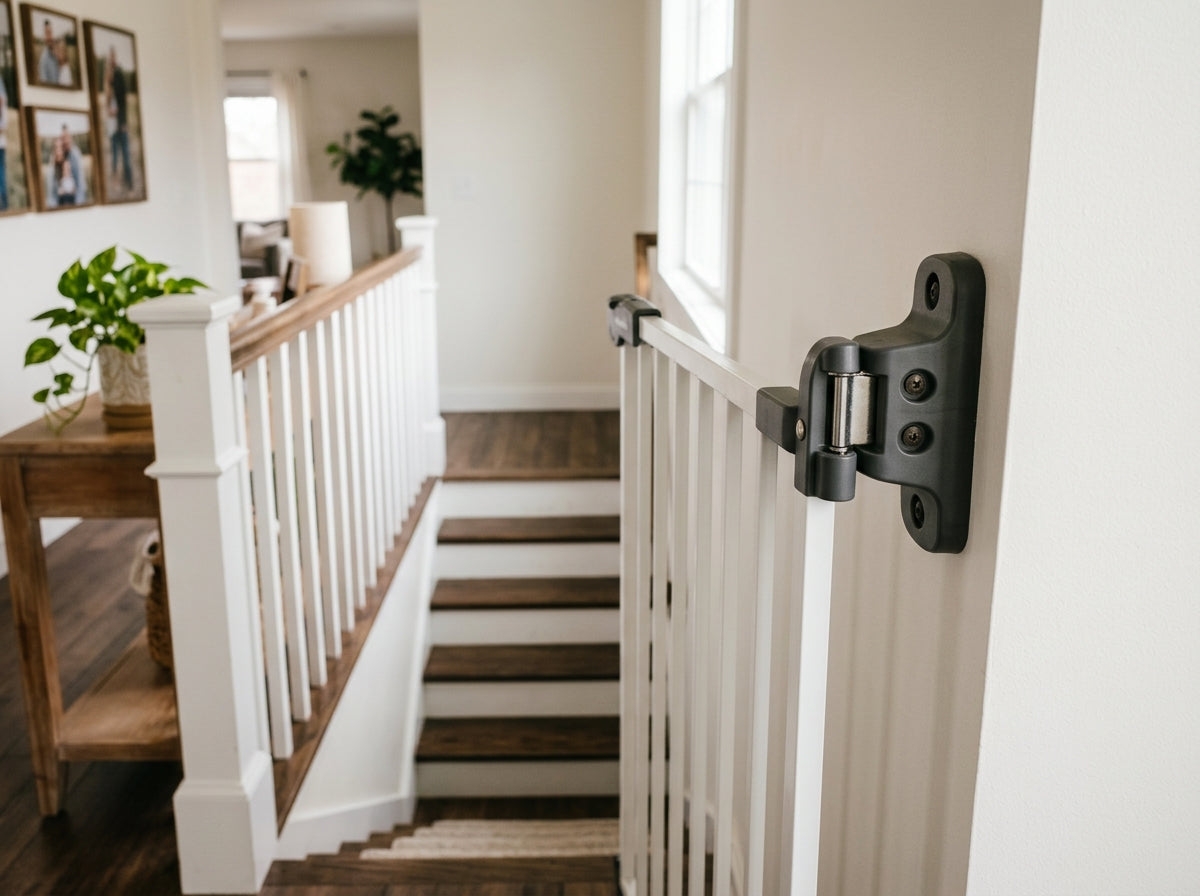
Keep your child out of the cooking zone entirely when the stove is in use. A baby gate across the kitchen entrance is the most reliable solution if your kitchen layout allows it. Look for gates certified to ASTM F1004, the federal safety standard for expansion gates. Look for that certification on any gate you buy.

- Under-sink cabinet: cleaning products and chemicals
- Stove knobs reachable by 18-month-old
- Oven door: hot glass, climbable handle
- Dishwasher: caustic pods, tip hazard
- Refrigerator: raw food, finger pinch risk
Oven, Dishwasher, and Refrigerator
The oven has two hazard zones: the door and the interior. Oven doors get hot, and the glass on some models reaches temperatures that can cause a contact burn in seconds. Oven door locks are available as both adhesive strap styles and latch-mounted styles. The latch-mounted versions are more reliable. If your oven has a self-clean cycle, make sure the lock holds during that cycle, because the door gets significantly hotter.
The dishwasher is often overlooked. The inside of a dishwasher door, when open, is a ledge a child will climb on. It can tip the whole machine forward. More immediately, the detergent compartment holds pods or powder that are highly caustic. Keep the dishwasher locked when not in use. Most modern dishwashers have a child lock in the control panel settings. Use it. For older models, a strap lock across the door handles works.
The refrigerator is lower stakes but not zero risk. A child who opens the refrigerator repeatedly can pull items off shelves, get into raw meat, or get their fingers caught in the door seal. Refrigerator door locks exist and are simple strap or latch designs. If your child is going through a phase of constant refrigerator raiding, they’re worth the five minutes of installation.

Cleaning Products and Medications: The Cabinet Rule
Under-sink cabinets and lower kitchen cabinets often store cleaning products. These need the strongest lock you have. Per CDC PROTECT data, unsupervised medication exposures send roughly 100 children under five to U.S. emergency departments every day. Cleaning products add to that burden.
The safest approach is to move anything toxic to a high shelf or a locked cabinet above counter height. If that’s not possible, a magnetic lock on the under-sink cabinet is the minimum. A spring-loaded latch is not enough for this location.
Medications should not be stored in the kitchen at all if you can help it. The humidity and temperature swings degrade some medications, and the kitchen is where your child spends the most time. A locked box on a high shelf in a bedroom closet is a better choice.


Sharp Objects: Knives, Graters, and Peelers
Knife blocks on the counter are accessible to a child who can pull up to counter height, which happens earlier than most parents expect. Move the knife block to the back of the counter, or better, switch to an in-drawer knife organizer in a locked drawer.
Loose peelers, graters, and box cutters in a junk drawer are a real risk. Consolidate sharp tools into one drawer with a reliable latch. When I reorganized my kitchen after my younger daughter started pulling up to counters, I was surprised how many sharp items had migrated into random drawers. A box cutter in with the takeout menus. A mandoline blade loose in the back of a utensil drawer.
Do a full sharp-object audit before you consider the kitchen locked down.
Kitchen Safety Checklist
Hot Liquids and the Counter Edge
Tablecloths and placemats that hang over the edge of a table or counter are a pull hazard. A child who grabs a hanging tablecloth can bring a full cup of coffee or a bowl of soup down on themselves. Switch to placemats that sit flat, or skip the tablecloth entirely during the years your child is in a pulling phase.
Keep hot drinks away from the counter edge. This sounds obvious, but the counter edge is exactly where we put things down when our hands are full. Build the habit of setting hot liquids toward the back.
The AAP recommends setting the water heater to 120°F (49°C) or lower to prevent scalds. At 140°F (60°C), a third-degree burn can occur in just five seconds. Check your water heater setting. It takes two minutes and it protects your child at the sink as much as in the bath.
A Room You Can Cook In Without Constant Anxiety
None of this needs to happen in one afternoon. Prioritize by hazard level. The under-sink cabinet and the stove knobs come first. Then the knife drawer and any cabinet with medications or cleaning products. Then the lower-risk cabinets, the refrigerator, the dishwasher.
Once the hardware is in place, test everything. Push the cabinet doors. Try the drawer latches with one hand. Get down to your child’s height and look for anything you missed. The goal is a kitchen where you can cook a full meal without stopping to redirect your child away from something dangerous every four minutes.
It’s achievable. It just takes a systematic pass and the right hardware in the right places.