How to Baby Proof a Medicine Cabinet Properly

Every 15 seconds, someone in the U.S. calls a poison center about an exposure, about 2.1 million calls in 2024 alone, according to America’s Poison Centers. A significant share of those calls involve children who found something they shouldn’t have. Usually somewhere in the bathroom.
The medicine cabinet is one of the most underestimated hazards in a home. Parents spend hours researching outlet covers and stair gates, then leave a bottle of ibuprofen on the bathroom counter because they needed it last night and forgot to put it away. I’ve done it. Most parents have. But per CDC PROTECT data, unsupervised medication exposures send roughly 100 children under five to U.S. emergency departments every day. That number is worth sitting with.
Here’s how to fix the problem.
Why the Medicine Cabinet Deserves More Attention Than It Gets
Child-resistant caps are not enough. They slow children down. They do not stop them, especially older toddlers who’ve watched you open the bottle a dozen times. And they do nothing once a cap is already loose, which is more common than you’d think after a bottle has been opened repeatedly.
CPSC ED-treated ibuprofen injuries in children under 5 rose from 2,000 to 3,600 between 2021 and 2022, and narcotic-related ED injuries more than doubled (1,200 to 2,500). These are medications that live in bathroom cabinets in most households. Acetaminophen, ibuprofen, prescription pain relievers, all common, all dangerous in the wrong dose, all accessible if a cabinet isn’t locked.
In 2024, 99.2% of poison center cases involving children under 6 were accidental, according to America’s Poison Centers. Children aren’t trying to get into your medications. They’re curious. They mimic what they see adults doing. A bottle that looks like something you handle every morning is interesting to a two-year-old. That’s the whole mechanism.
Choose the Right Lock for the Cabinet
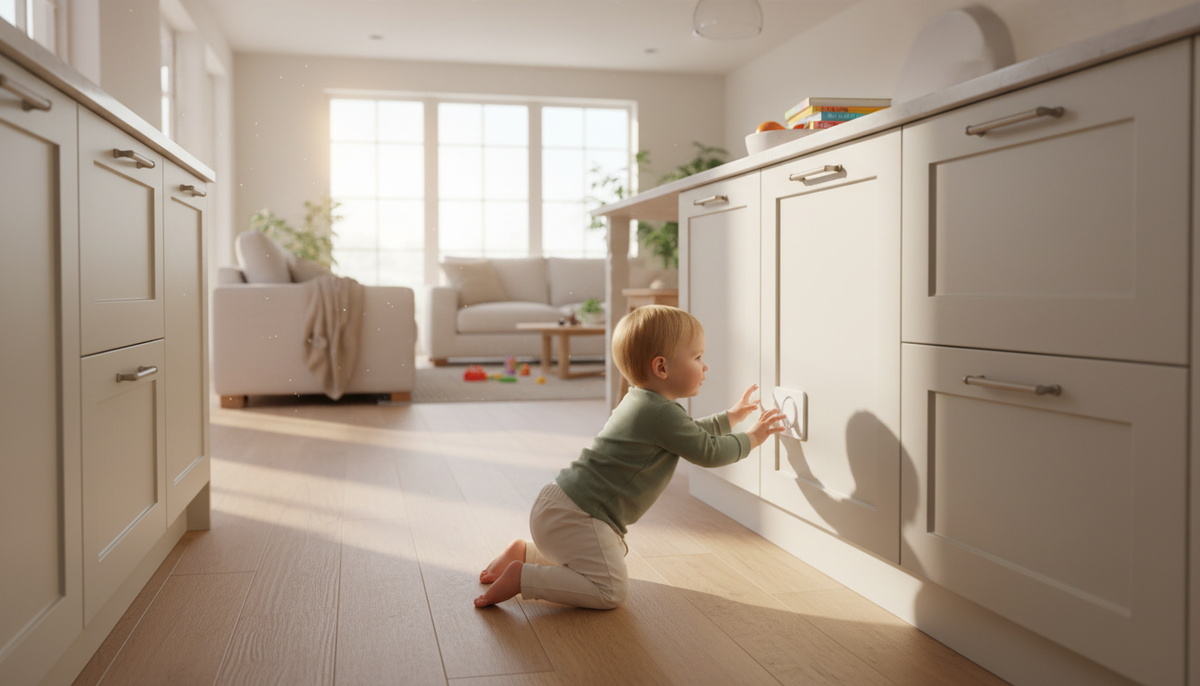
Not all cabinet locks are equal, and the medicine cabinet is not the place to go cheap. Adhesive strap locks work fine for kitchen cabinets storing pots and pans. For medications, you want something more secure.
My older daughter defeated an adhesive strap lock at 26 months. She didn’t break it. She figured out the release mechanism by watching me. That’s when I switched to magnetic locks for anything storing medications or cleaning products.
Magnetic locks mount inside the cabinet and require a magnetic key to open. There’s no visible mechanism for a child to study and replicate. Key-operated latches are another solid option. Both are significantly harder for young children to defeat than push-to-release designs.
ASTM F3492–21 is the voluntary consumer safety standard that applies to cabinet locks and latches in the U.S., and locks that meet it must withstand an average breaking force of at least 45.3 lbs across a 30-sample test. Look for that standard on the packaging.
A 2012 CPSC recall pulled 900,000 Safety 1st Push 'N Snap cabinet locks after reports of children as young as 9 months opening them. Three of those children reached toxic cleaning products. The lesson isn’t that all cabinet locks fail. It’s that lock design matters, and you should verify what you’re buying meets a current standard.


Height and Visibility Both Matter
A lock is your primary defense. Height is your backup. Store medications at least five feet off the ground, which puts them above the sightline of most children under five. Out of sight reduces curiosity. A child who can’t see the bottle doesn’t think to reach for it.
Wall-mounted medicine cabinets in bathrooms are often installed at adult eye level, which already helps. The problem is the stuff that migrates out of the cabinet. Vitamins left on the counter. A prescription bottle set down while you refill a glass of water. A tube of topical cream next to the sink. These are the items that cause emergencies, not the locked cabinet itself.
Keep everything in the cabinet. Every time.
-
Choose a secure lock
Install a magnetic or key-operated lock that meets ASTM F3492–21. Avoid push-to-release designs. -
Lock every cabinet and drawer
Secure the medicine cabinet, under-sink cabinet, and all bathroom drawers containing sharp items. -
Store everything inside
Return all medications, vitamins, and topical products to the locked cabinet immediately after use. -
Audit every three months
Remove expired or unused medications and take them to a pharmacy take-back program. -
Brief every caregiver
Show all regular caregivers how to open the lock and where emergency medications are stored. -
Inspect locks regularly
Check for loose mounting, worn mechanisms, or failing adhesive. Replace anything compromised.
What Belongs in a Locked Medicine Cabinet
This is where most guides stop at medications and miss half the problem. In 2024, household cleaning substances topped the list of substances kids under 6 got into, accounting for roughly 1 in 10 (10.1%) of all pediatric poison center cases, according to America’s Poison Centers. Mouthwash, rubbing alcohol, nail polish remover, and hydrogen peroxide all belong in the same locked storage as your prescriptions.
Here’s a practical breakdown of what to lock up:
- All prescription medications, including old or partially used bottles
- Over-the-counter medications (acetaminophen, ibuprofen, antihistamines, sleep aids)
- Vitamins and supplements, including gummy vitamins that look like candy
- Topical creams and ointments, especially those containing lidocaine, salicylates, or steroids
- Mouthwash (most contain significant alcohol)
- Rubbing alcohol and hydrogen peroxide
- Nail polish and nail polish remover
Many of the products parents store in cabinets are required by 16 CFR 1700.14 to ship in child-resistant packaging. That packaging is a legal minimum, not a safety ceiling. Lock them anyway.
Organize to Reduce Risk
A disorganized cabinet creates its own hazards. When you can’t see what you have, you forget what’s there. Forgotten medications are a real problem: old prescriptions, expired vitamins, topical products from a condition that resolved two years ago. Children may ingest or apply substances you’ve forgotten are present.
Separate prescriptions from over-the-counter products. Keep them together in a single locked container so you can do a fast inventory. Go through the cabinet every three months and remove anything expired or unused. Take expired or unused medications to a drug take-back site or pharmacy kiosk. If you can’t get to one soon, follow the FDA’s instructions: medicines on the FDA flush list, such as some opioids and fentanyl patches, should be flushed right away because one dose can kill a child; most others can go in the household trash, mixed with used coffee grounds or cat litter in a sealed bag.
Keep every medication in its original labeled container with the child-resistant cap intact. If something goes wrong, emergency responders need to know exactly what was ingested. A pill organizer on the counter removes that information and puts medications within easy reach. It’s a bad trade.
Don’t Forget the Cabinets Next to the Medicine Cabinet
My younger daughter once emptied the under-sink cabinet in the time it took me to answer the doorbell. She wasn’t interested in the medicine cabinet. She was interested in the cabinet right next to the toilet that I hadn’t locked because I thought of it as a "cleaning supplies" cabinet, not a medication risk.
Install locks on every bathroom cabinet and drawer. Razors, scissors, nail clippers, and tweezers live in bathroom drawers. Cleaning products and extra toiletries live under the sink. Children don’t distinguish between the "dangerous" cabinet and the others. They open everything.
Medicine Cabinet Lock-Up Checklist
Brief Every Caregiver
Grandparents, babysitters, and family members who care for your children need to know two things: where the locks are and how to open them quickly in an emergency.
This matters most for emergency medications. If your child has a severe allergy and carries an epinephrine auto-injector, or uses an inhaler, the caregiver needs to access that medication fast. Walk every regular caregiver through the lock mechanism. Show them where emergency medications are stored separately from the rest. And make sure they know the difference between "this is locked for safety" and "this is locked and inaccessible."
Post the Poison Control number, 1-800-222-1222, directly on or near the medicine cabinet. Program it into every phone in the house. If your child is unconscious, not breathing, or having a seizure, call 911 immediately. Otherwise, if a child swallows something, call Poison Control at 1-800-222-1222 right away, not a search engine. Don’t make your child vomit. Poison Control is available 24 hours a day, every day, and it’s free.
Maintain the System
Locks degrade. Adhesive fails. Children get older and more capable. A lock that held against your two-year-old may not hold against your four-year-old.
Check every cabinet lock every few months. Open and close each one deliberately. Look for looseness in the mounting, wear on the mechanism, or adhesive pulling away from the surface. Replace anything that feels compromised. This takes about ten minutes and belongs on the same schedule as changing smoke detector batteries.
About 3 million people are exposed to a poisonous substance every year, according to the AAP, and many are children under 5. Most of those exposures are preventable. A locked cabinet, properly maintained, stocked only with current medications in original containers, and known to every adult in the household, removes the opportunity before curiosity becomes a crisis.