How to Baby Proof a Spiral Staircase

Spiral staircases look stunning. They also represent one of the more complicated babyproofing challenges you’ll face, because almost nothing about them is standard. The steps are wedge-shaped. The curve defeats most gates. The baluster spacing is often whatever the original builder felt like using. And a fall doesn’t stop at a landing. It keeps going.
I’ve helped parents work through this in my years as an early childhood educator, and I’ve lived it myself. When my younger daughter was about 14 months old, she made it four steps up our open-riser spiral before I caught her. She was fast, she was quiet, and she had absolutely no concept of what was below her. That was the afternoon I got serious about every detail I’m covering here.
Why Spiral Staircases Are a Different Problem
About 93,000 children under 5 are treated in U.S. emergency rooms each year for stair-related injuries, according to a Nationwide Children’s Hospital analysis of CPSC NEISS data. That figure covers all stair types. Spiral staircases add layers of risk that straight stairs don’t.
The wedge shape of each tread means the inner edge is narrow enough for small feet to miss entirely. The outer edge has a continuous drop with no intermediate landing to interrupt a fall. A child who loses footing on a standard staircase might tumble five or six steps to a landing. On a spiral, the fall can travel the full vertical height of the staircase. That difference matters.
The curve also creates entrapment geometry that straight stairs don’t. Baluster spacing on older spiral staircases is frequently inconsistent, and gaps that seem minor to an adult are exactly the size to trap a toddler’s head or arm. These aren’t hypothetical risks. They’re the reason this staircase needs its own plan.
Measure Your Baluster Gaps Before You Do Anything Else
Pull out a tape measure before you buy a single product. Building codes have tightened over the decades, and many spiral staircases, especially in older homes or loft conversions, were built to older or no standards. Gaps between balusters on newer residential construction are typically limited to 4 inches, but you may find gaps of 5, 6, or even 7 inches on older installations.
A child’s head can pass through a gap around 4.5 inches wide. Once the head is through, the shoulders may not follow, and the child is stuck. If your gaps exceed 4 inches, a gate alone is not sufficient protection. You need to close those gaps with a secondary barrier.
Mesh banister guards and clear acrylic panels are the two most practical options. Mesh attaches with zip ties or hook-and-loop straps and runs the full height of the railing. Acrylic panels bolt or clamp into place and are nearly invisible, which matters in homes where the staircase is a design feature. Either option works. What doesn’t work is assuming the gate will keep a determined toddler away from the railing every single time.


Choosing and Installing a Gate
Standard pressure-mounted gates are not appropriate for spiral staircases. Pressure mounts work by pushing outward against two parallel, flat surfaces. A curved railing gives them nothing solid to grip. They can shift, rotate, or fail under load.
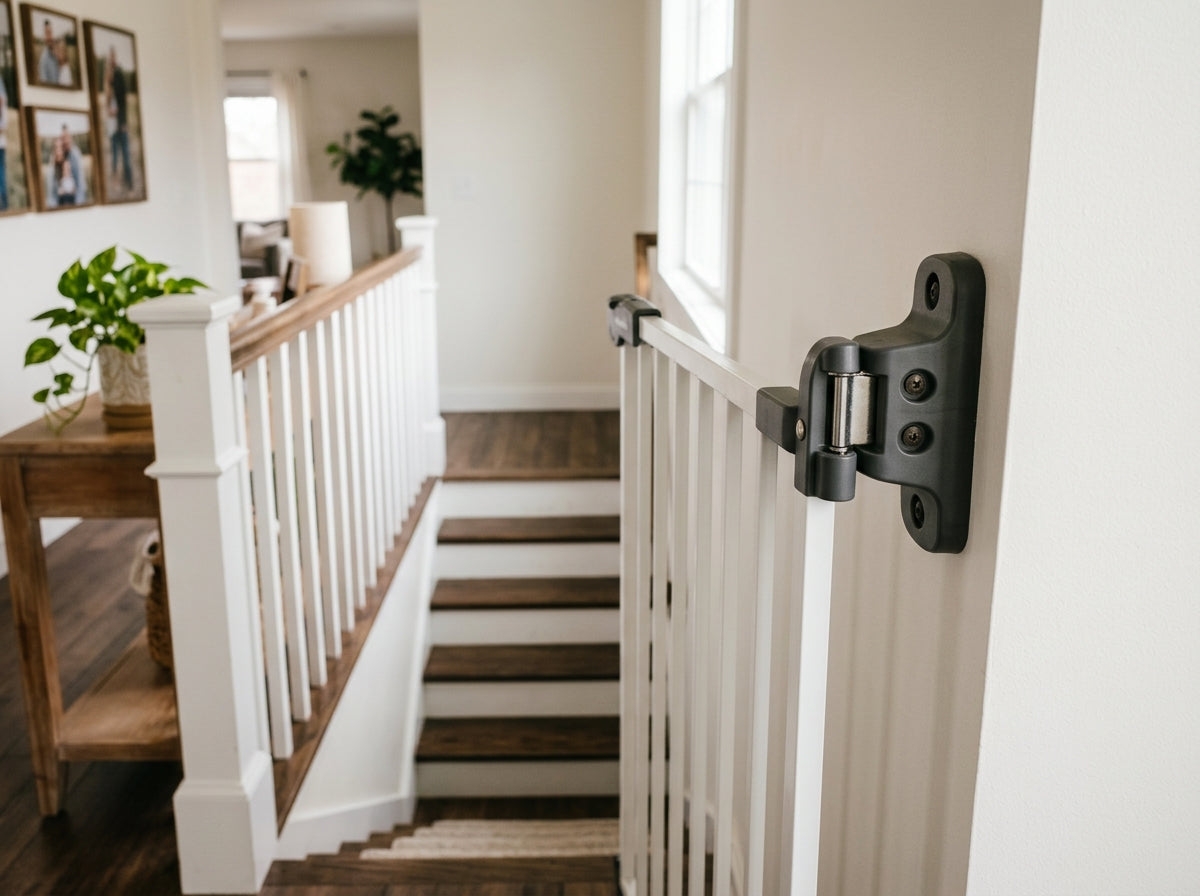
Hardware-mounted gates are the correct choice here. These attach with screws directly into the staircase structure, a wall, or a solid newel post. They don’t rely on friction. When my older daughter defeated an adhesive strap lock at 26 months, it reminded me that any product depending on surface adhesion or tension alone has a failure mode. Screws into wood or metal do not.
Look for gates that meet ASTM F1004, the federal safety standard for expansion gates and expandable enclosures, made mandatory under 16 CFR Part 1239 (effective 2021). This standard covers structural integrity, latch security, and load resistance. Check the packaging or product listing for explicit compliance language before you buy.
For curved or angled installations, some gate manufacturers offer angled mounting hardware or extensions that let you create a flat mounting surface on an otherwise curved post. Measure your newel post diameter and the angle of your wall or railing before ordering. Most manufacturers publish installation guides and have customer support lines worth using.
Position the gate at the top of the staircase. Children are far more likely to climb up and then lose their footing than to fall from the bottom. The gate should swing away from the stairwell opening, never into it. If the gate swings toward the stairs and a child pushes it open, they step forward into the drop. That design flaw has caused injuries.
Gating the Bottom Too
A gate at the top is your primary barrier. But if the bottom of your spiral staircase opens into a playroom, an open-plan kitchen, or any space where your child spends unsupervised time, you also need a gate at the bottom or a door that stays closed.
I’ve seen parents install a perfect top gate and then leave the bottom open because "they can’t reach the top anyway." Toddlers climb. They find ways. A bottom gate is a second layer of prevention, and on a spiral staircase where falls are more severe, layered prevention is the right approach.
Tread Safety and Slip Resistance
Spiral staircase treads are often finished wood, metal, or stone. They are frequently polished. They are almost always slippery in socked feet, which is exactly what toddlers wear.
Apply non-slip adhesive tape to each tread, focusing on the inner third of the step where small feet are most likely to land. Stair tread tape is inexpensive and available in clear or wood-tone finishes. Non-slip stair paint is an alternative if you’re refinishing the treads anyway.
Check the tape every few months. Edges lift with use, and a lifted edge becomes a trip hazard of its own. Replace sections as needed.
Railing and Edge Protection
Run your hand along your handrail. If it’s thin, ornamental wrought iron or a narrow wooden dowel, it may not give a small child enough to grip. Modern building codes specify railing diameter ranges that support a secure grip, but older spiral staircases often predate those requirements.
If the handrail is too thin or too smooth, consider wrapping it with foam grip tape or a rubberized sleeve. This improves grip and softens the surface if a child’s face or hand contacts it during a stumble.
The outer edges of spiral staircase steps are often sharp right angles. Furniture edge bumpers, the foam or rubber strips designed for coffee table corners, can be cut to length and applied to exposed tread edges. Make sure any bumper you use is firmly adhered and doesn’t create a loose piece that could become a choking hazard for a child under three.
Teaching Older Children to Use the Stairs Safely
Barriers are your first line of defense for children under two. For toddlers approaching three and older, supervised practice becomes part of the safety plan.
Walk the stairs with your child. Show them where to put their hands. Explain that the inner edge of each step is the safest place to put their feet. Practice going up and down slowly, holding the rail the entire time. Make the rule explicit: spiral stairs require a grownup, every time, until further notice.
This isn’t about frightening them. It’s about building competence. A child who has practiced the stairs with you and understands the rule is safer than one who has only ever been blocked from them and is therefore intensely curious about what’s up there.
Quarterly Spiral Staircase Safety Check
Regular Inspection
Spiral staircases move. Balusters loosen. Screws back out. Gate hardware shifts with seasonal wood expansion and contraction.
Check your gate mounting screws every three months. Wiggle each baluster by hand to confirm it’s tight. Re-examine your baluster gap measurements if the staircase is older, since wood shrinkage and settling can change gaps over time. Inspect tread tape for lifted edges. Confirm that your mesh or acrylic panels are still fully secured at every attachment point.
A gate that was solid in October may have loosened by March. Seasonal rechecks take ten minutes and catch problems before a child finds them first.
One More Thing About Access Points
Walk your entire home and identify every way a child could reach the base of the staircase. A spiral in the center of an open floor plan may be approachable from three or four directions. Each access point either needs a barrier or consistent supervision. Draw it out if it helps. The goal is no unmonitored path to the staircase, not just a gate on the stairs themselves.
Spiral staircases can be made safe. They require more hardware, more measurement, and more ongoing attention than a standard staircase. But the steps are the same: close the gaps, mount the gate securely, protect the treads, and check your work regularly.