How to Baby Proof a Staircase With Spindles Too Far Apart

The gap between a baluster and your child’s head is smaller than you think. Standard residential staircases built before modern safety guidelines were updated often have spindle spacing of 5, 6, even 7 inches. That’s wide enough for a toddler to push their head through and not wide enough to pull it back out.
If you’re standing at the bottom of your stairs wondering whether yours qualify as a hazard, here’s how to find out fast.
The 4-Inch Rule and How to Test Your Spindles
The reference point most child safety professionals use is a 4-inch sphere gauge, essentially a ball exactly 4 inches in diameter. If it passes through your spindle gaps, your staircase has a head-entrapment risk. This threshold comes from the same logic behind crib slat standards: CPSC rules under 16 CFR Part 1219 require crib slats to be no more than 2 3/8 inches (6 cm) apart to prevent head entrapment. Stair balusters aren’t regulated to the same spec, but the 4-inch standard is the widely accepted benchmark for residential safety.
You don’t need to order a gauge. A standard tennis ball measures about 2.5 inches. A baseball is about 2.9 inches. A 4-inch ball is roughly the size of a large orange. If a citrus fruit slides through your spindles, you have work to do.
In my experience, a child can discover these gaps quickly. My older daughter was 26 months when she figured out that the gap between our dining room balusters was just wide enough to get her head into. She didn’t get stuck, but watching her try was enough. We measured that evening. The gap was 5.25 inches.
Why a Gate Alone Doesn’t Solve This
A stair gate is necessary. It’s not sufficient.
Gates block vertical access, meaning they keep a child from climbing up or tumbling down. But a closed gate does nothing about a child who reaches through, pushes an arm or leg through, or presses their face against the spindles from a landing. If your spindles are too far apart, the hazard exists on every inch of railing your child can reach, not just at the top and bottom.
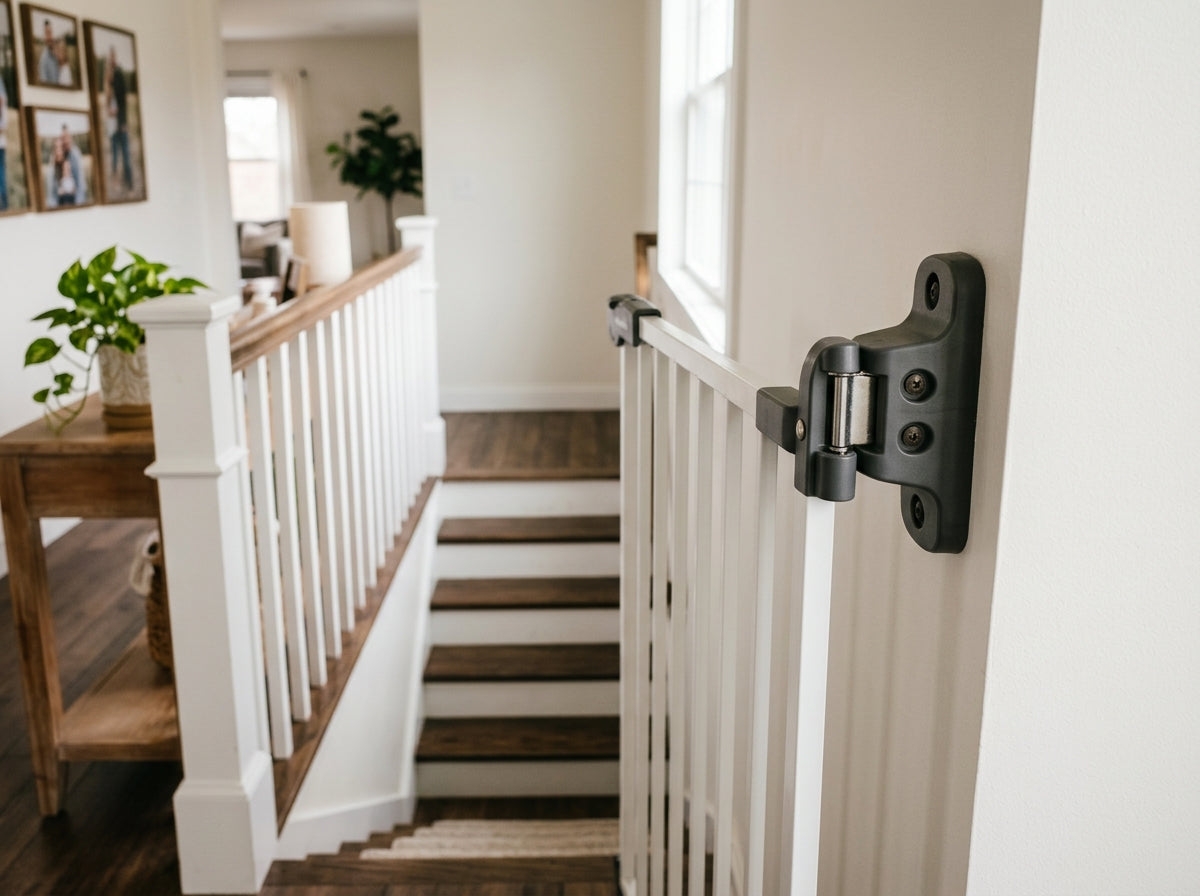
Gates should meet ASTM F1004, the federal safety standard for expansion gates and expandable enclosures, made mandatory under 16 CFR Part 1239 effective 2021. At the top of the stairs specifically, you need a hardware-mounted gate with a rigid frame. Pressure-mounted gates can be pushed out by a determined toddler and should never be used at the top of a flight. But again: the gate addresses access to the staircase. The spindle gaps are a separate problem that requires a separate solution.


Option 1: Acrylic or Polycarbonate Spindle Guards
These are the most popular non-permanent fix. Clear plastic panels wrap or clip around each individual baluster, reducing the visible gap between spindles without touching the original woodwork. Most are designed to slide on from the top or screw lightly into the spindle itself.
Pricing typically runs $15–40 per spindle depending on brand and height. For a standard staircase with 12–16 balusters, you’re looking at $180–640 for full coverage. Not cheap, but reversible. When you’re done needing them, they come off cleanly.
The tradeoff is installation time. Each guard has to be fitted individually, and if your balusters are turned (meaning they have a decorative profile rather than a flat face), some guards won’t sit flush. Measure your spindle width before ordering. In my experience, guards designed for square profiles tend to wobble on round balusters, which can reopen a gap if a child pushes on them. Verify the fit is snug before you consider the job done.
Option 2: Mesh or Fabric Safety Netting
Mesh netting stretched across the full staircase opening creates a continuous barrier rather than addressing each spindle individually. It’s faster to install on wide or complex railings, and it works on both sides of an open staircase.
Most products use a combination of anchor hooks and adhesive strips. The adhesive attachment points are the weak link. On painted drywall or textured surfaces, they can fail over time, especially in high-humidity areas. Hooks drilled into the railing or wall are more reliable. Whatever you use, the netting needs to be taut. A loose net is worse than no net because it creates a pocket a child can get tangled in.
Test the installation by pressing firmly on the center of the net with both hands. If it deflects more than a couple of inches or any anchor point pulls, redo the attachment before considering it safe.
Option 3: Retrofit Spindles or Wooden Dowels
If you own your home and you’re comfortable with a more permanent modification, inserting additional spindles or wooden dowels between existing balusters eliminates the gap entirely. This requires drilling into the top rail and the base shoe, and it should bring your spacing below 4 inches across the full run.
This is the most structurally sound option. It also affects the look of your staircase permanently, which matters if you have original woodwork or plan to sell. Before you drill, check your local building codes. Some jurisdictions have specific requirements for baluster spacing and materials, and a contractor or staircase specialist can tell you whether your railing system can accept additional spindles without compromising the structural integrity of the rail.
| Solution | Permanent | Avg. Cost | Best For |
|---|---|---|---|
| Acrylic guards | No | $180–640 | Renters, turned balusters |
| Mesh netting | No | $40–120 | Wide or open railings |
| Retrofit spindles | Yes | Varies | Homeowners, long-term fix |
Landings, Turns, and the Gaps Nobody Thinks About
A straight staircase is the easy case. If yours has a landing or a 90-degree turn, you have additional exposure points where the railing meets a wall, where two sections of railing join, or where a barrier ends before the opening does.
Walk the full perimeter of your staircase at toddler height. Get low. Look for any gap wider than 4 inches, including the space between the bottom of the railing and the floor on a landing, and the gap between any installed barrier and the wall or newel post at its edges. A barrier that covers 90% of the opening and leaves a 6-inch gap at one end has not solved the problem.
Foam Edge Guards: Useful, But Not a Spindle Fix
Soft foam corner guards and edge bumpers on newel posts and railings reduce injury from impact during a fall or collision. They’re worth installing. But they do not address spindle spacing and should not be treated as a substitute for spindle guards or netting. They serve a different function entirely.
Temporary Fixes and Their Limits
If you’re waiting on a product to arrive or planning a contractor visit, tension rods with fabric panels stretched between them can close a spindle gap temporarily. So can cardboard zip-tied to the railing. These are stopgap measures. They are not reliable under sustained pressure from a toddler who has decided to test them, and they can fail without warning. Use them only for a day or two while you get a real solution in place.
Staircase Safety Checklist
Ongoing Inspection Matters
My younger daughter once pulled the corner of a mesh panel loose from its adhesive anchor within two weeks of installation. I only caught it during a routine check. Removable solutions shift. Adhesive degrades. Hardware loosens.
Check every spindle guard, gate, and net at least once a month. Run your hand along the full length of the barrier and press on it firmly. Look for any point where the gap has widened, any anchor that has pulled, any guard that has slid. About 93,000 children under 5 are treated in U.S. emergency rooms each year for stair-related injuries, per a Nationwide Children’s Hospital analysis of CPSC NEISS data. Most of those injuries are falls, but the railing is part of the same environment. Keeping the whole system maintained is how you stay ahead of it.
When to Call a Professional
If you’re unsure whether your railing can support retrofit spindles, if your staircase has an unusual configuration, or if you’re renting and need a reversible solution that won’t violate your lease, a contractor or staircase specialist can assess your specific situation. Some also install spindle guards and netting as a service, which is worth considering if your staircase is large or complex.
The goal is simple: no gap wider than 4 inches, a hardware-mounted gate at the top and a gate at the bottom, and a monthly check to make sure nothing has shifted. That combination covers the hazard.