

A wood stove is one of the most beautiful hazards in a home. The radiant heat, the crackling fire, the cast iron glowing orange at the seams. And then your toddler walks over and reaches out a hand.
Burns from wood stoves and fireplace hearths are among the most serious contact injuries young children sustain at home. The surfaces stay dangerously hot long after the fire dies down, and toddlers have no instinct for that. My older daughter learned the concept of "hot" from a coffee cup. She had no framework for a stove that looked cold but wasn’t. That gap between what a child understands and what a surface can do is exactly what this guide is designed to close.
Why Wood Stoves Are a Different Problem Than Fireplaces
Most baby-proofing content treats fireplaces and wood stoves as the same hazard. They’re not. A fireplace sits behind a fixed surround, usually recessed into the wall, with a hearth that extends outward at floor level. A wood stove sits in open space, radiates heat from all four sides, and often has a flue pipe running up through the room. The entire unit, including the door, the side panels, and the flue collar, can reach temperatures well above 400°F (204°C) during a normal burn.
The hearth pad beneath the stove is a secondary concern. It’s hard, often raised, and creates a fall and impact hazard even when the stove is cold. You’re solving two problems at once: contact burns and blunt trauma from falls onto a stone or tile surface.
The Two-Layer Defense
Effective wood stove baby-proofing works in two layers. The first is a hearth gate, a freestanding or wall-mounted barrier that keeps children physically away from the stove and its surround. The second is a heat shield, a panel or surround installed directly on or near the stove to reduce the surface temperature children might contact if they breach the first layer.
Neither layer is optional. A gate alone fails when a child pushes through, climbs over, or the gate gets left open. A heat shield alone does nothing to stop a toddler from walking up and touching it. Together, they create a redundancy that holds up in daily life.


Choosing a Hearth Gate
The gate is your primary barrier. For wood stoves, you need a freestanding enclosure, not a pressure-mounted expansion gate. Pressure-mounted gates are designed for doorways and hallways. They are not rated for the forces a determined two-year-old applies when they want to get to something interesting.
ASTM F1004 is the safety standard for expansion gates and expandable enclosures. Any gate you buy should carry this certification. Look for it on the packaging or product listing. If it isn’t listed, move on.
For wood stoves specifically, look for:
- All-metal construction. Plastic components near a wood stove will degrade. The heat radiation alone, even several feet away, is enough to warp cheap plastic over a season.
- A configurable panel system. Wood stoves sit in different configurations. Some are centered on a hearth pad, some are in corners, some are freestanding in the middle of a room. You need a gate that can wrap the stove and its clearance zone, not just span a doorway.
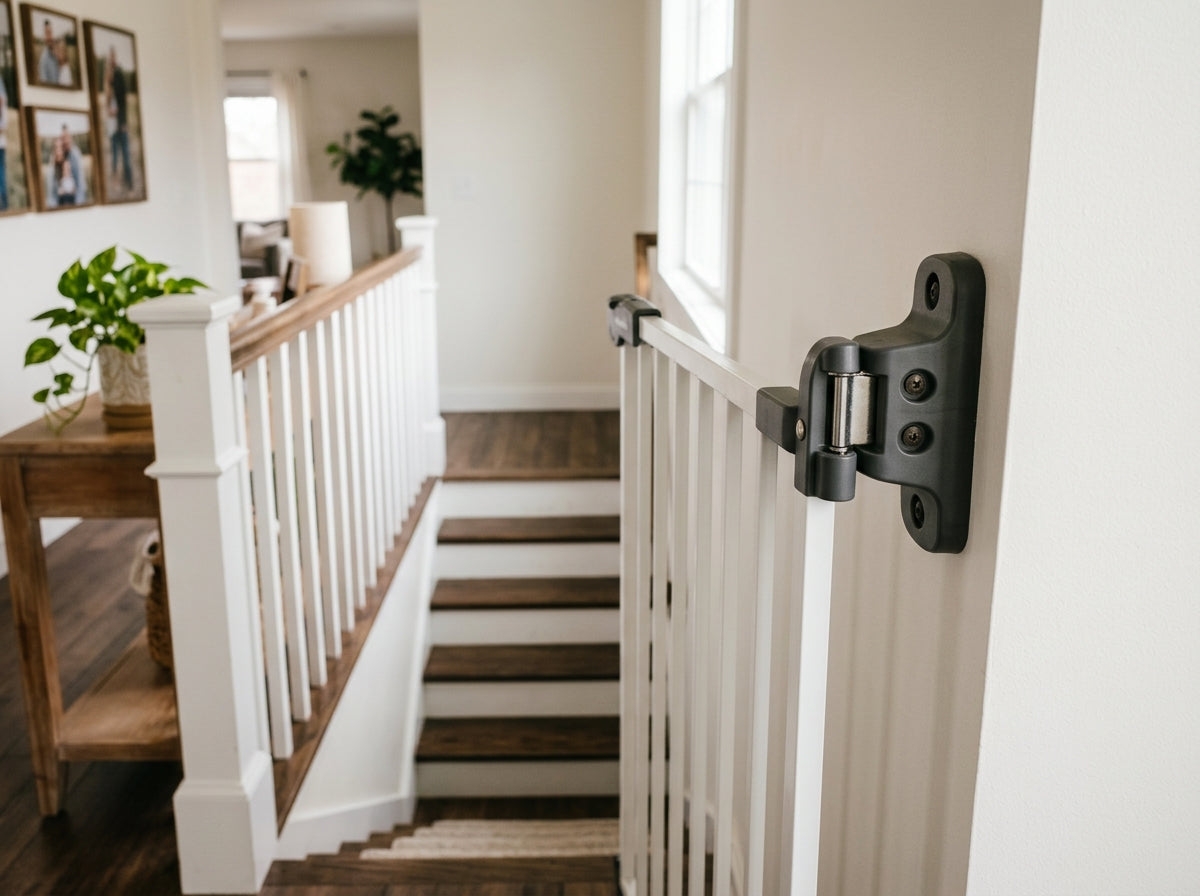
- A self-closing, self-latching door. This is the feature most parents skip and most regret. You will open that gate dozens of times a day to tend the fire. A gate that latches itself every time is the only kind that reliably stays closed.
- A footprint that extends beyond the stove clearance zone. Most wood stoves require 18–36 inches of clearance on the sides and front. Your gate should encompass that zone, not just the stove itself.
In my experience, measuring the full clearance zone and adding another 12 inches on the front is essential. A toddler can reach through a standard gate panel gap to touch the flue pipe. Reach distance matters as much as gate height.

- Stove body: all sides exceed 400°F
- Flue pipe: hottest reachable surface
- Stove door: direct contact burn risk
- Raised hearth edge: fall and impact hazard
What to Look for in a Heat Shield
A heat shield is a panel, usually steel or another metal, that mounts near the stove’s exterior surfaces to create an air gap. That air gap significantly reduces the radiant and conductive temperature on the outer face of the shield. A properly installed heat shield can bring surface temperatures down to a range that causes discomfort rather than immediate third-degree burns, though no heat shield makes a wood stove safe to touch during operation.
Some wood stoves come with built-in convection panels or leg clearance systems that function as partial heat shields. Check your stove’s manual. If your stove already has factory heat shielding, you may need less supplemental protection. If it doesn’t, aftermarket steel panels are available and can be mounted to wall surfaces or stove legs with appropriate standoffs.
Key considerations:
- Air gap is everything. A heat shield mounted flush against the stove does almost nothing. The gap between the shield and the stove surface is what allows convection to carry heat away. Most installations use 1-inch standoffs at minimum.
- Cover the flue pipe. The flue pipe running from the stove collar up through the ceiling is often the hottest accessible surface in the room, and it’s at exactly the height a standing toddler can reach. A flue pipe guard or wrap rated for high-temperature use should cover any section within reach.
- Don’t use combustible materials. This seems obvious, but aftermarket "heat shields" made of decorative materials are sold online. If it isn’t rated for high-temperature proximity to a solid-fuel appliance, it doesn’t belong near your wood stove.
-
Measure the clearance zone
Mark the full stove clearance zone (18–36 inches on sides and front), then add 12 inches to the front measurement. -
Lay out the panels
Arrange gate panels around the full clearance zone. Confirm the self-latching door is positioned for easy adult access. -
Mark and drill anchor points
Mark wall anchor points, drill into studs where possible, and use toggle bolts elsewhere. -
Assemble and anchor
Attach panels to wall anchors. Test stability by applying firm lateral pressure at the top of the gate. -
Test the latch
Open and close the gate door 10 times. Confirm it self-closes and latches fully every time without manual assistance.
Installing the Gate Correctly
A freestanding enclosure for a wood stove should be anchored. Most panel-style hearth gates include wall anchor points for exactly this reason. Use them.
The installation sequence that worked for me: lay out the panels around the full clearance zone, mark the anchor points on the wall, drill into studs where possible, and use toggle bolts where you can’t hit a stud. Then assemble the panels to the anchors. A gate that can be pushed over by a 30-pound child is not doing its job.
Check the gate height against your child’s current climbing ability, and then check it again in three months. Toddlers improve fast. A gate that was unclearable at 18 months may be a step stool at 24. Many parents add a second horizontal bar or switch to a taller enclosure as their child grows.
One thing I learned the hard way: leave enough clearance inside the gate for you to operate the stove safely. You need room to open the door, add wood, and manage the ash without contorting yourself. A gate that’s too tight to the stove creates a burn risk for the adult tending it.


Hearth Pad Hazards and Edge Protection
The hearth pad extends the hazard zone past the stove itself. Stone, slate, and tile hearth pads are unforgiving surfaces. A toddler who trips near the gate and falls toward the hearth edge can sustain a serious head or face injury even when the stove is cold.
Foam hearth pad covers are available and work well for the cold-stove season. During burn season, they’re not appropriate near the stove itself, but they can cover the outer edges of a large hearth pad that extends beyond the gate footprint. Edge bumpers rated for corner and edge protection can soften the perimeter of a raised hearth, though they are not a substitute for gate containment.
Wood Stove Safety Checklist
Ongoing Habits That Matter
Hardware is only part of the answer. The habits around the stove matter just as much.
Never leave the gate door open unattended. It takes seconds. In my experience, a child can move from across the room to the hearth in seconds. A closed gate is the only safeguard in that moment.
Teach the word "hot" early and consistently. Point to the stove, say it, and mean it every single time. Children this age learn through repetition, not explanation. You’re building a reflex, not conveying information.
Check the gate hardware monthly during burn season. Repeated heating and cooling cycles expand and contract metal. Fasteners loosen. A gate that was solid in October may have some play by January. Tighten everything before each season starts and spot-check monthly.
Keep a CO detector within 10 feet of the stove and test it monthly. According to the CDC, CO poisoning kills more than 400 people each year and sends more than 100,000 to U.S. emergency rooms. Wood stoves are a significant source when they’re not drawing properly, and children are more vulnerable to CO exposure than adults.
When to Reassess
The setup that works for a 14-month-old will not work for a 3-year-old. Reassess your barrier system every six months. Look at gate height, latch complexity, and whether your child has figured out the mechanism. Some parents move to a keyed or combination latch as their child gets older. Others find that consistent teaching has made the gate more of a reminder than a barrier by age four.
The goal is to make the safe behavior automatic before you remove the hardware. That transition point is different for every child. When your child can reliably tell you why the stove is dangerous and has demonstrated that understanding over months, not days, you can start scaling back. Until then, keep the gate latched and the heat shield in place.