
How to Childproof a Liquor Cabinet, Bar Cart or Wine Rack
Where alcohol belongs in a home with a baby or toddler: a locked cabinet, plus what to do with a bar cart or wine rack that has no door.

To childproof a liquor cabinet, the AAP says to keep all alcoholic beverages in a locked cabinet and to empty any unfinished drinks right away. So to child proof a liquor cabinet, you add a lock. A bar cart or open wine rack has no door to lock, so its bottles move into a cabinet that does.
The rest is detail: which lock suits which door, where the hidden alcohol is, and what to do if something goes wrong.
The AAP Baseline: Locked Cabinet, Empty Glasses
The AAP’s Home Safety page gives two instructions. Keep all alcoholic beverages in a locked cabinet, and empty any unfinished drinks immediately. It adds that alcohol can be very toxic to a young child.
The National Capital Poison Center (poison.org) gives the same two prevention lines. Lock up your alcoholic beverages, and empty beer cans, wine glasses and drinks glasses before children can get to them. Its alcohol article also says children commonly have access to alcohol. It names two routes: drinks left out after an adult gathering, and bottles with loosened caps within a child’s reach.
The scale of poison exposures explains the urgency. According to the AAP, about 3 million people are exposed to a poisonous substance every year, and many are children under 5.
Picture this: the last guests leave at 11 p.m., and you decide the glasses can wait until morning. By 6 a.m. a toddler who wakes early has the whole coffee table at eye level. The baseline exists for that gap between the party and the cleanup.
How to Childproof a Liquor Cabinet With a Lock
A liquor cabinet is the easy case, because the door already exists. You are adding a liquor cabinet lock to a door that already closes. To baby proof a liquor cabinet, start by checking what the door is made of and how it hangs.
CPSC’s guidance for cabinets and drawers is safety latches and locks. It says they can help keep children from medicines, laundry detergent, household cleaners, matches, lighters and knives. It asks for locks that adults can easily install and use, and that are sturdy enough to withstand pulls and tugs from children.
Those two tests are practical. A lock that frustrates you will end up left undone. A lock that flexes under a determined tug will not hold up against a toddler.
For interior-mounted cabinet latches, the relevant standard is ASTM F3492-21, published in 2021. It is voluntary, not a federal regulation. Check the packaging for it, and remember that a standard describes the lock, not your particular door.
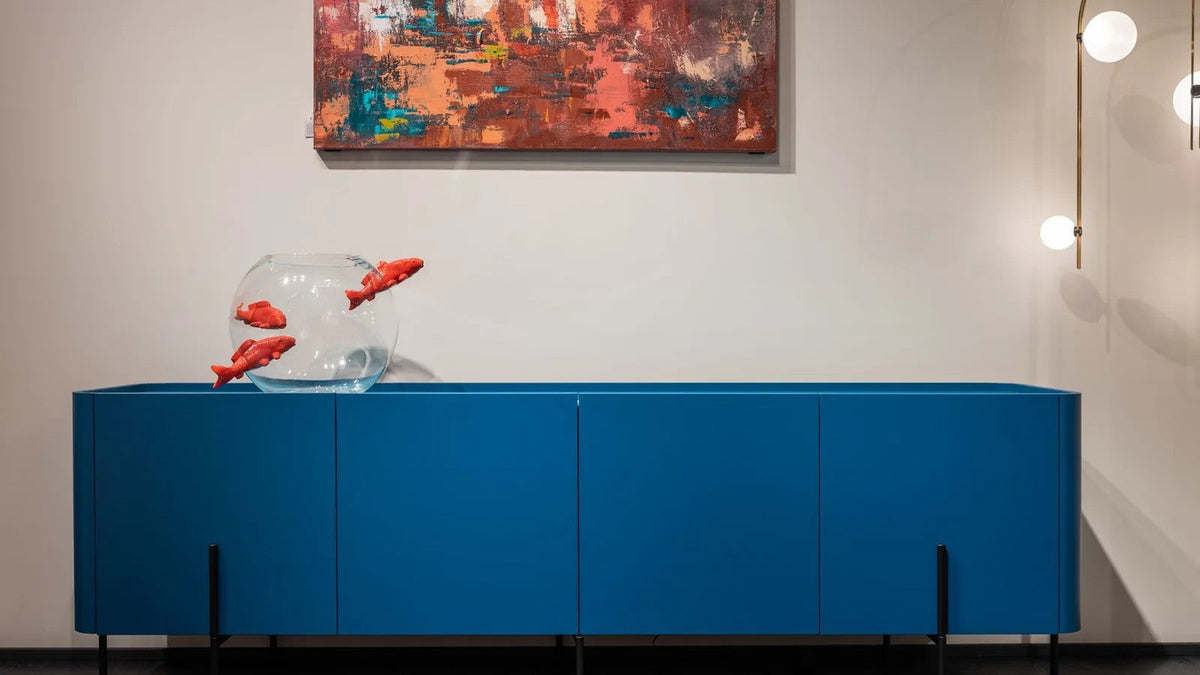
Furniture-grade doors, like the wood or veneer doors on a sideboard or bar cabinet, call for a lock that mounts cleanly. It should not wreck the finish. Locks come in several types, and each mounts differently depending on door style. Look at how the cabinet closes before you buy.
To child proof bar cabinet doors, treat every door the same. If a freestanding bar has two doors and a drawer, all three need a latch.


How to Baby Proof a Bar Cart
A cart is open furniture. Bottles sit on shelves or trays, and a crawling or cruising baby can reach the lower tier. There is nothing to lock.
Move the bottles into a cabinet that locks. The AAP’s advice is a locked cabinet. A cart cannot be one. CPSC adds that even packaged products with child-resistant packaging should be locked away and kept out of reach, so a screw cap is not a substitute.
What stays on the cart is up to you. You can keep it as an empty serving piece, with glasses and napkins only, and bring the bottles out for an evening. Return them to the locked cabinet before bed, and empty every glass.
Picture this: the cart rolls easily, and a toddler pulling up on the edge discovers the wheels. Even if the bottles are high, a cart can tip or travel. That is another reason to keep bottles off it.
If your only closed storage is a corner cabinet with a lazy susan, it needs its own lock approach. The turntable and the door work differently from a flat shelf.
How to Baby Proof a Wine Rack
A wine rack follows the same rule. Whether it is a countertop lattice, a floor stand or a wall grid, the bottles are in the open, and no lock fits the rack. The bottles come off it.
Wine bottles are heavy and breakable, and a toddler can pull one from a low slot. Move them into a cabinet that locks, and keep the cabinet shut. If the rack is decorative, leave it empty or fill it with something that is not alcohol.
If the new home for the bottles is a built-in cabinet with glass or paneled doors, the door style affects which lock fits. Check how the door is built before you pick hardware.
Opened bottles deserve extra care. The National Capital Poison Center names bottles with loosened caps within a child’s reach as one route to unintentional exposure. Tighten caps, and put opened bottles in the locked cabinet along with the sealed ones.
Alcohol Outside the Bar: Mouthwash, Sanitizer and Leftover Drinks
Alcohol is in more places than the liquor cabinet. The National Capital Poison Center says mouthwash and hand sanitizer are common sources of alcohol poisoning in young children. It advises storing hand sanitizer, mouthwash and other alcohol-containing products out of sight and reach. It also advises reading product labels to see whether they contain alcohol.
Do the label check room by room. Go through the bathroom counter, the diaper bag, the car console and the purse by the door. Anything with alcohol on the label goes up high or into a closed cabinet.
The other hidden source is the party leftover. Cups on end tables, a half-finished beer on the porch rail and a wine glass on the arm of the sofa all count. The routine is simple: after guests go home, walk the house with a tray and empty everything before you go to bed.
Picture this: you wipe the counter and leave the sanitizer pump on the edge, because you will use it again in the morning. A toddler at counter height reaches it first. Apply the same cabinet-by-cabinet thinking to the vanity and kitchen.
Locks matter because these exposures are accidental. According to America’s Poison Centers, in 2024, 99.2% of poison center cases involving children under 6 were accidental.
Hidden Alcohol Sweep
A Lock Is a Layer: Recall Lessons and Supervision
A lock adds a layer of protection. CPSC says no device is fully childproof, and that determined toddlers have been known to overcome or disable them.
The recall history shows how that happens. CPSC recalled 900,000 Safety 1st Push 'N Snap cabinet locks in March 2012 after 140 children defeated them. In three of the reported incidents, children who got into the cabinet swallowed or handled cleaning products such as dishwashing detergent. The recall notice says young children could disengage the locks and reach the cabinet’s contents.
The lesson is to test the one you fit. After you install a lock, close the door and try it yourself, pulling and tugging the way a toddler would. Check it again every few weeks, since doors loosen and adhesive ages.
Supervision still matters most. Keep the cabinet shut and locked every time, including after a party. Keep the key where a child cannot reach it, since a key left on a counter or hook defeats the lock.
If a Child Swallows Alcohol or Another Product
If a child swallows alcohol or any other product, call Poison Help at 1-800-222-1222 (America’s Poison Centers). The National Capital Poison Center describes the line as free, confidential and available 24 hours a day. Call 911 if the child is not breathing, is seizing or is unresponsive.
Save the number in your phone and post it on the fridge, where a babysitter or grandparent will see it. Do not wait to see how a child looks before you call.
Baby Proof Me Magnetic Safety Lock Kit: Product Note
The Baby Proof Me Magnetic Safety Lock Kit is one option for the cabinet doors and drawers. Its product page describes a kit of 12 locks and 3 keys, with larger and smaller kit sizes also listed. The page says it is made to look clean and minimal and describes the lock as invisible. It also says it fits most furniture and suits cabinets and pull-out drawers. Magnetic locks suit some cabinet types better than others, so check your door before you rely on one.
Mounting is a choice between two methods. The product page says you can secure the locks with the strong 3M adhesives or screw them in. It says to allow 24 hours for the adhesive to fully bond onto the surface for best results. The listed extras are an installation cradle, 6 alcohol pads, 12 clear positioning stickers, 24 screws and a ruler.
The product page states that the magnets are 3,100 Gauss (neodymium) with a 2 inch reach.
The same page warns that the kit is not a toy and is not a substitute for adult supervision. It says to stop using it immediately if it becomes faulty. Keep the keys up high, and keep any loose magnets out of reach too. CPSC’s magnet guidance is to keep small magnets away from children, because magnets go in easier than they come out.
If a child may have swallowed a magnet, CPSC says to seek immediate medical attention. Call 911 or Poison Help at 1-800-222-1222.