
Is a Baby Gate Really Necessary for Stairs?

About 93,000 children under 5 are treated in U.S. emergency rooms each year for stair-related injuries, according to a Nationwide Children’s Hospital analysis of CPSC NEISS data. That works out to roughly one child every six minutes. If you’re standing at the top of your stairs right now, wondering whether a gate is worth the installation effort, that number is your answer.
But the real question parents ask isn’t whether gates work. It’s: which kind, where exactly, and for how long? Those details matter more than the gate itself.
The Risk Window Is Narrower Than You Think
The highest-danger period for stair falls runs from about 6 months through age 3. That’s when mobility accelerates but judgment hasn’t caught up. A baby who learned to crawl last Tuesday has no concept of depth or consequence. A 14-month-old who walks confidently on flat ground will step off a stair landing without hesitation.
The AAP recommends gates at both the top and bottom of every staircase in homes with children under 3. Not one gate. Two, per staircase. The top gate is the critical one, because a fall from the top is a fall down the entire flight. The bottom gate is secondary, but it stops a child from beginning the climb unsupervised in the first place.
My older daughter figured out the bottom gate latch at around 22 months. She hadn’t figured out the stairs themselves yet, not really, but she had definitely figured out the latch. The bottom gate bought me maybe three more weeks of reliable containment before I had to rethink the whole setup. The top gate stayed in place until she was nearly 3.
Hardware-Mount at the Top, No Exceptions
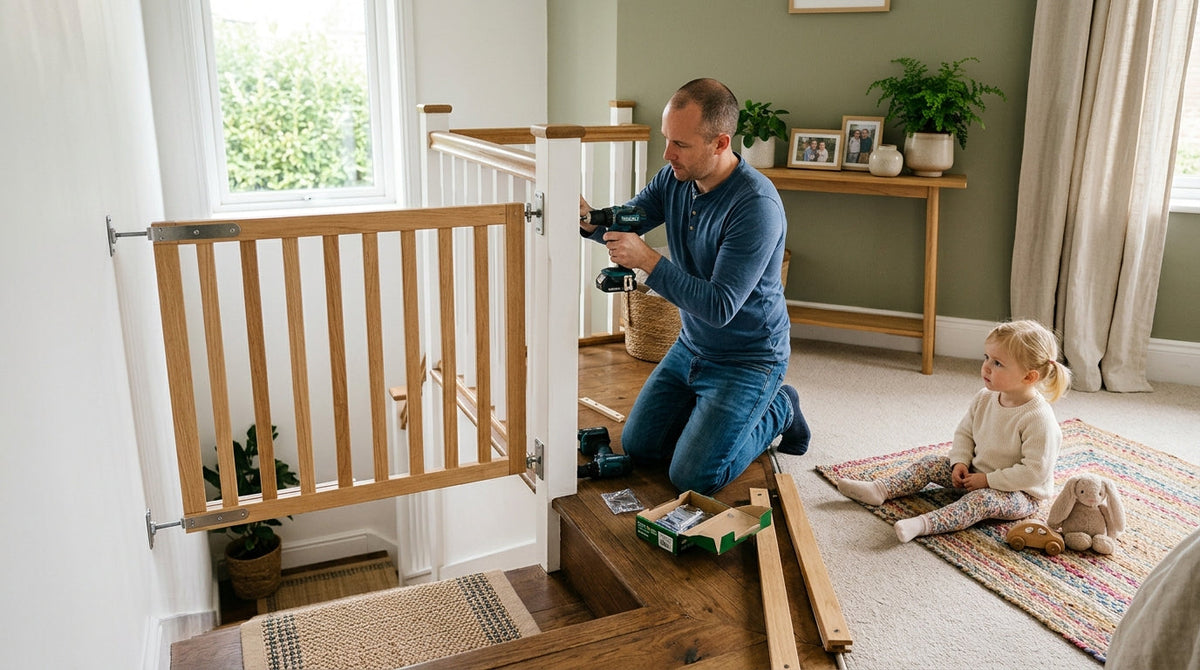
This is the single rule that matters most for stair safety, and it gets ignored constantly. Pressure-mounted gates work by wedging against two walls using tension. They’re convenient. They leave no holes. And they should never, ever be installed at the top of a staircase.
A child who falls against a pressure-mounted gate at the top of the stairs can push it out of position. The gate goes. The child goes with it. Hardware-mounted gates are bolted directly into wall studs or a banister mounting kit, and they do not move under a child’s weight or impact.
At the bottom of the stairs, pressure-mounted gates are generally acceptable. If a child pushes through a bottom gate, they fall onto the first step or the floor, not down a full flight. That’s still a fall worth preventing, but the consequence of gate failure is categorically different. Hardware mounting at the bottom adds security, but it isn’t the same non-negotiable it is at the top.
If your staircase has a banister rather than a wall on one or both sides, buy a banister-to-banister mounting kit designed for your gate model. Don’t improvise. The kit distributes force correctly. A gate screwed directly into a spindle without a proper mounting plate can pull the spindle loose under load.


What ASTM F1004 Requires
When you’re shopping, look for gates that comply with ASTM F1004, the federal safety standard for expansion gates and expandable enclosures, made mandatory under 16 CFR Part 1239 (effective 2021). This standard covers hinge strength, latch durability, and the spacing between vertical bars.
Bar spacing is the detail most parents overlook. The concern is head entrapment. CPSC’s crib standard under 16 CFR Part 1219 sets maximum slat spacing at 2 3/8 inches (6 cm), and that same threshold is the reference point for evaluating gate bar spacing. A child’s head can fit through gaps that look small to an adult eye. Once the head is through, the shoulders often can’t follow, and a panicking child can compress their airway against the bar.
Rigid or semi-rigid gates with uniform, small bar spacing pass this test. Accordion-style gates with large diamond-shaped openings do not. Those older accordion gates are still floating around on secondhand marketplaces. Don’t buy them. The diamond openings are large enough to trap a child’s neck, and the geometry of the opening gets worse as the child pushes against it.
Stair Safety by Age
Install gates now
Crawling begins. No depth perception. Gates at top and bottom of every staircase are essential.
Peak fall risk
Walking confidently on flat ground but will step off stairs without hesitation. Hardware mount at top is non-negotiable.
Latch awareness begins
Many toddlers start testing gate latches. Reassess latch complexity and check gate hardware for wear.
Begin supervised stair practice
Teach railing use and one-step-at-a-time technique. Keep gate as backup while building skill.
Gate removal window
Remove only when child navigates stairs reliably in both directions, including when tired or distracted.
Gates Wear Out. Check Them.
I installed a hardware-mounted gate at the top of our stairs when my younger daughter started pulling to stand. By the time she was 18 months old, I noticed the latch had developed a slight wobble from being opened and closed dozens of times a day. The hinge screws had backed out slightly from the repeated loading.
This is normal. It’s also fixable in five minutes with a screwdriver. But it requires checking.
Every month or two, test your gate by applying firm pressure to the latch side while it’s closed. Wiggle the hinges. Look at the mounting hardware and confirm the screws are seated flush. A gate that passed inspection at installation can develop real structural weakness over months of daily use. Bent bars, loose hinges, and fatigued latches are all reasons to replace a gate before it fails under load.
The Age-3 Transition
Around age 2 to 3, most children develop the physical ability to climb over a standard-height gate or manipulate the latch. When that happens, the gate stops being a reliable barrier and starts being a speed bump. A speed bump is still worth having, but it changes what you’re relying on.
This is also the window when stair skill-building becomes important. By age 2 to 3, children should be learning to navigate stairs with supervision: holding the railing, taking one step at a time, going down facing forward. Teaching these skills doesn’t mean removing the gate prematurely. It means using the gate as a backup while you build the skill, not as a permanent substitute for it.
My older daughter and I practiced the stairs together starting around 26 months. We went up and down holding the railing, slowly, repeatedly, until it was automatic. The gate stayed up until she was reliably doing it right on her own. The goal was always to make the gate unnecessary, not to keep her dependent on it indefinitely.
Frequently Asked Questions
Do I really need gates at both the top and bottom of the stairs?
What is the difference between a hardware-mounted and a pressure-mounted gate?
Can I use a pressure-mounted gate at the bottom of the stairs?
What safety standard should I look for when buying a gate?
Are accordion-style gates safe for stairs?
How often should I check my gate for wear?
When is it safe to remove the stair gate?
What other staircase hazards should I address beyond the gate?
The Staircase Itself May Have Problems a Gate Can’t Fix
A gate at the top of the stairs doesn’t help if the railing spindles are spaced more than 4 inches apart. A child can fit their head through a 4-inch gap, and a railing with wider spacing is a structural hazard that no gate addresses. If your home has older railings with wide spindle spacing, that’s a separate repair, and it needs to happen regardless of what gate you install.
Lighting matters too. A stairwell that’s dark at night is dangerous for adults and children both. Non-slip treads reduce the risk of a foot sliding off the edge of a step. Keeping the stairwell clear of toys, bags, and clutter is basic but often overlooked. A gate is one layer of protection. The staircase environment is another.
If your home has multiple staircases or an open-concept layout with more than one stair access point, assess each one individually. A gate on the main staircase doesn’t protect a child from the basement stairs around the corner. Each staircase is its own hazard.
Monthly Gate Inspection Checklist
When You Can Remove the Gate
There’s no universal age. The right time to remove a stair gate is when your child consistently navigates the stairs safely, in both directions, including when tired or distracted, and when they no longer attempt to climb or rush. For most children, that’s somewhere between 3 and 4 years old. For some it’s earlier. For some it’s later.
Don’t remove the gate because it’s inconvenient. Remove it because your child has outgrown the need. Until then, the gate, the supervision, the stair skills practice, and the well-lit, clutter-free stairwell work together. None of them alone is enough.