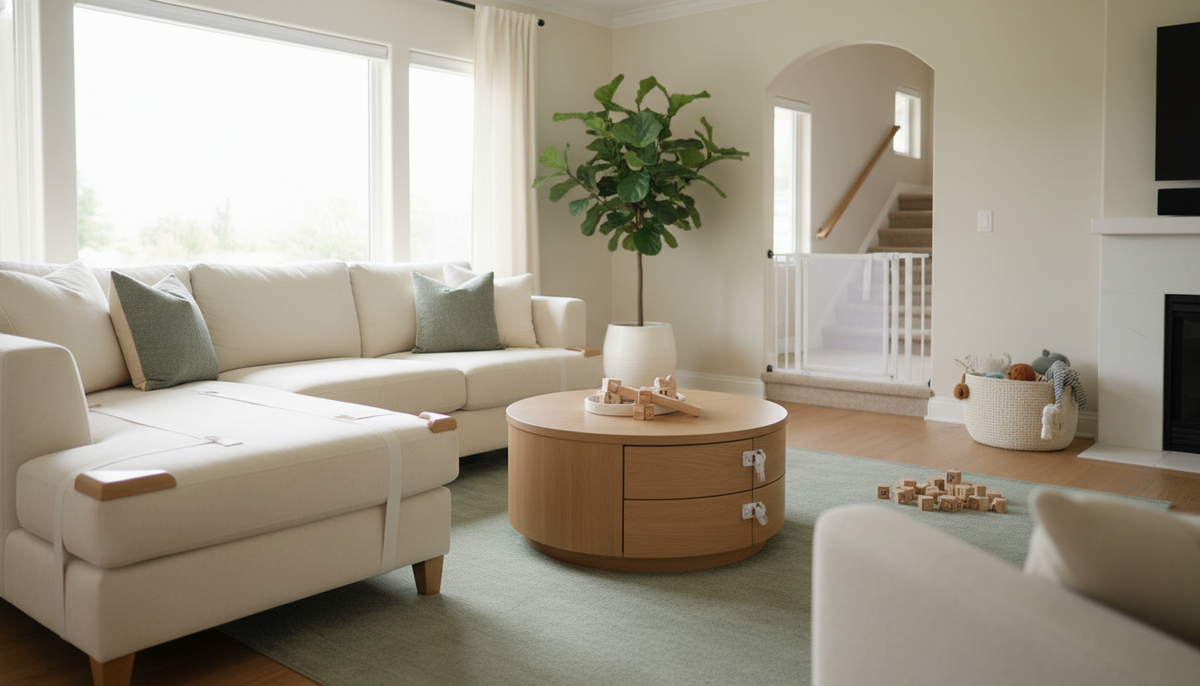

Every cabinet lock I’ve ever installed has been visible. The little plastic latches, the spring-loaded arms, the adhesive straps running across drawer fronts. They work, mostly. But they also telegraph exactly where the interesting stuff is, and any toddler worth their salt will spend the next six months figuring out the mechanism. My older daughter defeated an adhesive strap lock at 26 months. She didn’t pry it off. She figured out the angle.
Magnetic locks solve a different problem than most cabinet hardware does. They don’t just block access. They disappear.
How Magnetic Cabinet Locks Work
The mechanism is straightforward, which is part of why it’s reliable. A locking arm or catch mounts inside the cabinet, hidden from view. A small magnet embedded in the cabinet door or drawer front holds the latch closed. To open it, you hold a separate magnetic key against the outside of the cabinet, in the right spot, and the internal catch releases.
No visible hardware on the exterior. No latch to fiddle with. No lever a determined three-year-old can study and reverse-engineer.
The internal components are typically screwed into the cabinet frame or drawer box, not adhered, which matters for longevity. Most systems use rare-earth (neodymium) magnets in the key, strong enough to work through standard cabinet door thicknesses of roughly 3/4 inch, though thicker doors or doors with metal reinforcement can interfere with the signal.
There are two main configurations. Some systems use a single latch per cabinet with one universal key that works across the whole set. Others pair individual keys to individual locks. For most households, the universal-key system is more practical. You keep one key on the refrigerator or a high shelf, and it opens every cabinet in the kitchen.
Why Invisible Matters
The visible latch problem is real. Traditional spring latches and adhesive straps create a visual map of what’s worth investigating. Children are pattern-recognition machines. When every cabinet that contains cleaning products or sharp objects has a white plastic arm across the front, and the ones with Tupperware don’t, you’ve essentially labeled the interesting cabinets.
Magnetic locks offer no such signal. The cabinet looks identical whether it’s locked or not. There’s nothing to pull, nothing to poke, no mechanism visible at the child’s eye level.
This also matters for adults in the household. Guests, older relatives, older siblings, anyone who hasn’t been briefed on the latch system can open a cabinet normally. They just need the key. There’s no fumbling with a spring latch one-handed while holding a pot of boiling water. You wave the key, the latch releases, you open the door. The interaction is clean.
And aesthetically, if you’ve spent any money on cabinetry, you probably don’t want it covered in white plastic hardware. Magnetic locks are the only childproofing solution that leaves the cabinet’s appearance unchanged.
Installing a Magnetic Cabinet Lock
-
Plan latch placement
Use the included positioning template to mark where the internal latch will mount before drilling anything. -
Find the key sweet spot
Hold the key against the closed door and slide it slowly until the latch responds. Mark the spot with painter’s tape. -
Mount the internal latch
Screw the latch into the cabinet frame at your marked position. Add a backer plate on particleboard interiors. -
Test before finishing
Close the door and confirm the key releases the latch cleanly from the marked exterior position. -
Repeat and store the key
Install remaining locks, then store the key out of sight and above child reach in a consistent location.
What Magnetic Locks Protect Against
Cabinet access isn’t a trivial hazard category. Under-sink cabinets in kitchens and bathrooms typically contain cleaning products, drain chemicals, dishwasher pods, and sometimes medications. Per CDC PROTECT data, unsupervised medication exposures send roughly 100 children under five to U.S. emergency departments every day.
My younger daughter once emptied the under-sink cabinet in the time it took me to answer the doorbell. I was gone maybe ninety seconds. She had the cabinet open, had pulled out a spray bottle of all-purpose cleaner, and was working on the trigger. The bottle was child-resistant. The cabinet was not. That was the week I switched from adhesive strap locks to magnetic hardware in the kitchen.
Beyond cleaning products, magnetic locks make sense for:
- Cabinets containing sharp objects (knives, mandolines, graters stored at low heights)
- Cabinets with heavy items that could fall (cast iron, large appliances)
- Bathroom vanities with medications, razors, or nail care products
- Liquor cabinets
- Any drawer containing batteries, which are a serious ingestion hazard, particularly button cells
The lock doesn’t know what’s behind the door. But you do. Prioritize accordingly.
When Cabinet Access Becomes a Risk
Pulling to stand
Children begin using cabinet handles and drawer pulls to pull themselves upright.
Opening cabinets
Many toddlers can open unlatched cabinet doors and pull out contents.
Defeating simple locks
Spring latches and adhesive straps become vulnerable as toddlers study and test mechanisms.
Reverse-engineering hardware
Determined toddlers can figure out the angle or sequence needed to defeat visible latches.
Choosing a System: What to Look For
Not all magnetic lock systems are equal. In my experience, I’ve installed six different brands across two houses and a rental property, and the variation in quality is significant.
Magnet strength and door thickness tolerance. Most systems list a maximum door thickness, usually 3/4 inch to 1 inch. Measure your doors before you buy. Thicker doors, doors with decorative overlays, or doors with metal hinges close to the latch position can all reduce the key’s effectiveness. Some premium systems work through up to 1.5 inches, which matters for furniture-grade cabinetry.
Mounting hardware and surface compatibility. Screwed-in systems are more reliable than adhesive-mounted ones. If your cabinet interior is particleboard rather than solid wood, use the provided screws and consider adding a small backer plate to prevent pull-through. In my experience, one adhesive magnetic latch failed on a particleboard cabinet interior within four months. The screwed version in the same cabinet has held for three years.
Key design. Some keys are flat cards, some are cylindrical, some look like small discs. The flat card style is easiest to use one-handed, which matters when you’re cooking. The cylindrical keys can be harder to position precisely if you haven’t memorized the sweet spot on your cabinet.
Number of locks per kit. Most starter kits include 8–12 locks and one or two keys. For a full kitchen plus two bathrooms, you’ll likely need 15–20 locks. Buy more than you think you need. Installation goes faster when you’re not stopping to reorder.
Reset and key replacement. Ask before you buy: if you lose the key, can you reset the system? Some brands sell replacement keys easily. Others require you to remove the internal latch entirely to reset access. That’s a meaningful difference if you have a household with multiple caregivers.
Installation: What the Instructions Don’t Tell You
The installation process is straightforward, but a few things will save you time.
First, decide on latch placement before you drill anything. The internal latch needs to align with where you’ll hold the key on the outside. Most systems include a positioning template. Use it. I skipped the template on my first installation and spent twenty minutes repositioning a latch that was half an inch off.
Second, test the key position on the outside of the closed cabinet before you mark anything. Hold the key flat against the door and move it slowly until you feel the internal latch respond. Mark that spot lightly with painter’s tape. That’s your target zone for the external key hold, and it’s also where you want the latch positioned inside.
Third, for cabinets with a center stile (the vertical divider between two doors), you’ll need a latch on each door. Don’t assume one latch can secure both. It can’t.
Fourth, if your cabinet doors have a slight warp or don’t close flush, the latch may not engage consistently. Fix the door alignment first. A magnetic lock on a warped door will work intermittently, which is worse than not working at all because it gives you false confidence.
Most installations take about five minutes per cabinet once you have the process down. The first two or three will take longer.

Limitations to Know Before You Buy
Magnetic locks are excellent, but they’re not appropriate for every situation.
They require a key. This sounds obvious, but it has real implications. If you lose the key, you’re locked out of your own cabinets. Keep a backup key in a known location. I keep mine on a hook inside the pantry, which is not locked.
They don’t work well on metal cabinets. The magnetic field from the key can be disrupted or absorbed by metal door panels. If you have metal utility cabinets in a garage or laundry room, test the system before committing.
They’re not appropriate for refrigerators or appliances. Magnetic locks are designed for cabinet doors and drawers. For refrigerators, you need a dedicated appliance latch.
Older children can sometimes find the key. A magnetic lock is only as secure as the key’s storage location. A six-year-old who watches you retrieve the key from the same spot every time will eventually retrieve it themselves. Store the key out of sight and above reach.
They don’t replace supervision. No hardware does. But they add a layer of protection during the moments when supervision lapses, which is every household, every day.
Home Safety Checklist
When to Install and When to Upgrade
The window for installing cabinet locks is shorter than most parents expect. Children begin pulling themselves to standing using cabinet handles around 9–10 months, and many can open unlatched cabinets by 12 months. Install before they’re mobile, not after.
If you’re already past that point and working reactively, prioritize by hazard. Under-sink cabinets with cleaning products first. Bathroom vanities with medications second. Sharp-object drawers third. Decorative cabinets with breakables can wait.
If you currently have spring-latch or adhesive-strap locks and are considering switching, the upgrade is worth it if your child has started defeating the existing hardware, if you’re renovating and want a cleaner look, or if you have a second child coming and want a more durable long-term solution. Magnetic systems typically outlast the childproofing years without degrading, which means you install them once.
Making Magnetic Locks Part of a Broader Safety Plan
Cabinet locks address one access vector. A complete approach to toddler safety in the kitchen and bathroom involves several overlapping layers.
Secure heavy furniture and appliances to walls. A child who can’t get into a cabinet may try to climb it instead. According to CPSC data, one child dies every two weeks from tip-overs involving furniture, TVs, or appliances.
Keep countertops clear of items that could be pulled down by a cord or grabbed from a low shelf. A locked cabinet doesn’t help if the same dangerous item is accessible on the counter.
Store medications in their original child-resistant containers and in a locked location, not just a latched one. Magnetic locks add meaningful protection, but a dedicated locked medicine cabinet or box adds another layer for the highest-risk items.
Review your cabinet contents periodically. Products migrate. The cabinet that held baking supplies last year might now hold drain cleaner because someone reorganized. The lock is only as useful as your knowledge of what’s behind it.
Magnetic cabinet locks are one of the few childproofing products that work better the less you notice them. Install them correctly, store the key consistently, and they become part of the background of a safer home rather than a daily obstacle course.