
Toddler and Baby Sharing a Room: A Safe Setup
What the AAP and CPSC say about a baby and toddler sharing a room: a bare crib, safe cords, anchored furniture and small-part toys stored away.

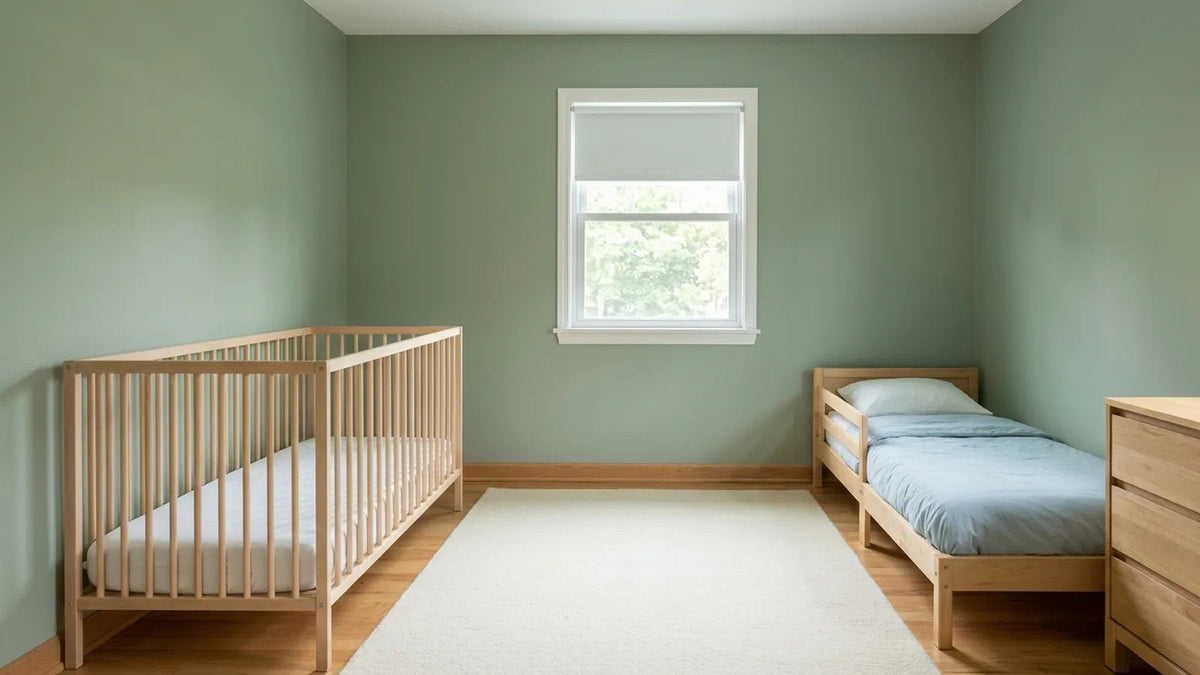
The safe-sleep guidance from the American Academy of Pediatrics (AAP) and the U.S. Consumer Product Safety Commission (CPSC) gives no age at which a baby and a toddler can share a room. A toddler and baby sharing a room comes down to the setup. That setup rests on a bare crib, window cords and furniture the toddler cannot reach, and small-part toys stored where the baby cannot get them.
Toddler and Baby Sharing a Room: What the AAP Guidance Covers
The AAP’s safe-sleep guide says that instead of sharing a bed, you should share a room with your baby for at least the first 6 months of life. It explains this as keeping your baby’s sleep area in the same room where you sleep, close to your bed but not in the same bed. The AAP advises room sharing because it can decrease the risk of SIDS by as much as 50%.
That advice is written about the parents’ room. The 50% figure belongs to a baby sleeping on a separate surface in the room where the parents sleep. It says nothing about a brother or sister in the room.
At What Age Can a Baby Share a Room With a Toddler?
There is no AAP age to quote. The AAP’s safe-sleep guide does not mention siblings, and the CPSC’s crib and safe sleep guidance does not either. Take the question about your own baby to your pediatrician.
It is easy to read the room-sharing advice as a green light for siblings. It is not one, and it is not a warning either.
What the AAP and CPSC do cover is the crib, the window, the furniture and the small objects in the room. Those rules apply whichever room the crib is in. They apply to a toddler and newborn sharing a room just as they do to a baby alone in a nursery. A toddler adds new ways to break each one.
A Bare Crib in a Shared Room: Fitted Sheet Only
The AAP’s crib rule is the same in every room: use a fitted sheet only, because nothing else should be in the crib with your baby. The CPSC’s "Bare is Best" message says the same for a crib, bassinet or play yard. Nothing but a fitted sheet.
The AAP says soft objects and loose bedding can increase a baby’s risk of entrapment, suffocation or strangulation. It lists blankets, pillows, stuffed toys and bumper pads. A shared room brings a new source of those items.
Picture this: the toddler wants the baby to have a favorite blanket and slides it between the crib slats. Or a stuffed toy gets pushed through "to keep the baby company." The AAP does not write about siblings, so this is an application of its soft-objects rule. A toddler’s blanket or stuffed toy handed through the slats is one more thing that does not belong in the baby’s crib.
So the toddler’s blanket and stuffed toy live on the toddler’s bed, and the crib stays off limits for toys during daytime play too. A short, repeatable rule works for a small child: the crib is the baby’s, and nothing goes through the slats.
The AAP’s safe sleep practices treat the crib as a bare space. A quick look for stray items before each sleep is a reasonable habit, especially after the toddler has been playing near the crib.


Temperature and Bedding Follow the Baby
The AAP says overheating can increase the risk of SIDS. It says your baby needs only one more layer than you would wear to be comfortable. It also names the signs to check for: sweating, a hot chest or flushed skin.
The AAP adds that once you are home from the hospital, you should not put a hat on your baby indoors.
In a shared room, the baby sets the standard. A toddler may want a thicker blanket or a warmer room, but the AAP’s guidance on layers, overheating and hats is about the baby. Dress the baby by the AAP’s one-more-layer rule, and let the toddler’s covers stay on the toddler’s bed.
Check the baby, not the toddler’s comfort, for those AAP overheating signs. If the toddler offers the baby an extra blanket or a hat, the answer is no.
Window Cords and Furniture Placement in a Shared Room
The CPSC says children have strangled to death on the cords of window blinds, shades, draperies and other window coverings. This is a hazard for both children in the room. The CPSC advises moving all cribs, beds, furniture and toys away from windows and window covering cords, preferably to another wall.
That advice includes the toddler’s bed. It also includes the step stool or toy box the toddler drags over to look outside, since the CPSC lists furniture and toys alongside beds and cribs.
Picture this: the crib sits against the only free wall, and a cord hangs a few inches above the rail. Across the room, a toddler’s stool sits under the window. Each one is a reason to rearrange before the baby’s first night.
A simple check helps. Stand at the crib rail, then at the toddler’s bed, and look toward each window. If a cord hangs within reach of either bed, move that bed to another wall. Move any stool, toy box or other climbable item away from the window too.
The CPSC says cordless window coverings are the only option to eliminate the strangulation hazard. In a CPSC go-cordless release, then Acting Chairman Robert Adler warned that even if you tie cords high or use so-called safety cleats, kids can still strangle to death in under one minute.
For cords that remain, the same release advises keeping all window covering cords out of the reach of children and making pull cords as short as possible. The same window rules apply to any room shared by two small children, which makes them part of baby-proofing for twins as well.
Anchoring Dressers, Bookcases and TVs a Toddler Can Climb
A toddler climbs. The CPSC says tip-over incidents typically occur when children have climbed onto, fallen against or pulled themselves up on furniture. A shared room often holds a dresser, a bookcase and sometimes a TV, and each one is a climbing target.
In the CPSC’s Anchor It release, then Acting Chairman Robert Adler said any piece of furniture that could topple over and injure a child if they play near it, bump it or climb on it should be anchored to the wall. The release’s tips are plain:
- Low-cost anchoring devices can keep TVs, dressers and bookcases from tipping.
- Always place a TV on a sturdy, low base pushed as far back as possible, particularly if anchoring is not possible.
- Avoid storing toys and remotes where kids might be tempted to climb up to reach them.
Walk the room at toddler height and ask which pieces a child could play near, bump or climb. Each one is a candidate for anchoring.
The release’s last tip, about toys and remotes, matters in a room with an older child. Toys on top of a dresser invite climbing. Keep favorite items at toddler height on a low shelf, and leave the tops of tall furniture empty.
Small-Part Toys Need a Home the Baby Cannot Reach
The AAP’s choking-prevention page says many choking incidents happen when older brothers or sisters give dangerous foods, toys or small objects to a younger child. It tells parents to be aware of what older children are doing and to avoid toys with small or detachable parts. The same page lists toys with small parts among the choking hazards around the home to keep away from infants and children. A shared room puts them within reach of the baby, on the floor or through the crib slats.
That list also includes small button-type batteries. The AAP says to keep small household items out of the reach of infants and young children. A closed closet or drawer is one way to give small-part toys a home away from the crib and the floor.
Picture this: playtime ends, and a few small pieces are left on the floor beside the crib. The toddler has moved on to something else. That gap between playing and tidying is when small parts can end up within the baby’s reach.
Make it a routine. When the toddler finishes playing, the small-part toys go back in that drawer or closet. Pick one spot and use it every time, so cleanup becomes a habit for the toddler.
To keep a drawer or closet door shut, the Baby Proof Me Adjustable Safety Strap Lock is a peel-and-apply strap with 3M adhesive and no drilling required. Its product page lists drawers and closets among its uses. The page says to allow 24 hours for the adhesive to bond for best results, so apply it a day before you rely on it. It also warns that the strap is not a substitute for adult supervision. It lowers the chance that a small-part drawer gets opened, and you still need to watch both children.

A Short Checklist for the Shared Room
Run through this list before the baby’s first night in the room:
Shared Room Checklist
Households with a toddler and a baby need more than a nursery checklist, and baby-proofing with older kids at home covers the rest of the house. Do the window and furniture walk-through before the baby’s first night in the room. The CPSC’s cord and climbing advice applies to both children from the start. The toddler’s toys, blanket and stuffed animals belong outside the crib from the first night on.