
Amazon Baby Registry Safety Items: What to Add from BabyProofMe

Every year, parents spend hours curating the perfect baby registry, agonizing over stroller brands and nursery aesthetics. The safety items get added last, almost as an afterthought, usually after someone’s baby shower comment or a pediatrician visit. That’s backwards. The products that prevent the worst outcomes deserve the same research energy you gave the crib mattress.
This list is what I’d tell a close friend to add before the baby arrives, based on years of installing, testing, and living with these products, and occasionally learning the hard way what "good enough" costs you.
Cabinet Locks and Drawer Latches
Start here. In 2024, household cleaning substances topped the list of substances kids under 6 got into, accounting for roughly 1 in 10 of all pediatric poison center cases (America’s Poison Centers). That number reflects real kitchens and real bathrooms where the cabinet under the sink was not locked.
My younger daughter emptied the entire under-sink cabinet in the time it took me to answer the front door. She was 14 months old. The cabinet had no lock because I’d told myself she wasn’t mobile enough yet. She was.
Choose magnetic locks over adhesive strap models. Adhesive straps fail on textured cabinet interiors, and they fail without warning. A 2012 CPSC recall pulled 900,000 Safety 1st Push 'N Snap cabinet locks after reports of children as young as 9 months opening them. Three children reached toxic cleaning products. The recall is a useful reminder that "CPSC-tested" on the box means little if the underlying design is flawed. Look for products with current CPSC compliance documentation and JPMA certification where available.
Install locks on every cabinet containing chemicals, medications, sharp objects, or heavy items that could fall. That includes the bathroom vanity, the kitchen under-sink, and the junk drawer with the batteries.
Outlet Covers and Tamper-Resistant Receptacles
Simple plug inserts, the small plastic caps that fill unused outlets, are a starting point, not a solution. Children over 18 months can remove them. Sliding plate covers are better because they require simultaneous pressure from two points to open, a motion toddlers cannot easily replicate.
The most durable long-term fix is tamper-resistant receptacles (TRRs), which have spring-loaded shutters built into the outlet itself. An electrician can swap these in during a single afternoon, and they meet current NEC requirements for new construction. If you’re renting or prefer a no-tools option, look for outlet cover plates with integrated sliding mechanisms rather than individual plug caps.
Prioritize outlets at floor level in every room the baby will access, including the nursery, living room, and kitchen.
Safety Gates
About 93,000 children under 5 are treated in U.S. emergency rooms each year for stair-related injuries, per a Nationwide Children’s Hospital analysis of CPSC NEISS data. That figure has not aged out. Stairs remain one of the most consistent injury sources in the home for young children.
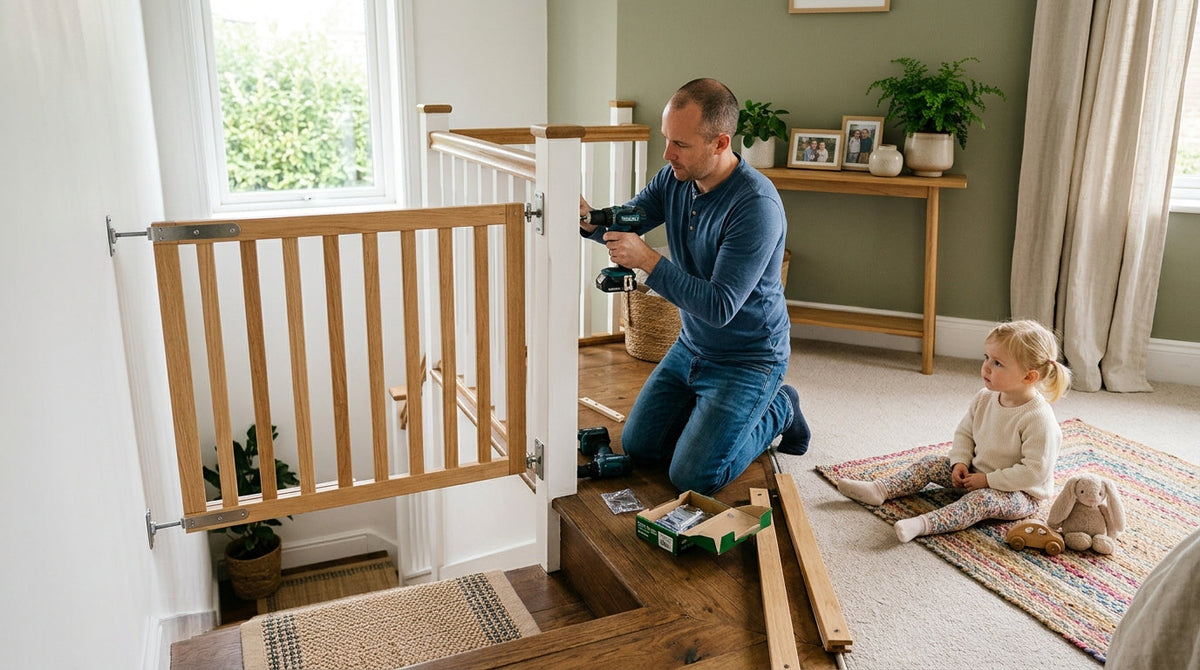
Hardware-mounted gates are required at the top of stairs. Pressure-mounted gates are fine for doorways, where a failure means a child walks into a room. At the top of a staircase, a pressure-mounted gate failure means a fall. Do not substitute one for the other.
When shopping, look for gates that meet ASTM F1004, the federal safety standard for expansion gates and expandable enclosures, made mandatory under 16 CFR Part 1239 (effective 2021). JPMA-certified gates have been independently tested to this standard. Measure your opening before you buy. A gate installed with excessive extender panels can compromise the structural integrity of the mount.


Corner Guards and Edge Bumpers
The crawling and early walking window, roughly 6–18 months, is when hard furniture edges do the most damage. Coffee tables, hearths, and low shelving units are the main offenders. Corner guards cushion impact during the falls that are going to happen regardless of supervision.
Clear silicone guards are less obtrusive than foam ones and adhere better to smooth surfaces. Test adhesion on your specific furniture before trusting it. I’ve had foam guards peel off marble and glass within a week. Silicone with a strong 3M adhesive backing holds significantly longer on those surfaces.
Replace guards that show compression damage. Once the foam or silicone is permanently deformed, it’s providing less protection than it looks like it is.
Window Locks and Cordless Window Coverings
Two separate hazards live in your windows. Falls from open windows are a risk for any child who can climb. Blind and shade cords are a strangulation hazard for infants and toddlers, and cord-operated window coverings should be replaced before the baby comes home.
Window stops or locks that limit how far a window can open are inexpensive and install in minutes. A window should not be able to open more than 4 inches in any room a child can access.
For window coverings, cordless or motorized options have become widely available and are not significantly more expensive than corded alternatives. If you have existing corded blinds, cord wind-ups and tie-down devices reduce but do not eliminate the risk. Replacement is the right answer.
Baby Monitors with Temperature Display
A monitor with two-way audio lets you respond to your baby without a full trip to the nursery for every sound. The room temperature display is more useful than it sounds. Infant thermoregulation is less efficient than an adult’s, and the AAP’s safe sleep guidance includes keeping the room at a comfortable temperature for a lightly clothed adult, generally cited as 68–72°F (20–22°C).
Video monitors add the ability to assess whether a repositioning sound requires intervention or not. Audio alone misses a lot. I used audio-only for my older daughter’s first year and switched to video for my younger one. The difference in useful information is significant.
Non-Slip Bath Mats and Tub Seats
Drowning is the leading cause of unintentional injury death in children ages 1–4 (CDC). A child can drown in as little as one to two inches of water (AAP). Both of those facts apply to the bathtub.
Non-slip mats reduce slip-and-fall injuries during bathing, but they do not address drowning risk. Tub seats keep a child upright and stable, but they are bathing aids, not flotation devices. No product replaces constant adult supervision during bath time. Within arm’s reach means within arm’s reach, not across the bathroom.
Look for mats with strong suction cups and replace them when the cups no longer hold. A mat that slides defeats the purpose entirely.
Door Locks and Handle Covers
Bathroom doors, kitchen doors, and any door leading outside need to be inaccessible to an unsupervised toddler. Standard lever handle covers work for a short window. My older daughter defeated the lever cover on the bathroom door at 26 months by gripping the cover itself and torquing it sideways. She was very proud of herself. I was not.
Combination door knob covers, or secondary deadbolts installed high on exterior doors, are more reliable for determined climbers. For interior doors to bathrooms and kitchens, a simple hook-and-eye latch mounted at adult height is inexpensive and effective.
Furniture Anchors
Furniture tip-overs kill children every year in the United States. Dressers, bookshelves, and televisions are the most common items involved. Heavier furniture and top-heavy pieces require multiple anchor points.
Furniture anchor kits are inexpensive and widely available. Most require a stud finder and a drill. The strap anchors to both the furniture and the wall stud. Anti-tip feet alone are not sufficient for tall or heavy pieces. If you’re mounting a TV, the wall mount itself serves as the anchor, but the TV stand or console beneath it still needs to be secured separately.
Add this to the registry and ask someone handy to help install it before the baby arrives. It is one of the tasks that gets skipped because it feels like a project.
Registry Safety Checklist
Bed Rails and Guardrails
The transition from crib to toddler bed introduces fall risk from a height that wasn’t there before. Bed rails attach to the bed frame and create a barrier along the open side of the mattress.
Measure your bed frame before purchasing. Bed rails are not universal. A rail that doesn’t fit snugly to your specific frame creates gaps, and gaps create entrapment risk. Check the product’s compatibility list against your frame model. Portable bed rails for travel are a separate category and should meet the same fit standards. Either way, bed rails are made for children about 2 to 5 years old in an adult-size bed, and the CPSC says never to use one for a child under 2.
Stove Knob Covers and Oven Locks
Burns and scalds from kitchen appliances are a consistent source of pediatric injury. Stove knob covers prevent a child from turning on a burner by requiring a squeeze-and-turn motion that small hands cannot easily execute. Oven door locks prevent a child from opening a hot oven.
Test any knob cover on your specific stove knobs before buying in bulk. Some cover designs don’t fit flush on certain knob profiles and can be pulled off rather than turned. The cover should feel secure when you try to remove it with one hand.
Poison Control and First Aid
Physical barriers will fail at some point. Every caregiver in your home needs the Poison Control number: 1-800-222-1222. Post it on the refrigerator. Program it into every phone. The time to find it is not after an exposure has occurred.
A basic first aid kit stocked for infants should include a rectal thermometer, infant acetaminophen (once age-appropriate), saline drops, and a bulb syringe. Add an infant-specific first aid guide if you haven’t taken a pediatric CPR course yet. The course is worth more than any product on this list. Many hospitals and community centers offer them free or at low cost. Put it on the registry as a gift card or a class registration if your platform allows it.
The registry is a practical tool. Use it to get the safety infrastructure in place before the baby comes home, not after the first close call.