

Renting changes the math on almost every babyproofing decision you make. You can’t drill into the tile. You can’t mount a gate to the wall without risking your deposit. And yet the hazards inside a rental are identical to the hazards inside a home someone owns outright.
The good news: most of what keeps a baby safe doesn’t require a single permanent hole. Here’s how to do it right.
Why "No-Damage" Doesn’t Mean "No-Protection"
The instinct renters have is to skip the heavy-duty stuff and hope for the best. Resist that. A child dies every two weeks from furniture, TV, or appliance tip-overs, and that number doesn’t care whether you own the dresser or rent it. The hazards are real. The question is just which tools you use.
Most landlords object to damage, not to safety. Frame it that way when you talk to yours. In my experience, a quick email explaining what you’re installing and how it comes out cleanly tends to get a "fine, whatever" response rather than a fight. Some landlords will even give written permission for wall anchors if you agree to patch on move-out. Ask. The worst answer is no.
Cabinet Locks: The First Thing to Install
My younger daughter once emptied the entire under-sink cabinet in the time it took me to answer the doorbell. I’m talking drain cleaner, dishwasher pods, a bottle of furniture polish. She was 14 months old and very motivated.
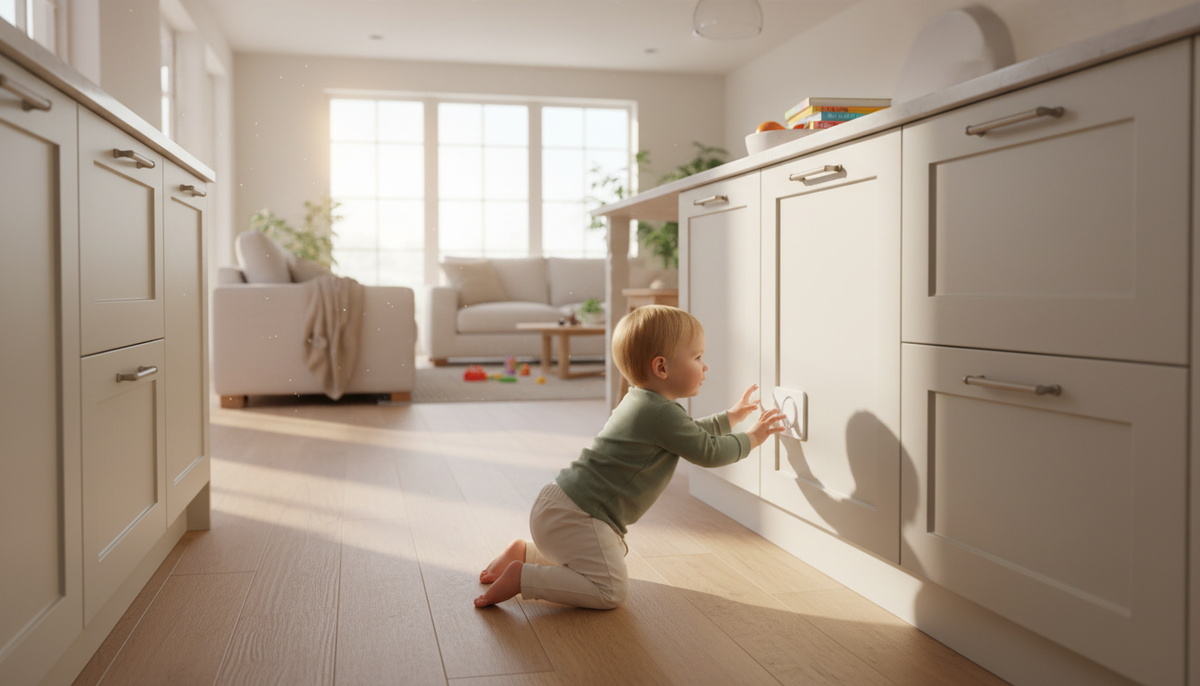
Cabinet locks are non-negotiable, and most of the best ones leave zero marks. Magnetic locks are the gold standard for rentals. You mount a small adhesive catch inside the cabinet and keep the magnetic key on top of the fridge. No external hardware, no drilled holes. The adhesive versions hold well on most cabinet interiors as long as the surface is clean, dry, and not textured.
The relevant standard for interior-mounted child-safety cabinet latches is ASTM F3492–21, published in 2021. Look for that compliance mark on packaging. And check recall history before you buy. CPSC recalled 900,000 Safety 1st Push 'N Snap cabinet locks in March 2012 after 140 children defeated them, and three of those children reached toxic cleaning products. Lock failure is a documented problem, not a hypothetical one.
One more thing on cabinets: child-resistant packaging on the products inside is not a backup plan. Under 16 CFR 1700.15 (poison-prevention packaging for household chemicals), packaging passes the "child-resistant" bar if at least 85% of tested children (ages 42–51 months) can’t open it within 10 minutes. That means roughly 15–20% of children in that age range can still get in. The lock on the cabinet matters more than the cap on the bottle.


Baby Gates Without Wall Damage
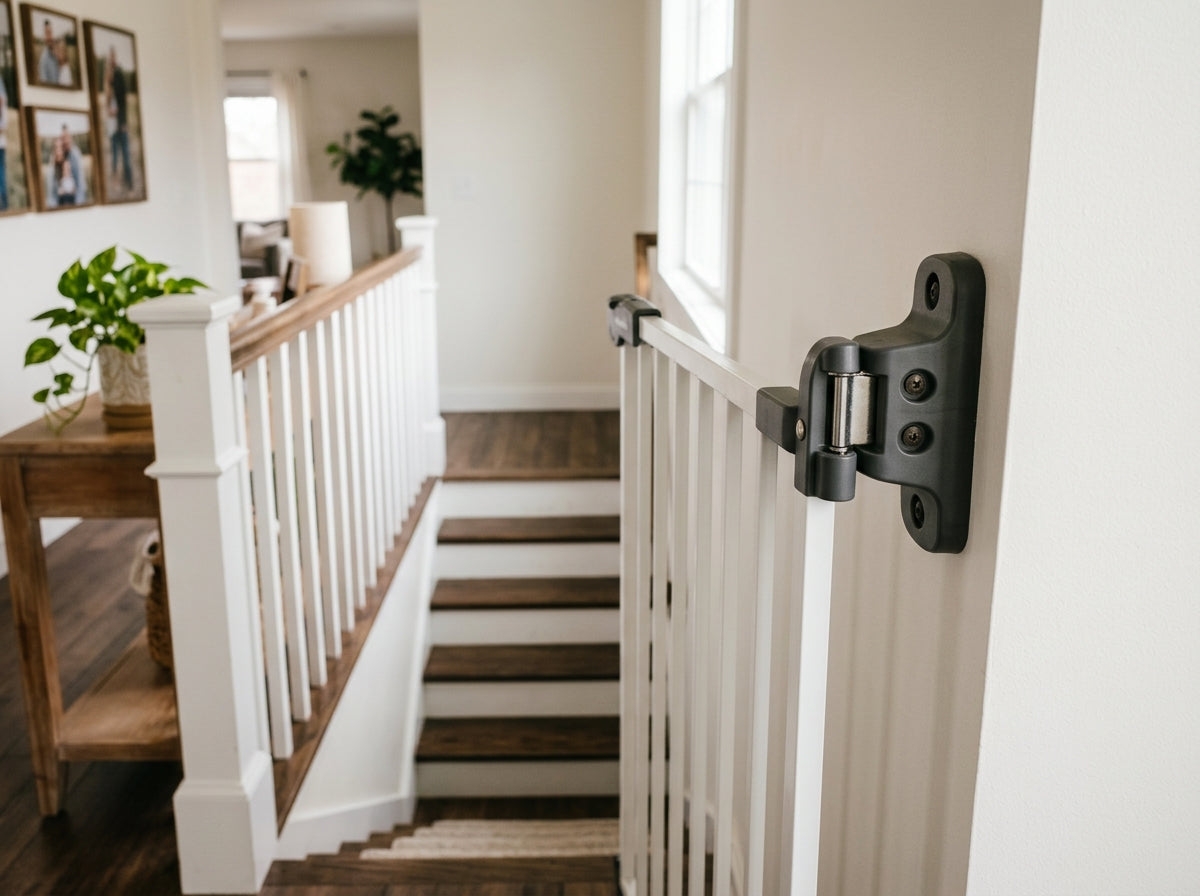
Stair gates are where renters get the most nervous, and with good reason. About 93,000 children under 5 are treated in U.S. emergency rooms each year for stair-related injuries (Nationwide Children’s Hospital analysis of CPSC NEISS data). A pressure-mounted gate at the bottom of the stairs is acceptable. At the top, you need a hardware-mounted gate, full stop. Pressure gates at the top of stairs can be pushed out by a falling or leaning child.
Here’s the rental workaround: banister-to-wall and banister-to-banister gate kits. These use padded clamps that grip the existing newel post and railing without drilling. Several brands make them specifically for this situation. They’re not as rigid as a drilled mount, but they’re far better than a pressure gate, and most landlords won’t object because there’s no damage.
ASTM F1004 is the federal safety standard for expansion gates and expandable enclosures, made mandatory under 16 CFR Part 1239 (effective 2021). Buy only gates that meet this standard. The box should say so.
For doorways and room dividers, pressure-mounted gates work fine. Install them snug. Check the tension weekly because they loosen with use.

- Dresser: load bottom drawers, push to wall
- TV: use wide-base stand, hide power cord
- Power strip: route cords in adhesive cable channels
- Blind cords: tie up with adhesive cleat hook
- Outlets: install sliding-plate covers throughout
Furniture Anchoring Without Drilling
This one requires some creativity in a rental, but it’s solvable.
For dressers and bookshelves, furniture anchor straps are the standard fix, and most require two screws into studs. If your landlord won’t allow that, you have a few options. First, ask again with the CPSC tip-over data in hand. Many landlords soften when they understand what’s at stake. Second, push heavy furniture flush against the wall and load the bottom drawers with the heaviest items. It reduces tip-over risk without any hardware. Third, consider furniture configuration: a dresser in a corner, braced by two walls, is harder to tip than one sitting in the open.
For TVs, use a low-profile TV stand with a wide base rather than mounting on the wall, and run the power cord behind furniture so it’s not a pull hazard. If you have a TV console with a flat top, an adhesive anti-tip strap can anchor the TV to the console itself rather than the wall. It won’t hold against a full-force pull, but it slows the tip enough to matter.


Outlet Covers and Cord Management
Plug-in outlet covers cost almost nothing and leave no mark. Use the sliding-plate type rather than the individual plug caps. The plug caps are a choking hazard if a child removes them.
Cord management is trickier. Blind and curtain cords are a strangulation risk for infants and toddlers. In a rental, you can’t replace the blinds, but you can tie cords up with a cleat hook mounted with adhesive, or replace the pull cord with a cordless retrofit kit. Both are inexpensive and fully reversible.
Power strip cords and lamp cords can be routed through adhesive cable channels along the baseboard. They peel off cleanly with a little heat from a hair dryer.
Smoke Alarms, CO Detectors, and Water Safety
Three out of five home fire deaths occur in homes with no smoke alarms or non-functioning ones (NFPA). Most states require landlords to provide working smoke alarms, but "provided" doesn’t always mean "currently functional." Test every alarm in the unit when you move in. Replace batteries immediately. If an alarm is over ten years old, buy a new one and swap it. You can swap it back when you leave.
CO poisoning kills more than 400 people each year and sends more than 100,000 to U.S. emergency rooms (CDC). A plug-in CO detector requires no installation at all. Put one on every floor.
For bathrooms: drowning is the leading cause of unintentional injury death in children ages 1–4 (CDC). A child can drown in as little as one to two inches of water (AAP). Empty the tub immediately after every bath. If your rental has a freestanding bucket, a decorative planter, or any container that collects water, keep it dry or out of reach. No hardware required.
Set your water heater to 120°F (49°C) if you can access the thermostat. If your landlord controls the water heater, ask them to adjust it, or use a tub faucet cover with a built-in thermometer.
Rental Babyproofing Checklist
The Medicine Cabinet Problem
Unsupervised medication exposures send roughly 100 children under five to U.S. emergency departments every day (CDC PROTECT data). In 2024, 99.2% of poison center cases involving children under 6 were accidental (America’s Poison Centers). Medications are the category where renters often get complacent because they assume the bathroom cabinet is "out of reach." It isn’t. Not for a toddler who has learned to drag a step stool.
Move all medications to a high shelf in a closet, inside a zippered pouch or a dedicated lockbox. Portable lockboxes with combination locks are inexpensive, require no installation, and move with you. This is the simplest fix in the article and one of the most important.
Before You Move Out
Keep a photo record of every product you install. Photograph the surface before installation and after removal. Adhesive residue from magnetic lock catches can usually be removed with a little rubbing alcohol. Adhesive cable channels come off with a hair dryer. Pressure gate scuffs on door frames can be touched up with a small amount of matching paint.
A written log of what you installed and when also helps if there’s any dispute. In my experience, most landlords are relieved that a tenant took safety seriously. But documentation protects you either way.
The goal is to leave the unit exactly as you found it, except for the part where your child made it through toddlerhood safely.