
When Do Babies Start Crawling? Milestones and Baby Proofing Timelines

Most parents picture crawling as a distant milestone, something to worry about later. Then one afternoon your baby rolls across the room and disappears behind the couch, and "later" is suddenly right now.
The window between "not yet mobile" and "everywhere at once" is shorter than almost anyone expects. And the hazards that open up the moment a baby can move independently, even just a slow, lopsided army crawl, are real and specific. Getting ahead of them by even a few weeks makes a meaningful difference.
What the Developmental Timeline Looks Like
The AAP places the typical crawling window between 7 and 10 months, though many babies begin showing the precursor movements, rocking on hands and knees, pushing backward, pivoting on their belly, as early as 6 months. The CDC’s developmental milestone framework notes that most babies are sitting without support by 6 months, which is itself a signal that floor-level exploration is close.
What surprises many parents is the variability. Some babies crawl at 6 months. Some skip crawling entirely and go straight from sitting to pulling up to walking. Both are within the range of normal development. The AAP is clear that skipping crawling is not a red flag on its own, provided other motor milestones are progressing. What matters for your baby-proofing timeline is not whether your baby will crawl in the textbook way. What matters is when they become independently mobile in any form.
Rolling over, which typically begins between 4 and 6 months, is the first real signal. Once a baby can roll, they can cross a room. Slowly, yes. But they can get there. In my experience, rolling happens faster than expected. My older daughter rolled from the center of our living room rug to the edge of the fireplace hearth at around 5 months. That was the moment I stopped thinking of baby-proofing as something to do "before she walks."
The Floor-Level Audit You Need to Do Before Crawling Starts
Get down on your hands and knees and look at your home from 12 inches off the ground. This sounds obvious. Almost no one does it until after something goes wrong.
From that height, you will see things you have never noticed. Cords running along baseboards. A forgotten coin under the radiator. The gap between the oven and the cabinet where a small object could lodge. Pet food in a bowl on the kitchen floor. A low shelf with decorative objects that look harmless from standing height but are small enough to be swallowed.
The exercise is not about finding one or two things. It is about recalibrating your mental model of your home. Every surface below 36 inches is now accessible territory. Treat it that way.
Small objects are the most immediate concern. A crawling baby’s first instinct is to put things in their mouth. Anything that fits through a standard toilet paper tube is a choking hazard. Work through every room at floor level and remove or relocate anything in that size range: coins, batteries, pen caps, small toys belonging to older siblings, rubber bands, pieces of dry pet food.
Mobility Milestones to Watch
Rolling over
First sign of independent movement. A rolling baby can cross a room.
Sitting without support
CDC milestone that signals floor-level exploration is close.
Rocking and pivoting
Precursor crawling movements begin. Start your floor-level audit now.
Crawling
Typical AAP window. Some babies skip this and go straight to pulling up.
Pulling to stand
New hazards emerge at higher levels. Reassess reach height monthly.
Stairs, Gates, and the Standards That Matter
About 93,000 children under 5 are treated in U.S. emergency rooms each year for stair-related injuries, according to a Nationwide Children’s Hospital analysis of CPSC NEISS data from 1999 to 2008. The majority of those injuries involve falls, and most falls happen when a baby or toddler reaches a staircase before a gate is in place.
Install gates before crawling begins. This is one of those cases where waiting until you "need" it means you are already behind.
The federal safety standard for expansion gates and expandable enclosures is ASTM F1004, made mandatory under 16 CFR Part 1239 effective 2021. When you are shopping, look for gates that carry this certification. Avoid accordion-style gates with large diamond-shaped openings. The V-shapes created by those openings can trap a child’s head or neck.
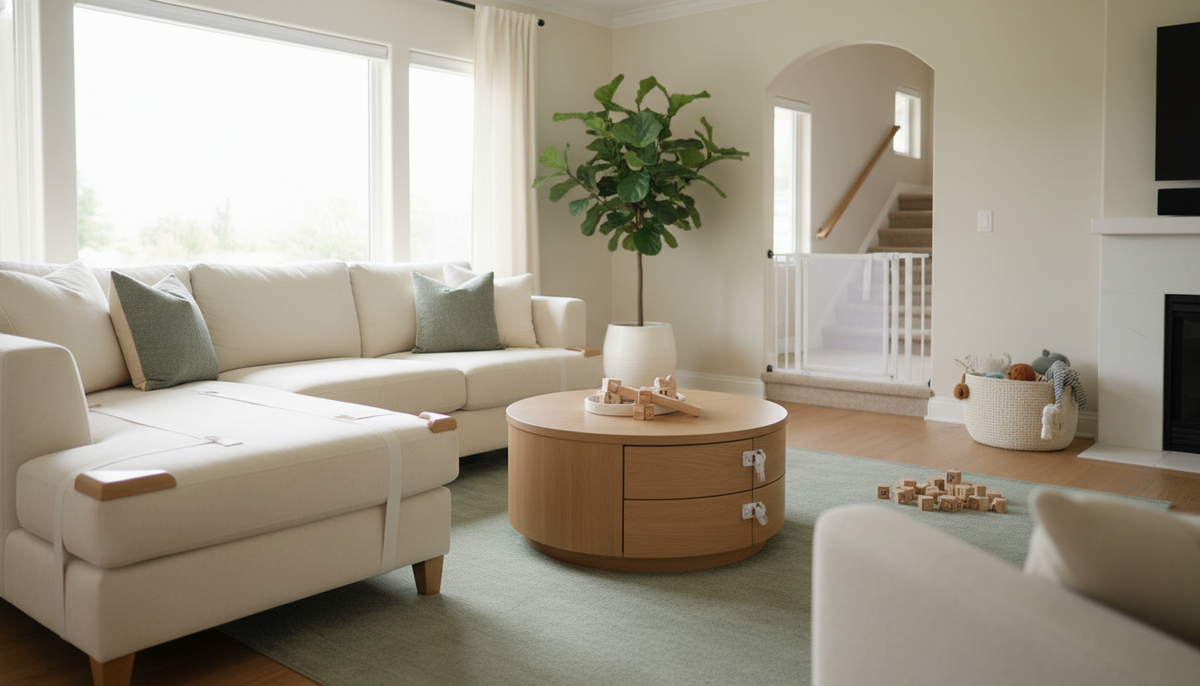
Hardware-mounted gates belong at the top of stairs. Pressure-mounted gates are appropriate at the bottom of stairs or in doorways where a fall through the gate would not result in a tumble down a flight of steps. This distinction matters. A pressure-mounted gate at the top of the stairs can be pushed out by a determined toddler. My younger daughter, at around 14 months, leaned hard enough into a pressure-mounted gate in a doorway to pop it loose. At the top of stairs, that outcome is catastrophic.

- Cords running along baseboards
- Small objects on floor near rug edge
- Coffee table sharp corners at head height
- Low shelf with small decorative objects
- Electrical outlet at floor level
Outlets, Cords, and Electrical Hazards
The AAP recommends covering all accessible electrical outlets in homes with young children. Standard plastic plug covers are better than nothing, but sliding plate covers are more secure. A motivated toddler can remove a plug cover. A sliding plate requires a two-step motion that is harder to defeat.
Cords are a more serious concern than outlets for the youngest crawlers. Window blind cords, appliance cords, and charging cables at floor level are strangulation hazards. According to CPSC GoCordless data, about 9 children under age 5 die each year from window-covering cord strangulation. The CPSC reports that nearly half of more than 200 corded-window-covering incidents involving children up to age 8 from 2009 to 2021 resulted in a death.
In 2022 the CPSC adopted federal safety rules requiring most new residential window coverings to be cordless or have inaccessible cords, with the custom standard under 16 CFR 1260 taking effect May 30, 2023. If you have older corded blinds in your home, replace them before your baby becomes mobile. This is one of the few baby-proofing tasks where the risk-to-cost ratio makes the decision straightforward. Cordless blinds are widely available and not significantly more expensive than corded ones.
For appliance and electronics cords, use cord bundlers or cable management channels to run them along walls and out of reach. A cord lying across the floor is a tripping hazard for you and a pull-down hazard for a baby who grabs it and yanks.


Toxic Substances and the Poisoning Risk
Crawling babies explore by mouthing. This means any substance at floor level or in accessible low cabinets is a potential ingestion hazard. Cleaning products, dishwasher pods, laundry detergent, medications, vitamins, and even some houseplants need to move before your baby becomes mobile.
According to America’s Poison Centers, there were nearly 2.1 million human poison exposures in 2024. That figure covers all ages, but young children are disproportionately represented. The under-sink cabinet is the most common source of household chemical exposure in young children. Move everything in it to a locked or high shelf before your baby crawls.
Magnetic cabinet locks and spring-loaded latches are both effective, but installation quality matters enormously. In a 2012 CPSC recall, 900,000 Safety 1st Push 'N Snap cabinet locks were pulled from the market after 140 children defeated them. Three of those children reached toxic cleaning products including dishwashing detergent, window cleaner, and oven cleaner. When you install locks, test them hard. Pull on them. Try to defeat them yourself. If you can open one without the release mechanism, a persistent toddler will find the same weakness.
Medications are a separate category. Even child-resistant caps are not child-proof. Store all medications, including vitamins and supplements, in a locked box or on a high shelf that requires a step stool to reach. This applies to purses and bags left on low hooks or the floor, which are a common source of accidental medication ingestion.


Furniture Tip-Over Hazards
The CPSC recommends securing all heavy furniture to walls to prevent tip-over injuries. Dressers, bookshelves, and television stands are the most common culprits. A crawling baby who pulls up on a dresser drawer can tip a piece of furniture that weighs several times their own body weight.
Anti-tip straps are inexpensive and take about 20 minutes to install. Use them on every tall or top-heavy piece of furniture in rooms where your baby spends time. This includes furniture that seems stable. A dresser with its drawers closed may feel solid. The same dresser with two drawers pulled out as a ladder becomes dangerously unstable.
Televisions mounted on stands rather than walls should be secured with anti-tip straps rated for at least several times the TV’s weight. Wall-mounting is the more reliable option if your setup allows it.
Corner Guards, Floor Padding, and Fall Mitigation
Hard flooring and low furniture edges are a consistent source of head injuries as babies learn to crawl and pull up. Coffee tables with sharp corners, fireplace hearths, and brick or tile surfaces at floor level are the main offenders.
Foam corner guards on coffee table edges and similar furniture are a low-cost, high-value addition. They will not prevent falls, but they reduce the severity of the impact when a baby goes down, which happens constantly during the pulling-up phase. Soft play mats in areas where your baby spends the most floor time add a layer of cushioning for the inevitable tumbles.
The hearth is worth special attention. It is hard, often raised, and positioned exactly where a baby learning to pull up will try to use it for support. Hearth padding kits are available specifically for this purpose and are worth installing before your baby reaches the pulling-up stage.
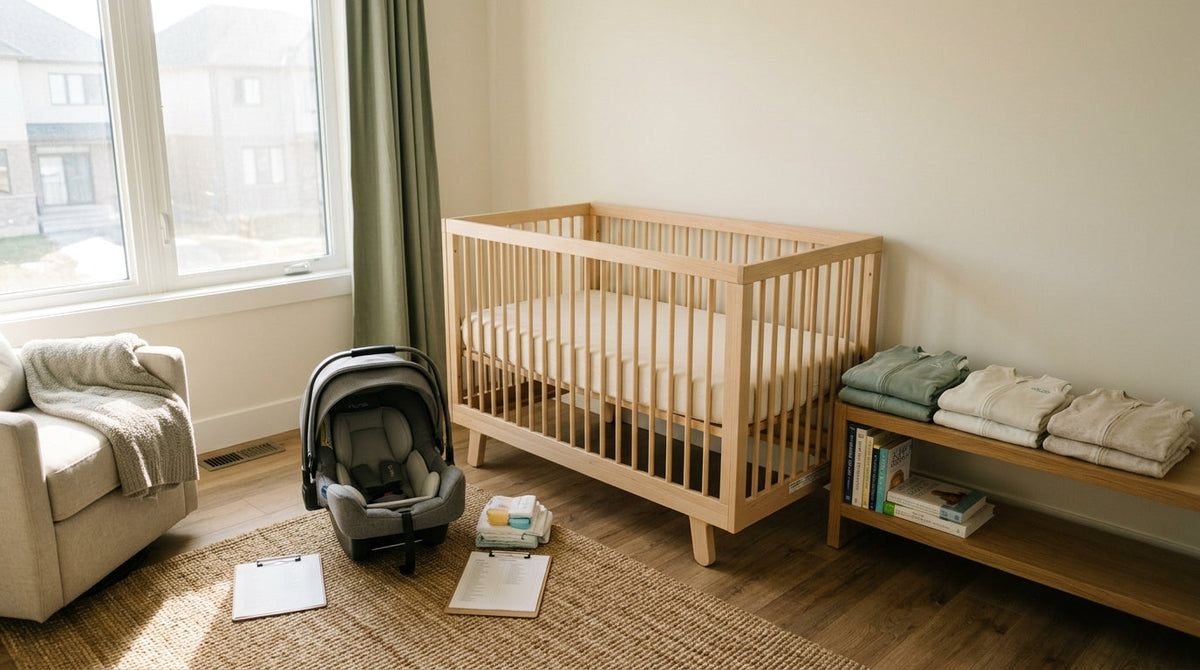
Pre-Crawling Safety Checklist
Pet Areas, Plants, and the Overlooked Hazards
Pet food and water bowls at floor level are accessible to crawling babies. Dry kibble is a choking hazard. Standing water in a bowl is an aspiration risk. And litter boxes, if accessible, present a bacterial contamination concern. Move feeding stations to rooms the baby cannot access, or use a pet gate to create a separation.
Pet toys often contain squeakers, stuffing, or small components that are not designed to withstand infant chewing. Separate your pet’s toys from your baby’s floor space.
Houseplants are frequently overlooked. Many common houseplants are toxic if ingested, including pothos, philodendron, dieffenbachia, and peace lily. Move all plants to surfaces above 36 inches or out of the rooms your baby accesses. If you are unsure whether a plant is toxic, the American Association of Poison Control Centers maintains a reference list.
Low shelves with decorative objects, remote controls, and small electronics should be cleared. A remote control contains batteries. Loose batteries, particularly button batteries, are a serious ingestion hazard that goes beyond choking. Button battery ingestion can cause internal burns within two hours.
Baby-Proofing Is a Moving Target
The work you do before your baby crawls is not a one-time project. As crawling skills improve and your baby begins pulling to stand, typically between 8 and 12 months, new hazards emerge at higher levels. A baby who could not reach the second shelf last month may be able to reach it this month.
Plan to reassess your home monthly during this period. Walk through each room at your baby’s current reach height, which changes fast. What was safely out of reach at 8 months may be accessible at 10 months. Drawer handles become handholds. Chair rungs become climbing steps.
The crawling phase is also when siblings’ toys become a significant hazard. Small Lego pieces, game tokens, and toy accessories designed for older children are not safe at floor level when a baby is mobile. Establish a clear rule: older children’s small-part toys stay in their room with the door closed, or in a space the baby cannot access.
In my experience, a magnetic door latch on an older child’s room kept the Lego collection off the living room floor during the crawling phase.
The developmental window from first roll to first steps is roughly 6 to 12 months of constant adjustment. Build the habit of looking at your home through your baby’s eyes, at your baby’s height, and updating what you see every few weeks. The hazards shift. Your response needs to shift with them.