
Baby Proofing Essentials: The Non-Negotiable Products for Every Room
The Non-Negotiable Products for Every Room

Every room in your house looks different to a crawling baby than it does to you. You see a living room. Your baby sees a cable to chew, a bookshelf to climb, and a coffee table corner at exactly eye level.
Babyproofing is not one product. It is a layered system, room by room, matched to your child’s current abilities and the next stage you haven’t reached yet. I learned this the hard way when my older daughter defeated an adhesive cabinet lock at 26 months, calmly peeled the whole mechanism off the door, and handed it to me like a trophy. The product wasn’t wrong. My installation was. And I hadn’t thought ahead to what she’d be capable of by then.
Stair Gates: The First Thing You Install
About 93,000 children under 5 are treated in U.S. emergency rooms each year for stair-related injuries, per a Nationwide Children’s Hospital analysis of CPSC NEISS data. That is roughly one child every six minutes. Stairs are one of the most predictable hazards in a home, and a gate is the most direct fix. There are two types. Pressure-mounted gates are fine for room dividers and spaces where a fall isn’t the consequence of failure. Hardware-mounted gates belong at the top of any staircase. A pressure-mounted gate can be pushed out by a determined toddler or a stumbling adult. Hardware-mounted gates are anchored into wall studs and won’t give.
What to look for:
- ASTM F1004 certification. If the gate doesn’t reference this standard, skip it.
- A one-hand adult operation mechanism. You will be carrying a baby on your hip every time you use this gate.
- A walk-through design at the top of stairs. Stepping over a gate while holding a child is a fall waiting to happen.
Buy two. One for the top of the stairs, one for the bottom.
Furniture Anchors: The Invisible Hazard Most Parents Skip
CPSC reports one child death every two weeks from furniture, TV, or appliance tip-overs. Dressers, bookshelves, and TV stands are the most common culprits. The reason this hazard is so underestimated is that nothing looks wrong until a toddler grabs a drawer to pull themselves up.
Furniture anchor straps are inexpensive, take about ten minutes to install, and are one of the highest-impact products on this list. You anchor the furniture to a wall stud with a strap, and the piece cannot tip forward more than a few degrees even under a child’s full weight.
What to look for:
- Straps rated to hold at least several times the weight of the piece you’re anchoring. Check the product’s listed weight capacity before you buy.
- Metal hardware, not plastic clips. The strap itself can be nylon, but the wall bracket and furniture bracket should be metal.
- A kit that includes both wall anchors and furniture screws. Some kits are missing one or the other.
Anchor every dresser, bookshelf, TV stand, and wardrobe in your home. The TV itself should also be secured, either with a strap or mounted to the wall.
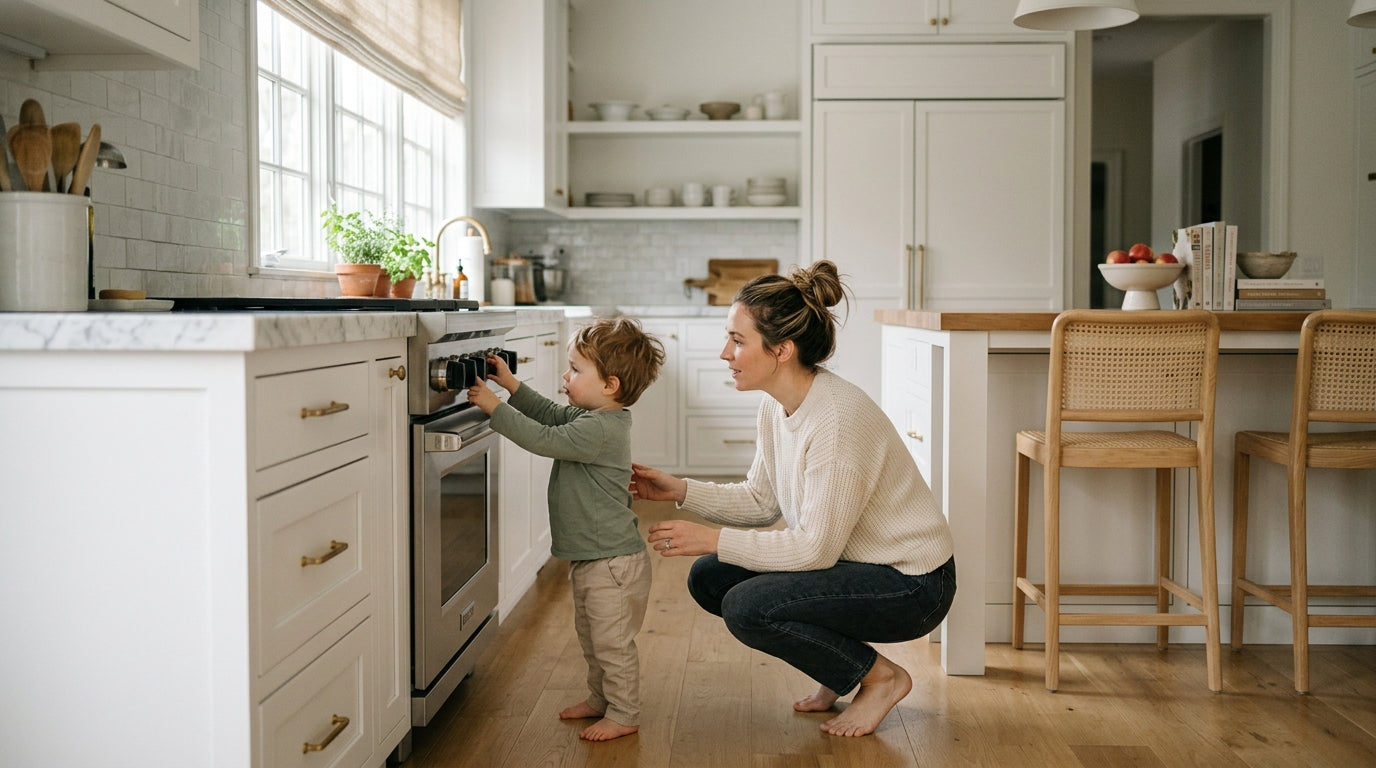
Cabinet and Drawer Locks: Under-Sink Is Non-Negotiable
My younger daughter once emptied the entire under-sink cabinet in the time it took me to answer the doorbell. She was 18 months old and very efficient. Cleaning products, a box of trash bags, a spare sponge, a bottle of drain cleaner. All of it on the kitchen floor before I got back.
The under-sink cabinet is the most urgent locking priority in any home. Cleaning products, dishwasher pods, and drain chemicals are acutely toxic. The principle extends to any drawer or cabinet that holds medications, knives, heavy cookware, or anything breakable.
Types worth knowing:
- Magnetic locks are the most tamper-resistant option. A hidden magnetic key releases the latch from outside. No external hardware for curious hands to grab. I use these under the sink and in any cabinet with chemicals.
- Spring-loaded latches are faster to install and work well for most kitchen drawers and pantry cabinets. They require adult hand strength to open.
- Adhesive strap locks are the weakest option. They work for low-stakes cabinets, but as I mentioned, a determined two-year-old can defeat them. Don’t rely on them for anything hazardous.
Per CDC PROTECT data, unsupervised medication exposures send roughly 100 children under five to U.S. emergency departments every day. Medications stored in a bathroom cabinet or bedside table need a lock just as much as the kitchen does.


Outlet Covers: Simple, Cheap, and Still Worth Doing
Outlet covers are the most visible babyproofing product and probably the most purchased. They’re also the most misused.
The sliding plate covers that replace your existing outlet covers are significantly better than the plug-in plastic caps. The plastic caps are a choking hazard if a child removes one, and children can remove them. Sliding plate covers require simultaneous pressure and sliding motion to open, which is beyond most toddlers and many preschoolers.
What to look for:
- A sliding cover that replaces the whole outlet plate, not an insert.
- Tamper-resistant (TR) outlets are now required by code in new construction and are worth installing if you’re renovating. They have built-in spring-loaded shutters that block insertion of a single prong.
- Cover every outlet at floor level in every room, including guest rooms and the garage.


Baby Monitor: Eyes When You Can’t Be There
A monitor is not optional for the first years. Whether you use audio-only or video depends on your preference, but video adds a layer of information that matters. You can see whether your baby has rolled into an unsafe position without going into the room and waking them.
What to look for:
- A dedicated baby monitor, not just a smart home camera. Dedicated monitors have lower latency and don’t depend on your home Wi-Fi staying connected.
- Two-way audio so you can soothe without entering the room.
- If you choose a Wi-Fi-connected model, look for one with end-to-end encryption. Baby monitors have a known security vulnerability history.


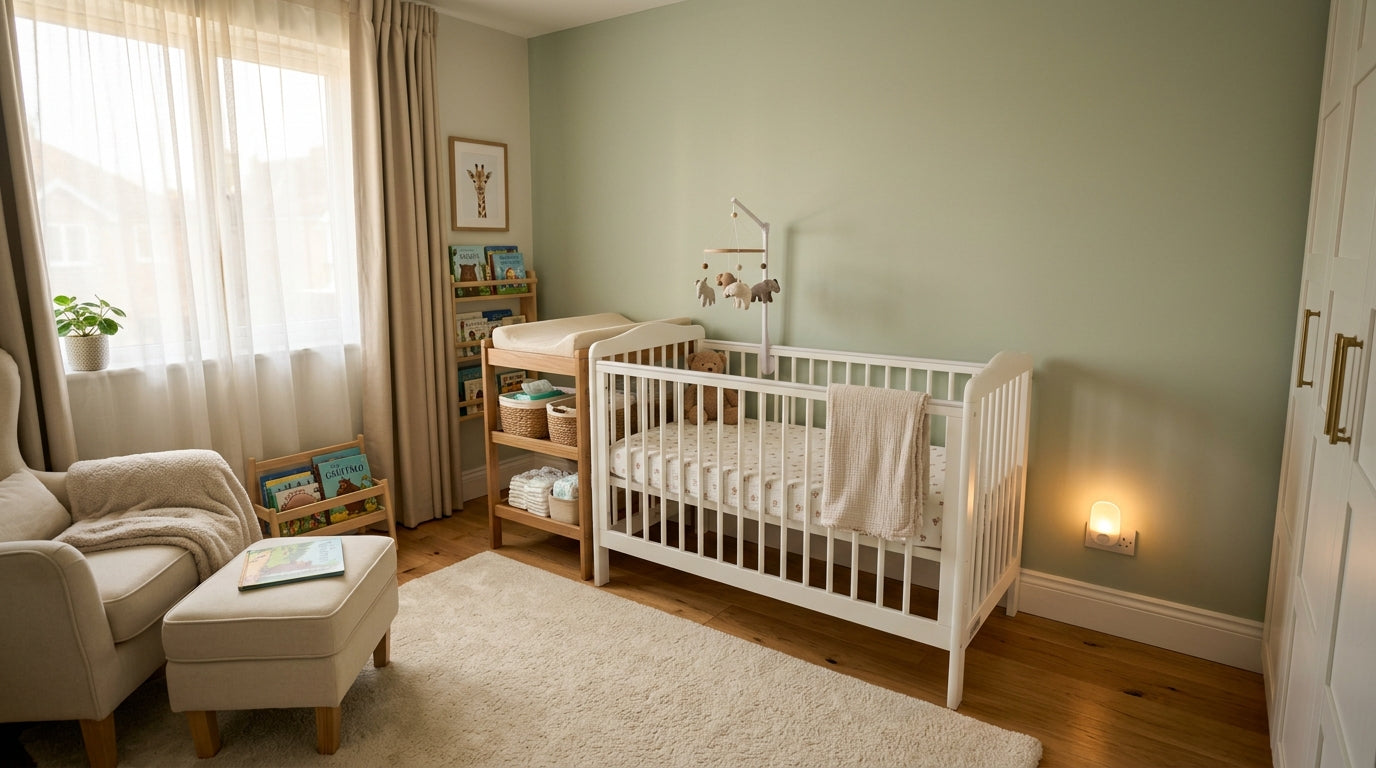
Safe Sleep Products: The Bedroom Requires Its Own List
About 3,500 infants die each year from sleep-related causes in the United States, per CDC SUID data. Unintentional suffocation kills roughly 1,000 infants under age 1 each year (CDC). These numbers reflect what happens when sleep environments include soft bedding, inclined surfaces, or shared sleep without informed precautions.
The AAP’s safe sleep guidance is clear: firm, flat surface, no soft bedding, no inclined sleepers, no bed-sharing. The products that support this are simple.
The essentials:
- A firm, flat crib mattress that fits the crib with no gap at the edges. If you can fit more than two fingers between the mattress and the crib rail, the mattress is too small.
- A fitted sheet designed for that specific mattress. Nothing else in the sleep space.
- A wearable blanket or sleep sack instead of loose blankets once your baby outgrows the swaddle stage.
Avoid any product marketed for infant sleep that is inclined, padded, or designed to be used inside the crib. The CPSC has recalled dozens of these products.

- Toilet: top-heavy toddlers can fall in
- Tub spout: hard metal causes head injuries
- Wet tile floor: slip and fall risk
- Under-sink cabinet: cleaning products inside
- Door handle: toddlers can let themselves in
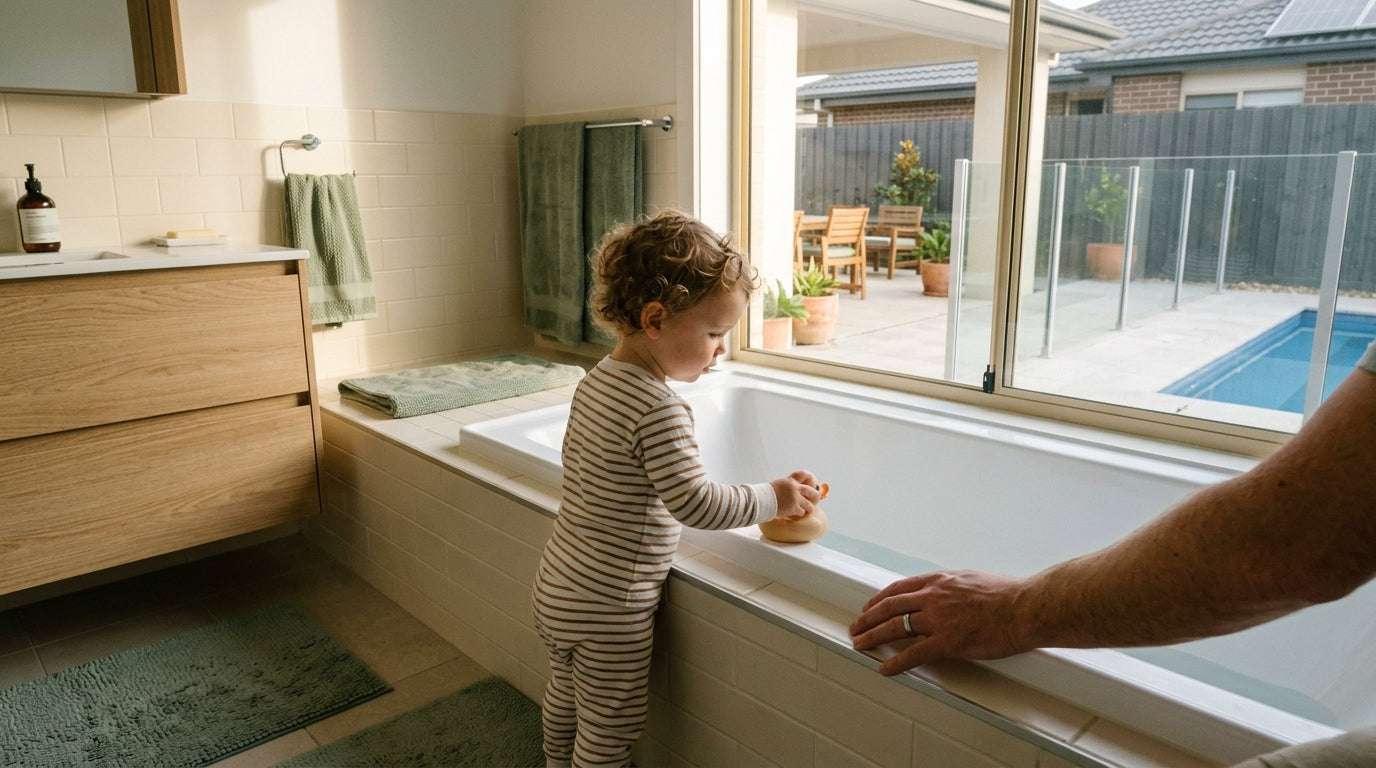
Bathroom Safety: Water Hazards Start at the Tub
Drowning is the leading cause of unintentional injury death in children ages 1–4, per the CDC. A child can drown in as little as one to two inches of water, per the AAP. The bathroom is a serious room.
The products that matter here:
- A toilet lock. Toddlers are top-heavy and curious. A toilet lock prevents the lid from being opened without adult intervention.
- A tub spout cover. Soft rubber covers fit over the metal spout and protect against head injuries from falls in the tub.
- Non-slip bath mat. Inside the tub and on the floor outside it.
- A door handle cover or door knob lock. Keeping the bathroom door closed when not in use is the first line of defense. A handle cover prevents a toddler from letting themselves in.
Set your water heater to 120°F (49°C) or below. At that temperature, a serious scald takes about five minutes of exposure. Above 130°F (54°C), a scald can happen in under 30 seconds.
Smoke and CO Detectors: Not Babyproofing Products, but Non-Negotiable
Three out of five home fire deaths occur in homes with no smoke alarms or non-functioning ones, per NFPA. CO poisoning kills more than 400 people each year and sends more than 100,000 to U.S. emergency rooms, per the CDC.
These are not products most people think of when they think "babyproofing." But a baby cannot wake themselves and exit a burning house. You are their only exit plan. Working detectors on every level of your home, inside every bedroom, and near any gas appliance are essential.
What to look for:
- Combination smoke and CO detectors reduce the number of units you need.
- Interconnected alarms: when one sounds, they all sound. This matters in a two-story home where a fire starts while you’re upstairs.
- Test monthly. Replace batteries annually. Replace the units themselves every 10 years.
Corner and Edge Guards: Lower Priority, Still Worth Doing
Coffee table corners, fireplace hearths, and sharp furniture edges are a real hazard for new walkers. The injuries are rarely life-threatening, but a corner to the forehead at toddler height causes a lot of blood and a lot of fear.
Foam edge guards and corner protectors are inexpensive and easy to install. The clear ones are less obtrusive and hold up better than the colored foam strips. For fireplace hearths, look for a padded hearth gate that creates a barrier around the entire surround, not just a strip along the edge.
These are not the first products you buy. Get the gates, the anchors, the cabinet locks, and the safe sleep setup in place first. Then come back to the corners.
How to Prioritize When You Can’t Do Everything at Once
If your baby is newly mobile and you’re starting from scratch, here is the order I’d recommend:
- Hardware-mounted gate at the top of the stairs
- Furniture anchors on every tall piece
- Magnetic locks on under-sink and medication cabinets
- Safe sleep environment in the crib
- Outlet covers throughout
- Bathroom locks and tub safety
- Smoke and CO detectors checked and functioning
- Corner guards and remaining cabinet locks
Babyproofing is not a single weekend project. It’s a series of passes you make as your child develops new skills. What stops a 9-month-old crawler won’t stop a 20-month-old climber. Reassess every few months, and stay one stage ahead.