Baby Proofing for Families Who Co-Parent in Two Homes

Children don’t experience a "transition period" when they move between homes. They just arrive, curious and fast, in a space that may or may not be ready for them.
Co-parenting across two households is already logistically complex. Add a mobile infant or a newly walking toddler, and the safety calculus doubles. Every hazard you’ve addressed at your place may be waiting, unaddressed, at the other one. And the research on pediatric injuries is unambiguous: the home environment is where most of them happen, and consistency in hazard management is what prevents them.
This guide is built for families navigating that reality.
Why Two Homes Require One Standard
The instinct, when you’re managing two households with different budgets, different layouts, and sometimes different levels of buy-in, is to do what you can control and hope for the best elsewhere. That instinct will get you into trouble.
Young children don’t generalize safety. A toddler who has learned that the cabinet under your sink is locked will still open it at the other home if it isn’t. A child who has never encountered an unsecured bookcase doesn’t know to avoid it. The hazard exposure at each location is independent, which means the risk at each location is also independent.
Both homes need to meet the same baseline. That’s the non-negotiable starting point.
Building a Shared Safety Checklist
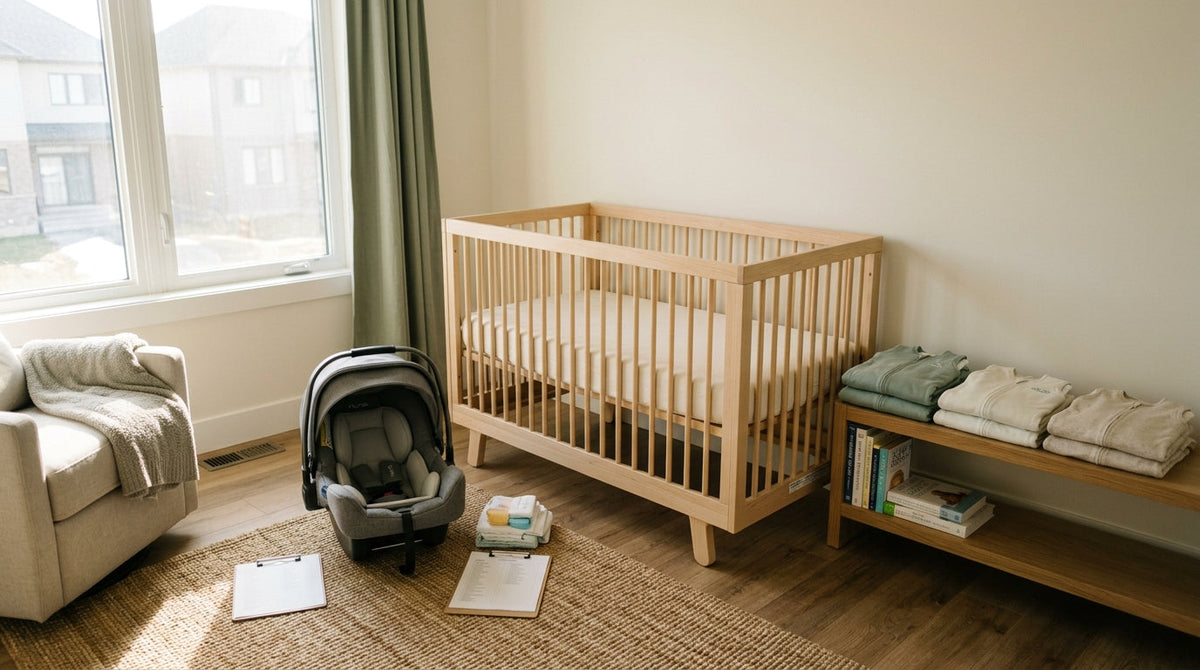
The most practical thing two co-parents can do is agree on a checklist before a child spends time in either home. Not a general list of "good ideas," but a specific, room-by-room document that both caregivers work from and update.
The four hazard categories that belong on every co-parenting checklist:
- Fall hazards: Stairs without gates, furniture that can tip, unsecured rugs, beds or changing surfaces without rails
- Drowning hazards: Bathtubs, buckets, toilets, standing water, pools or hot tubs
- Choking hazards: Small objects, coins, button batteries, whole grapes, nuts, toy parts intended for older children
- Poisoning hazards: Medications, cleaning supplies, vitamins, laundry pods, cosmetics
A shared Google Doc or a dedicated co-parenting app works well for this. The format matters less than the commitment to update it when something changes, when a new product is installed, when a hazard is identified and addressed, or when a child reaches a new developmental stage and the risk profile shifts.
Gates, Locks, and Covers: Portable Solutions for Renters
One of the most common barriers I hear from co-parents is that one or both homes are rentals, and the landlord won’t allow permanent modifications. This is a real constraint, and it has real solutions.
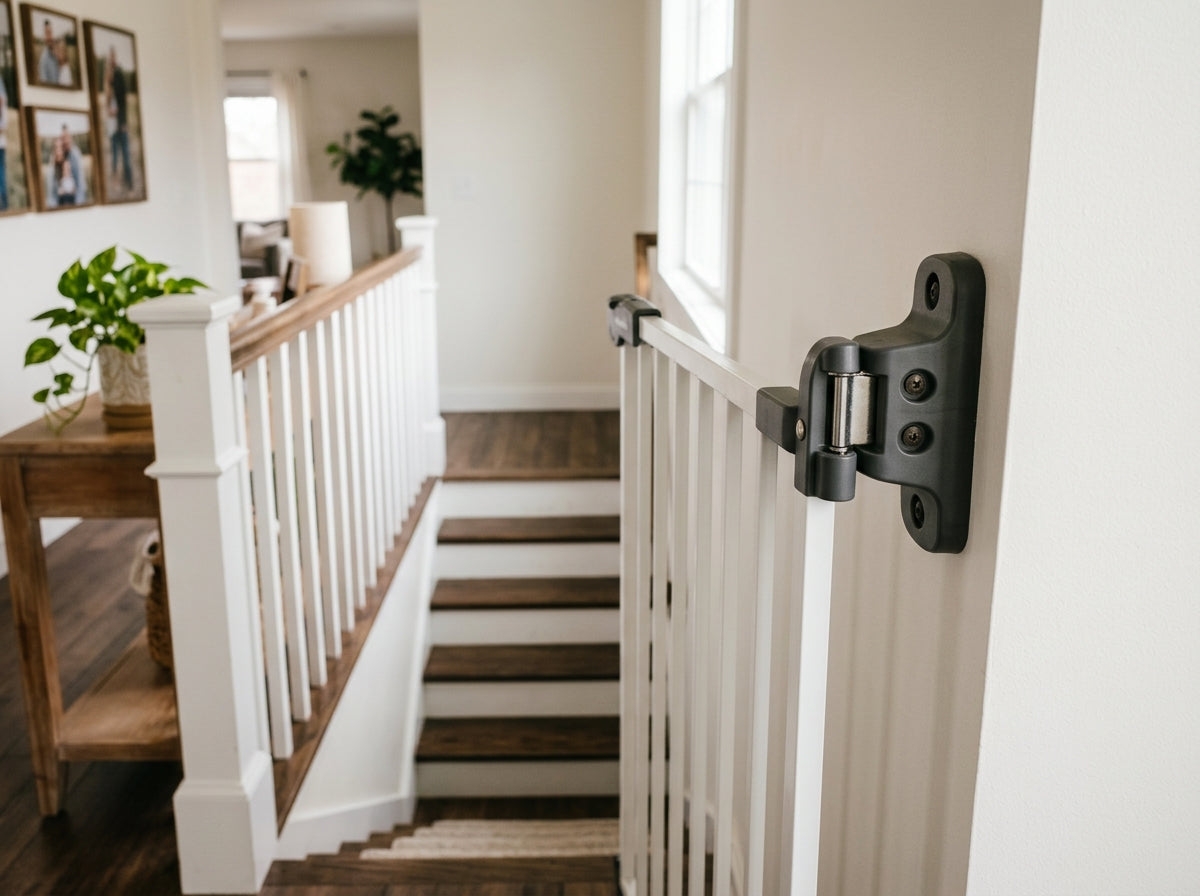
Pressure-mounted safety gates are the primary tool here. They require no drilling and can be repositioned or removed without leaving damage. For stairs, I want to be clear: pressure-mounted gates should not be used at the top of stairs. At the top, you need a hardware-mounted gate. At the bottom, a pressure-mounted gate is appropriate and effective. When shopping, look for gates certified to ASTM F1004, the federal safety standard for expansion gates and expandable enclosures. That certification means the gate has been tested to resist a child pushing against it with sustained force.
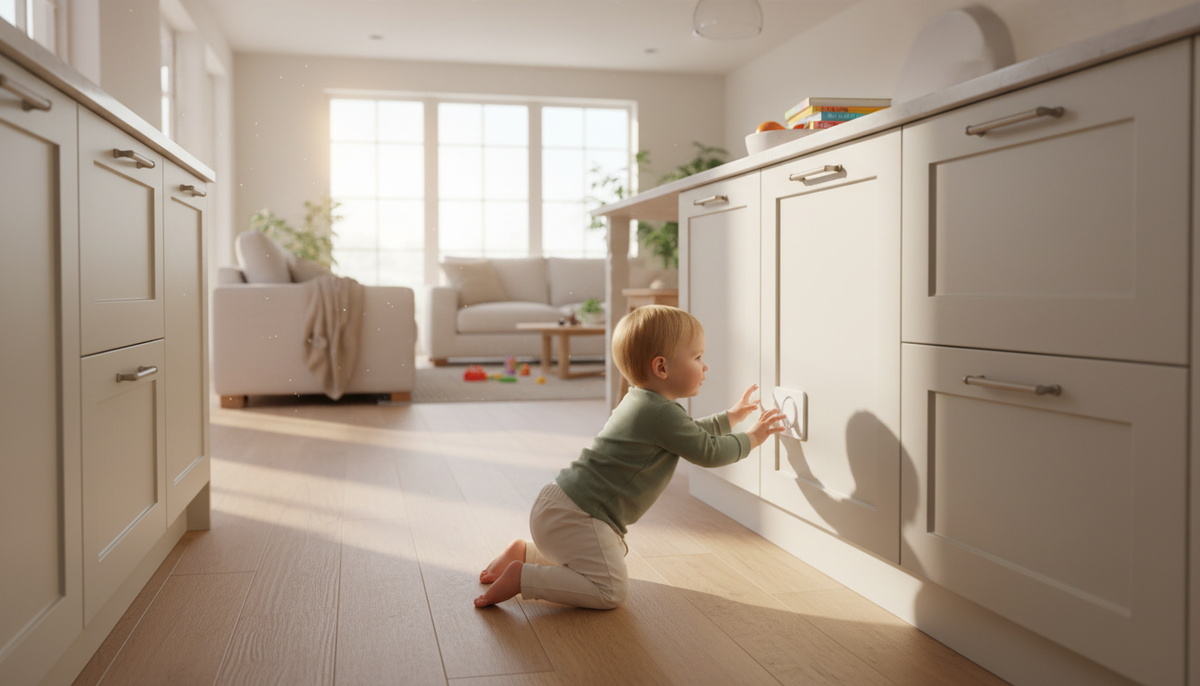
For cabinets and drawers, adhesive-mounted magnetic locks are the rental-friendly standard. In my experience, the adhesive holds on most surfaces but can fail on laminate cabinet faces after a few weeks. Test your installs after 48 hours and again at two weeks.
Outlet covers are the lowest-cost, highest-portability item on the list. Buy two sets. Keep one at each home. Done.


Medication Storage: The Hazard That Travels With the Child
Medication is where co-parenting safety gets complicated. At a single-household family, there’s one medicine cabinet to secure. In a co-parenting arrangement, there are two, and a child who takes a daily medication may be carrying it between homes in a bag that also contains small toys and snacks.
According to CPSC data, pediatric poisoning deaths in children under 5 reached 97 in 2022 and 90 in 2023. Narcotic-medication fatalities specifically doubled from 33 in 2021 to 66 in 2023.
According to CPSC, ED-treated ibuprofen injuries in children under 5 rose from 2,000 to 3,600 between 2021 and 2022, and narcotic-related ED injuries more than doubled from 1,200 to 2,500.
Every medication at both homes belongs in a locked cabinet or container, out of reach, every time. This includes vitamins, melatonin, and over-the-counter products that feel benign. Both parents need to maintain this standard independently, because a child may access either location on any given day.
When a child’s medication travels between homes, it should travel in a locked case, not loose in a bag.
Window Safety at Both Locations
According to CPSC GoCordless data, about 9 children under age 5 die each year from window-covering cord strangulation. Nearly half of more than 200 corded-window-covering incidents involving children up to age 8 between 2009 and 2021 resulted in a death. In 2022, the CPSC adopted federal safety rules requiring most new residential window coverings to be cordless or have inaccessible cords.
If either home has older corded blinds, the cord is a strangulation hazard, and a fall hazard for infants. Cordless replacements are widely available and inexpensive. If replacement isn’t immediately possible, wind cords up and secure them out of reach with a cord wind-up or tie-back mounted high on the wall.
Window guards are the second piece of this. A child who climbs furniture can reach a window. Window stops that limit how far a window opens (no more than 4 inches) are a low-cost, often renter-approved modification. Check both homes.
Water Safety: Supervision Is a Protocol, Not a Feeling
Drowning is among the leading causes of unintentional injury death in young children. It happens quickly and silently, which is why supervision protocols need to be explicit, not assumed.
Both homes should have the same rules: an adult within arm’s reach during any bath, toilet lids latched, buckets and containers emptied and stored upside down, and no standing water left accessible.
If either home has a pool or hot tub, four-sided fencing with a self-latching gate is the standard. ASTM F1346 is the performance specification for safety pool covers, and a cover meeting that standard adds a layer of protection, but it does not replace fencing or supervision.
The bath seat question comes up often. Bath seats are a convenience product, not a safety device. A child can tip out of one. Neither home should treat a bath seat as a substitute for active supervision.
The Portable Safety Kit
Safety products need to exist at the location where the child is, not at the location where you thought ahead.
For co-parenting families, a portable safety kit solves the problem of gaps during transitions. Pack duplicates of the essentials:
- Outlet covers (a full pack)
- Adhesive cabinet locks or a set of magnetic locks with the key
- Door pinch guards
- Cord organizers and cord wind-ups
- Corner and edge bumpers
- A door knob cover or two
This kit doesn’t replace permanent installation at each home. It covers the gaps during visits to unfamiliar spaces, the other parent’s new apartment, a grandparent’s house, a hotel room. It also gives both parents a shared baseline to work from when setting up a new space.
Co-Parenting Safety Baseline: Both Homes
Furniture Anchoring and Soft Edges
Furniture tip-overs kill and injure children every year in the US. Dressers, bookshelves, and televisions are the most common culprits. Anti-tip straps are inexpensive, widely available, and in most cases do not require landlord approval since they anchor to a stud and leave a small hole that is typically considered normal wear.
Both homes should anchor dressers, bookshelves, wardrobes, TVs, and any other furniture a child could climb or pull on, whatever its height.
Corner and edge bumpers are the other piece. Foam edge guards adhere without permanent damage and cover the sharp geometry that toddlers are drawn to.
Car Seats: Verify Both Installations
Car safety doesn’t live inside either home, but it belongs on the co-parenting checklist. Both households need a properly installed car seat meeting current standards, and installation should be verified at each location, not assumed.
LATCH systems reduce installation variation, but they don’t eliminate it. If either parent is uncertain about their installation, NHTSA maintains a database of certified Child Passenger Safety Technician inspection stations at nhtsa.gov. The inspection is free. Use it.
A car seat should never transfer between vehicles without a reinstallation check. The fit that was correct in one car may not be correct in another.
Keeping Communication Open Between Homes
The safety standard at both homes is only as strong as the communication between the adults maintaining it. When a child figures out how to defeat a lock or discovers a new hazard, that information needs to reach both caregivers immediately.
A shared document, a dedicated thread in a messaging app, or a section of a co-parenting platform works for this. The goal is a running record of what’s installed where, what’s been identified as a hazard, and what’s been addressed. When one parent upgrades or changes something, the other parent knows.
This kind of communication also prevents duplicate purchases and wasted effort. If one home already has a gate at the top of the stairs, the other parent knows to prioritize the bathroom cabinet instead.
Both homes don’t have to be identical. They do have to be safe. A shared checklist, portable duplicates of key products, and a clear line of communication between caregivers is what makes that possible.