
Baby Proofing Gift Set Ideas: Practical Shower Gifts New Parents Actually Need

Most baby shower registries are full of swaddle blankets and nursery art. The cabinet locks, outlet covers, and furniture anchors that matter at month eight? Almost nobody puts those on a list.
That’s the gap a good baby proofing gift set fills. And if you’re shopping for a new parent, or building a registry yourself, understanding what makes one of these bundles useful versus decorative is worth a few minutes of your time.
Why Safety Gear Gets Left Off Registries
New parents are thinking about the newborn phase when they build registries. That’s natural. A baby who can’t roll over yet doesn’t need cabinet locks. But the window between "can’t move" and "can reach everything" closes faster than most first-time parents expect.
By the time parents realize they need to babyproof, they’re sleep-deprived, short on time, and suddenly staring at a wall of hardware at the home improvement store with zero context. Decision fatigue is real. A curated set that pre-selects compatible items, say, a magnetic cabinet lock system paired with the right drill bit and a finger pinch guard for the same cabinet door, removes the research burden entirely.
I’ve watched friends receive six sets of newborn pajamas at their showers and not a single outlet cover. Then at nine months, they’re texting me in a panic asking what to buy before their kid starts pulling to stand. A proofing gift set given at the shower would have been sitting in a closet, ready.
What Every Credible Set Should Include
Not all bundles are equal. Some are padded with items that look useful but address low-priority hazards. A solid starter set covers the four categories that matter most in the first year.
Outlet protection is non-negotiable. The CPSC recommends tamper-resistant receptacles (TRRs) as the most effective outlet protection because they require simultaneous pressure on both slots to open, which a child pressing a key or hairpin can’t replicate. Any set you buy or give should include TRR-style covers or, better, point parents toward replacing standard outlets with TRRs during any planned renovation. Sliding plate covers are the minimum; loose plug-in covers that can be pulled out and swallowed are not acceptable.
Cabinet and drawer locks should be magnetic or adhesive-mounted, depending on the cabinet type. Magnetic systems are quieter and less visible, which matters to parents who care about aesthetics. In my experience, magnetic systems consistently win on usability across two homes and two kids. Parents who hate their locks stop using them. That’s not a safety outcome.
Furniture anchors and anti-tip straps address one of the most serious hazards in any home with young children. Dressers, bookshelves, and televisions can tip onto a child who pulls on a drawer or climbs. Any set worth giving should include adjustable furniture straps and appropriate wall anchors for both drywall and stud mounting.
Corner and edge guards for coffee tables, hearths, and low shelving round out the basics. Clear guards are preferable because they disappear against most furniture, and parents are more likely to leave them on.


The Hazards Parents Don’t Think About
Beyond the obvious hardware, good bundles include items for hazards that don’t look dangerous until they are.
Blind cords are a strangulation risk for infants and toddlers. Cord organizers and wind-up cleats that keep cords out of reach belong in any complete set. Refrigerator latches, stove knob covers, and appliance locks address the kitchen specifically, where hazards multiply quickly once a child is mobile. Toilet locks matter more than most parents anticipate, particularly for children between 9 and 18 months who can topple forward into a toilet bowl.
A child can empty an entire cabinet under the kitchen sink in the time it takes to answer the front door. Cleaning supplies, a bottle brush, a box of trash bags. All of it on the floor. We had locks on the upper cabinets and had overlooked that one. Sets that include a room-by-room checklist catch exactly these oversights, because what’s obvious to a safety editor is invisible to a first-time parent.
When Each Hazard Becomes a Priority
Outlet covers, cord management, furniture anchors
Cabinet locks, drawer stops, corner guards
Stair gates, toilet locks, appliance latches
Stove knob covers, refrigerator latches, door handle guards
Window guards, door pinch guards, pool and yard barriers
Stair Gates Deserve Their Own Conversation
According to Nationwide Children’s Hospital analysis of CPSC NEISS data, 93,000 children under 5 are treated in U.S. emergency rooms each year for stair-related injuries. That number should be on every baby shower invitation.
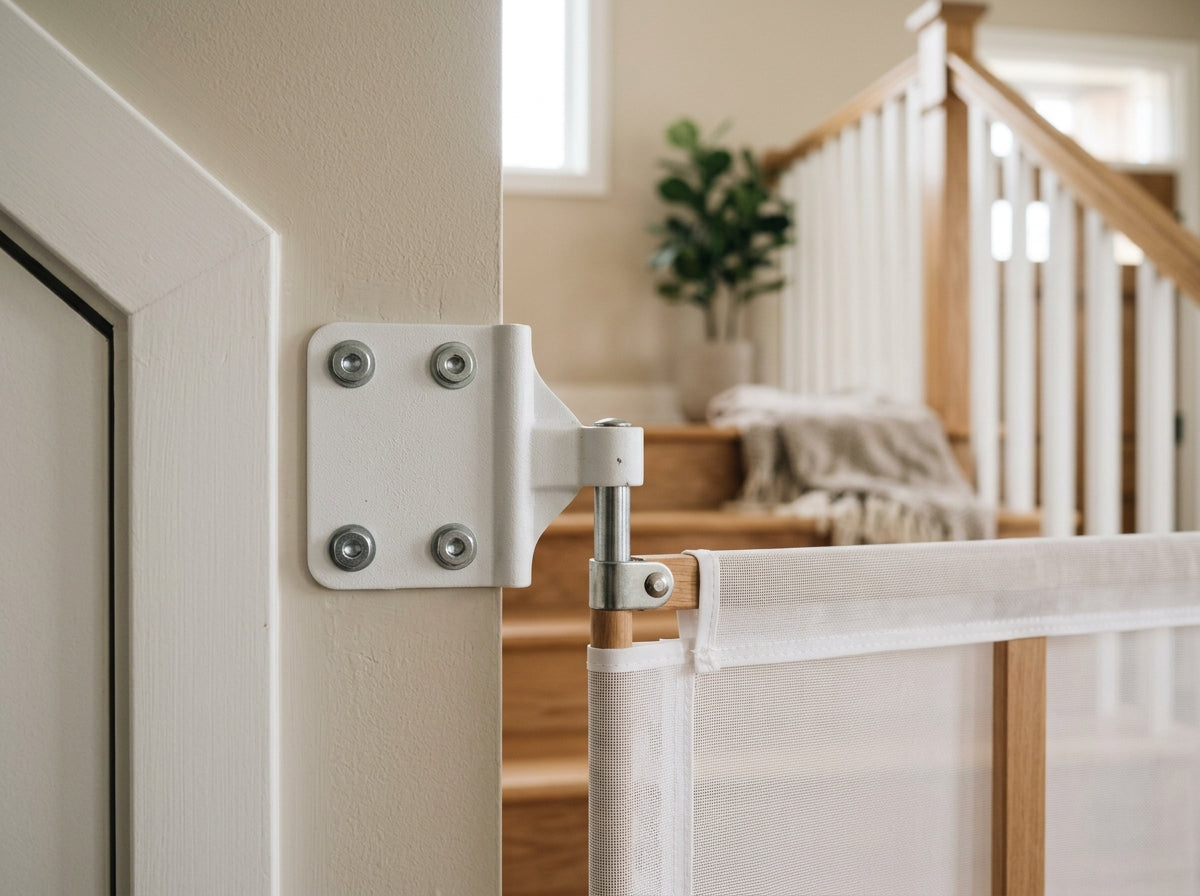
Gates are the single most visible piece of baby proofing hardware, and they’re also the most misunderstood. Pressure-mounted gates work at room dividers and low-risk openings. Hardware-mounted gates are required at the top of stairs. ASTM F1004 is the federal safety standard for expansion gates and expandable enclosures, made mandatory under 16 CFR Part 1239 effective in 2021. Any gate included in a gift set or recommended alongside one should meet this standard.
Gift sets don’t always include gates because of the size and cost, but the best ones either include a gate or explicitly recommend one with a specific ASTM F1004-compliant model. A checklist that says "you’ll also need a stair gate" without guidance is only half helpful.
Building a Set for a Specific Home
One thing I appreciate about the better bundles on the market is scope labeling. A set marketed as a "starter kit" should tell you whether it covers a single room, a full apartment, or a three-bedroom house. It should specify the age range it’s designed for, whether that’s birth through 18 months or through age 5, because the hazards shift as kids develop new skills.
Crawling, pulling to stand, climbing, and running each unlock new risks. A set that includes a developmental milestone guide alongside the hardware helps parents understand why a toilet lock matters at 12 months but a stove knob cover matters more at 18. The AAP’s HealthyChildren.org resource on home safety covers this developmental framing well, and any bundle that links to or reprints that guidance is more useful than one that just ships hardware.
Modular sets that let parents start with essentials and add specialized items later make practical sense for families who rent, who are moving, or who have unusual home layouts. A family in a single-story apartment doesn’t need the same set as a family in a split-level with a pool.
Core Items Every Bundle Should Have
Materials and Packaging
Eco-conscious parents increasingly scrutinize what safety products are made of, which is reasonable. BPA-free plastics and non-toxic materials matter when you’re attaching things to surfaces a child will mouth or handle. Minimal packaging is a secondary but real consideration. A set that arrives in a recyclable box with a reusable checklist card signals that someone thought about the whole product, not just the hardware.
In my testing, some outlet covers smell strongly of plastic off-gassing. Parents noticed. Those covers ended up in a drawer. A product that doesn’t get installed is not a safety product.
What to Write on the Card
If you’re giving a proofing set as a shower gift, say something specific on the card. "These are for month eight, when things get real" is more memorable than a generic note. Parents who understand why they received something are more likely to use it.
The CPSC’s Baby Safety resource page and the AAP’s HealthyChildren.org home safety section are both worth including as QR codes or printed URLs inside a bundle. A gift that comes with a starting point for further research is more valuable than one that assumes the hardware is self-explanatory.
Putting It Together
A useful baby proofing gift set has outlet protection, cabinet locks, furniture anchors, corner guards, and cord management at minimum. It labels its scope clearly. It includes a room-by-room checklist or developmental guide. It uses materials parents won’t reject. And it points toward a stair gate even if it can’t include one.
The best version of this gift arrives before the baby does, sits in a closet for a few months, and then gets opened at exactly the right moment, when a newly mobile child is making the house feel suddenly very dangerous. That’s the gift. Not the hardware itself, but the head start.