

Most households treat baby-proofing and pet-proofing as two separate projects. That’s a mistake. Your dog’s food bowl, your cat’s litter box, your baby’s play gate, the cabinet under the sink where you keep both the drain cleaner and the pet flea treatment, these spaces overlap constantly, and the hazards compound each other in ways that a single-purpose safety sweep will miss.
I learned this the hard way when my younger daughter was about ten months old. I had baby-proofed the kitchen pretty thoroughly, or so I thought. What I hadn’t accounted for was our dog’s water bowl sitting on the floor near the dishwasher. She made a beeline for it every single time I put her down. A child can drown in as little as one to two inches of water (AAP). A dog bowl holds more than that.
Why the Overlap Is More Dangerous Than Either Problem Alone
A standard baby-proofing checklist assumes a static environment. Your home with pets is not static. Food bowls move. Litter boxes get relocated. Pet medications sit on counters. Chew toys scatter across floors. And your baby, once mobile, treats all of it as equally interesting.
The cabinet under your kitchen sink is a good example. Many parents lock it because it holds cleaning products. But if you have a dog, it probably also holds flea and tick treatments, ear cleaning solution, and medicated shampoo. These are not covered by the same child-resistant packaging rules that apply to human medications. Under the federal Poison Prevention Packaging regulation (16 CFR Part 1700), specific household chemicals and medications must arrive in child-resistant packages, but veterinary products are a separate category with different requirements. Your baby does not know the difference between a bottle of children’s ibuprofen with a safety cap and a bottle of permethrin-based flea spray without one.
The hazard is not intent. It is access.
Cabinet Locks That Work for Both Purposes
The goal for any cabinet holding products dangerous to children or pets is the same: a lock that a toddler cannot defeat, that an adult can operate one-handed (because you will often have a baby on your hip), and that holds under repeated stress.
ASTM F3492–21 is the voluntary consumer safety standard that applies to cabinet locks and latches in the U.S. Locks that meet it must withstand an average breaking force of at least 45.3 lbs across a 30-sample test. That matters because not all locks on the market meet this benchmark, and the failure consequences are real. CPSC recalled 900,000 Safety 1st Push 'N Snap cabinet locks in March 2012 after 140 children defeated them, three reached toxic cleaning products.
For cabinets holding pet medications or veterinary chemicals alongside cleaning products, magnetic cabinet locks outperform adhesive strap locks. Adhesive strap locks fail on textured cabinet interiors, and once a toddler finds the flex point, the lock is defeated. Magnetic locks have no exterior strap or button for a toddler to work on, but no lock is completely childproof, so test them regularly. The magnet key stays in a drawer above the counter, out of reach, and the lock itself is invisible from outside the cabinet.
For the cabinet under the sink specifically, use a two-point magnetic lock system if the cabinet has double doors. A single center lock leaves enough gap for small fingers, and for a determined dog snout.

- Under-sink cabinet: cleaning and pet chemicals mixed
- Dog water bowl: drowning risk at floor level
- Pet food bowl: choking and bacterial exposure risk
- Gate gap: large enough for baby to squeeze through
Gates and Enclosures: Keeping Zones Separate
Zone separation is the most underused strategy in dual pet-and-baby households. The concept is simple: the baby’s primary play area should not be the same space where pet food, water, and litter are accessible. Achieving this requires gates that work against both a crawling infant and a medium-to-large dog.
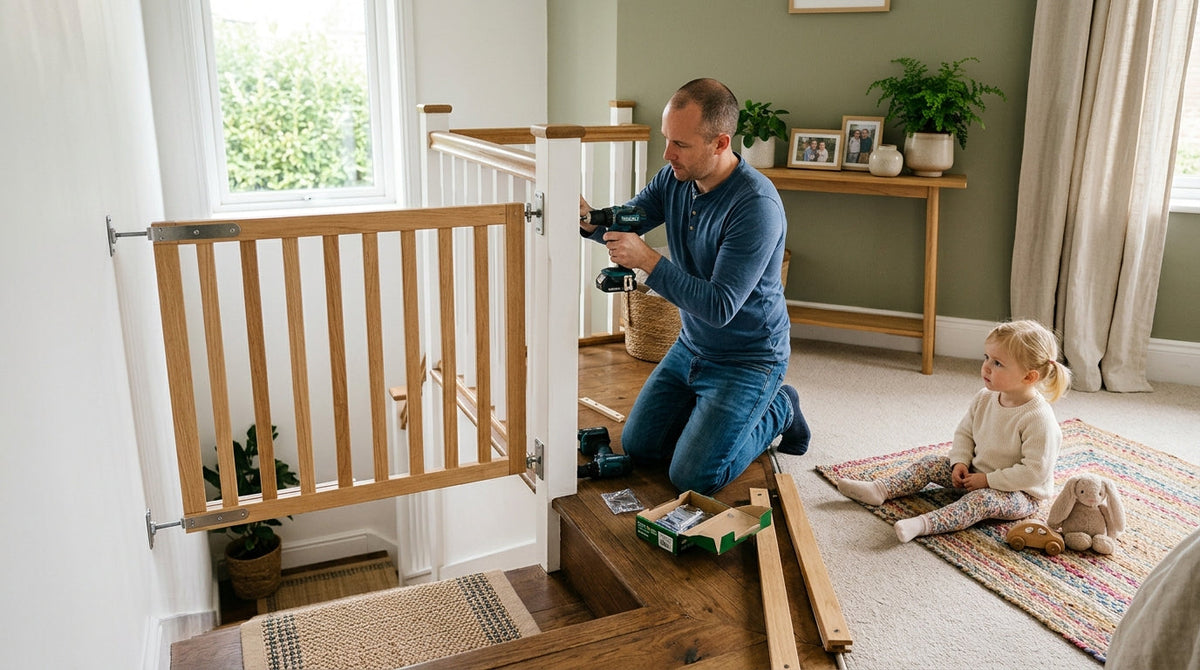
ASTM F1004 is the federal safety standard for expansion gates and expandable enclosures, made mandatory under 16 CFR Part 1239 (effective 2021). Pressure-mounted gates that meet this standard are adequate for doorways between low-traffic rooms. For the top of stairs, use a hardware-mounted gate only. No exceptions. About 93,000 children under 5 are treated in U.S. emergency rooms each year for stair-related injuries (Nationwide Children’s Hospital analysis of CPSC NEISS data).
The pet-specific wrinkle: most baby gates are not designed to contain a 60-pound Labrador. If your dog can push through a pressure gate, your baby’s zone is not protected. Test the gate yourself before relying on it. Push it hard from both sides. If it rocks, it will fail. For large dogs, look for gates with a hardware-mount option and a steel frame rather than plastic corner brackets. The baby safety certification tells you it will hold against a toddler. Your own push test tells you whether it will hold against your dog.
For the litter box, a covered litter enclosure inside a room the baby cannot access is the cleanest solution. Cat doors cut into a baby gate are commercially available and work well for cats under about 12 lbs. Above that weight, the opening tends to be large enough that a mobile baby can squeeze through by 12–14 months.


Pet Food and Water: The Floor-Level Problem
Pet food and water bowls are floor-level, which means they are exactly at the height of a crawling or cruising baby. Dry kibble is a choking hazard. Wet food is a bacterial exposure risk. And water, as noted above, is a drowning risk in a quantity that surprises most parents.
The practical solutions here are behavioral as much as physical. Feed your pet on a schedule and pick up the bowl between meals. If your pet is a free-feeder, transition to scheduled feeding before the baby becomes mobile. This is a harder change for cats than dogs, but it is achievable with a two-to-three week transition.
For water, an elevated stand keeps the bowl off the floor, but a baby who can pull to stand, which most can by their first birthday, can reach a bowl at 12–18 inches. Keep the water bowl in an area your baby can’t get into, or pick it up whenever your baby is on the floor.
Automatic pet feeders with locking lids are worth the investment if you have a baby who has figured out how to open standard bowls. The lid mechanisms on most of these are not designed to resist a toddler, so test before trusting.


Medications: Yours, Theirs, and the Cabinet They Share
This is the category where the stakes are highest and the habits are worst. Pet medications often live in the same cabinet as human medications because that is where people keep "medicine stuff." The problem is that veterinary medications are not subject to the same child-resistant packaging requirements as human drugs.
About 36,000 children under five are treated in U.S. emergency departments each year for unsupervised medication exposures (CDC PROTECT / NEISS-CADES). And even federally child-resistant packaging only has to keep 80–85% of test-panel children (ages 42–51 months) out, meaning roughly 15–20% can still get in. A bottle of flea prevention medication with a simple screw cap offers less protection than that.
Store all medications, human and veterinary, in a locked cabinet. Not a high shelf. Not a drawer with a strap lock. A cabinet with a magnetic lock or a keyed lock. CPSC Pediatric poisoning deaths in children under 5 reached 90 in 2023, and narcotic-medication fatalities specifically doubled from 33 in 2021 to 66 in 2023.
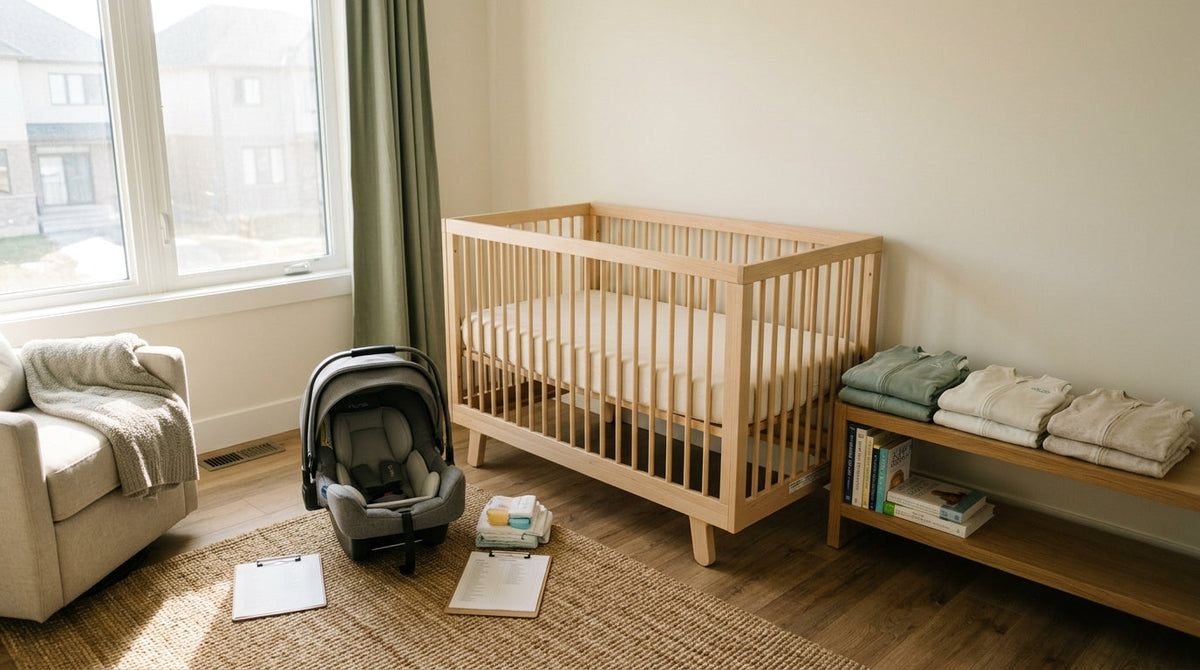
Dual Pet-and-Baby Safety Walk-Through
Furniture Anchoring: Protecting Babies and Pets Alike
Furniture tip-overs are a hazard that affects both babies and pets, though for different reasons. A child pulls up on a bookshelf or dresser. A large dog jumps against a TV console. The physics are the same. CPSC reports one child death every two weeks from tip-overs (CPSC).
Anchor every piece of freestanding furniture taller than 30 inches to a wall stud. Use anti-tip straps rated for at least several times the weight of the furniture piece. The strap itself is inexpensive. The installation takes twenty minutes. And it protects against both a toddler pulling up to stand and a dog who has decided the bookshelf is a launching pad.
A jumping cat exerts a lateral force that, combined with a baby pulling on a cabinet door, creates a different tip-over equation than either hazard alone. Anchoring takes fifteen minutes and protects against both.
The Walk-Through You Need
Standard baby-proofing checklists are written for homes without animals. Do your own walk-through with both populations in mind.
Get down to floor level in every room and look for:
- Pet food, water, or treats within a baby’s reach
- Veterinary medications stored without a locked cabinet
- Pet toys with small parts (squeakers, plastic eyes, rope fibers) that are choking hazards
- Litter boxes accessible to a crawling baby
- Pet doors or flaps that open to hazardous spaces
- Cords from pet heating pads or automatic feeders at floor level
- Gaps under gates large enough for a baby to squeeze through but too small for you to notice
Then look at your gates from the pet’s perspective. A gate that stops your toddler but not your dog means your toddler’s zone is only protected when the dog is elsewhere. That is not a system. That is luck.
The goal is a home where your baby’s safest spaces are safe, your pet has unobstructed access to what they need, and the hazardous overlap zones are locked, anchored, or physically separated. It takes more planning than a single-purpose baby-proofing sweep, but it holds up better in daily life.