
Baby Proofing for Toddlers Who Climb Everything

Somewhere around 22 months, my older daughter figured out that dresser drawers make excellent ladder rungs. I walked into her room one afternoon to find her standing on the third drawer, eye level with the top of a five-drawer chest, reaching for a tube of diaper cream she’d spotted up there the week before. The dresser hadn’t moved. But it absolutely could have.
If your toddler climbs, you already know the particular dread of that moment. And the statistics behind it are not reassuring: the CPSC reports one child death every two weeks from furniture, TV, or appliance tip-overs. An average of 17,800 people visit emergency departments every year for injuries from furniture and TV tip-overs. Toddlers are not a small share of that number.
The good news is that climbing itself is not the problem. It’s the environment that either contains the risk or multiplies it.
Why Toddlers Climb Everything (And Why You Can’t Stop Them)
The AAP describes climbing as developmentally normal behavior for toddlers from roughly 18 months through age 3. By 1 year, most children are already pulling to stand and walking while holding onto furniture, per the CDC’s Learn the Signs. Act Early. milestones. Climbing is the natural next step. They are building gross motor skills, testing spatial reasoning, and figuring out what their bodies can do. Punishing it doesn’t work. It also doesn’t address the actual hazard, which is the furniture, not the child.
What does work is redirecting climbing to appropriate outlets and hardening every surface that could become an unintended target. A foam climbing structure, a low indoor slide, or consistent outdoor playground time gives a climbing toddler somewhere to put that energy. It won’t eliminate indoor climbing entirely. But it reduces the frequency, and frequency is what wears down your vigilance.
Anchor Every Tall Piece of Furniture. Every One.
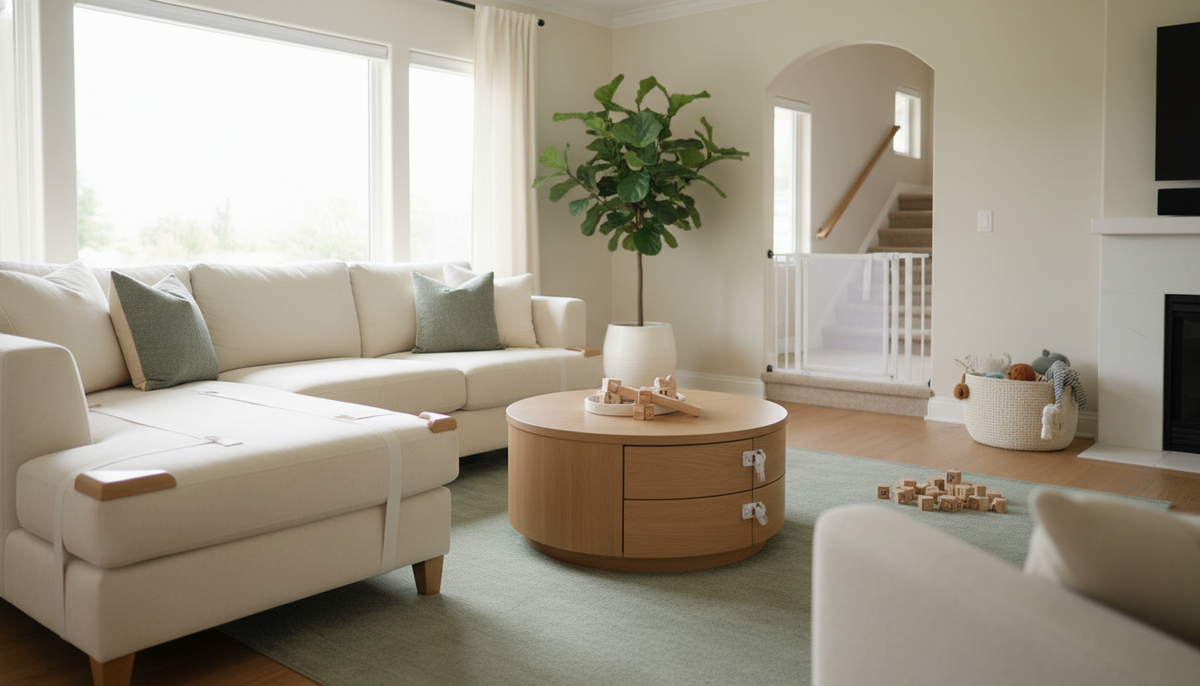
The CPSC recommends anchoring all furniture taller than the child to the wall, regardless of how stable it looks. That qualifier matters. A five-drawer dresser that has sat in the same spot for years without tipping will tip when a 28-pound child grabs the top two drawers and pulls. The physics change when weight shifts forward and upward simultaneously.
Furniture anchor straps work by distributing the force of a tip-over across wall studs rather than allowing the piece to pivot forward. When you’re choosing straps, look for ones rated for the combined weight of the furniture plus the heaviest load it will hold. A bookcase with books on every shelf is significantly heavier than an empty one. Account for that.
Installation matters as much as the strap itself. Anchors must go into wall studs or into toggle bolts or molly bolts rated for at least 50 pounds per anchor. Drywall alone will not hold. If you can’t locate studs, use heavy-duty drywall anchors rated for the load, and install at least two anchors per piece of furniture. The manufacturer’s specified height and angle for the strap are not suggestions. A strap installed too low changes the leverage geometry and reduces effectiveness.


Dressers and Nightstands: The Highest-Risk Pieces
Any dresser over 30 inches tall should be anchored. Full stop. Toddlers target dressers specifically because the drawers create a natural ladder, and because there’s always something interesting on top. My older daughter wasn’t the first child to discover this. She won’t be the last.
Anti-tip straps on dressers need to be installed with the drawer-as-ladder scenario in mind. When a toddler opens the bottom drawer and steps in, then opens the next one, the center of gravity shifts forward with every step. Even a heavy, solid dresser can tip under those conditions. The strap needs to be taut, not just attached. A loose strap allows significant forward movement before it catches, and that movement may be enough.
Nightstands are lower but not safe to ignore. A toddler who can’t reach the top of a dresser will use a nightstand as a stepping stone. If it tips while they’re transitioning, the fall is from a height, onto furniture, often in a small space between the bed and the wall.
Televisions Require Two Layers of Protection
A TV bolted to a stand is not a secured TV. The stand itself can tip. I’ve watched a toddler rock a 55-inch TV on a furniture stand by pulling on the stand’s lower shelf, which they’d identified as a step. The TV didn’t fall that time. But the stand moved several inches before I got there.
Free-standing televisions should be wall-mounted whenever possible. If wall-mounting isn’t an option, use both a weighted base and anchor straps connecting the TV and stand to the wall. The anchor strap alone won’t prevent the stand from tipping if the stand itself is lightweight. Both layers are necessary.
Cords and cables trailing down from a TV are a secondary hazard. A climbing toddler will grab them, and a taut cord can pull a device off a surface faster than you’d expect.
Bookcases and Shelving: Instant Climbing Structures
My younger daughter cleared the bottom two shelves of a low bookcase in about 90 seconds, then used the empty shelves as steps. She was 19 months old. I had not yet anchored that particular shelf because it was short and I thought it was too heavy to tip. I was wrong on the risk calculation, if not the physics.
Anchor all shelving to the wall. Even lightweight shelves can cause serious injury if they tip onto a small child. Once anchored, load heavier items on lower shelves. This lowers the center of gravity and reduces the tip-over force required, which matters if the anchor ever experiences stress.
Clear the lower shelves of anything that looks interesting to a toddler. If the shelf holds nothing worth reaching, the motivation to climb it drops.
Drawers and Cabinets: Locks That Hold
Drawer locks serve two purposes for a climbing toddler. They prevent the drawer from opening as a handhold, and they block access to whatever is inside. Test every lock by pulling hard on the drawer or door after installation. Apply the kind of force a frustrated toddler generates, which is more than most parents expect.
Magnetic cabinet locks are harder for toddlers to defeat than spring-loaded latches. In March 2012, the CPSC recalled 900,000 Safety 1st Push 'N Snap cabinet locks after 140 children defeated them, including three who reached toxic cleaning products. Spring-loaded mechanisms that require simultaneous push-and-pull can be figured out by a persistent 2-year-old. Magnetic locks require a key that stays out of reach, which removes the puzzle element entirely.
Under-sink cabinets deserve particular attention. Cleaning products, drain openers, and dishwasher pods are among the most hazardous items in most homes. A two-lock system on under-sink cabinets, or relocating those products entirely, is worth the inconvenience.
Window Cords and Blind Pulls
Climbing toddlers are at heightened risk from window cords because they can reach them. A child who pulls themselves up to a windowsill using furniture, or who climbs onto a nearby bed or chair, can reach a cord that would otherwise be considered out of range.
Cordless blinds or motorized options eliminate this hazard entirely. If you have corded blinds, secure the cords with a cleat hook mounted well above the child’s maximum reach, accounting for what they can reach while standing on furniture. Looped cords are the most dangerous configuration. Cut them and install safety tassels, or replace the blinds.
Room-by-Room Anchoring Checklist
Maintenance: Anchors Loosen Over Time
I check every anchor strap in our house every three months. It sounds excessive until you find a bolt that has backed out a quarter-turn from vibration and humidity cycling. Hardware loosens. Straps develop slack. A strap that was taut at installation may have enough play six months later to allow dangerous forward movement before it catches.
Set a calendar reminder. Tighten any loose bolts. Replace any strap that shows fraying, cracking, or deformation at the attachment points. As your toddler grows stronger, the forces on these anchors increase. The hardware needs to keep up.
Reducing Temptation Through Room Layout
Furniture-free pathways reduce the chance a toddler uses furniture as a shortcut or launching pad. When pieces are close together, a child navigates by touching and leaning on them. When there’s clear floor space, they walk through it.
Keep the tops of furniture clear of interesting objects. A toddler who can see something worth reaching will find a way to reach it. One who sees nothing worth the effort is more likely to move on. This isn’t foolproof, but it reduces the number of climbing attempts, which reduces the number of opportunities for something to go wrong.
Supervision remains the most important layer of protection. Environmental modifications buy you time and reduce consequences when supervision lapses. They don’t replace it. A room that is fully anchored and locked is still a room that needs a parent nearby, because a climbing toddler will always find something you didn’t anticipate.