
Baby Proofing Service Cost: What Professionals Charge and Is It Worth It?

About 93,000 children under 5 are treated in U.S. emergency rooms each year for stair-related injuries. That’s one child every six minutes, according to a Nationwide Children’s Hospital analysis of CPSC data. And stairs are just one hazard in a house full of them. So when parents ask whether hiring a professional baby proofer is worth the money, the honest answer is: it depends on your home, your kids, and how much you trust yourself to catch everything.
Here’s what professionals charge, what you get for that money, and how to decide if it makes sense for your family.
What Professional Baby Proofing Costs
Most professional baby proofing services fall in a range of $200 to $1,500 or more for a complete assessment and installation. The spread is wide because the variables are real. A 900-square-foot apartment with one bathroom is a different job than a three-story house with a pool, a finished basement, and a toddler who already climbs.
Initial consultations are often free, or run $50–$150 if the consultant charges separately for the walkthrough. Many fold that fee into the total if you book the installation. Hardware costs are usually billed on top of labor, so ask upfront whether the quote includes products or just the service.
Bundled packages, covering an initial assessment, full installation, and a follow-up visit three to six months later, typically cost less per hour than booking each visit separately. If you’re comparing quotes, ask what each one includes. A $300 quote that covers only installation is not the same as a $450 quote that includes a written hazard report and a return visit.
What a Consultant Does That You Might Not
The value of a professional goes beyond the hardware. It’s the systematic eye.
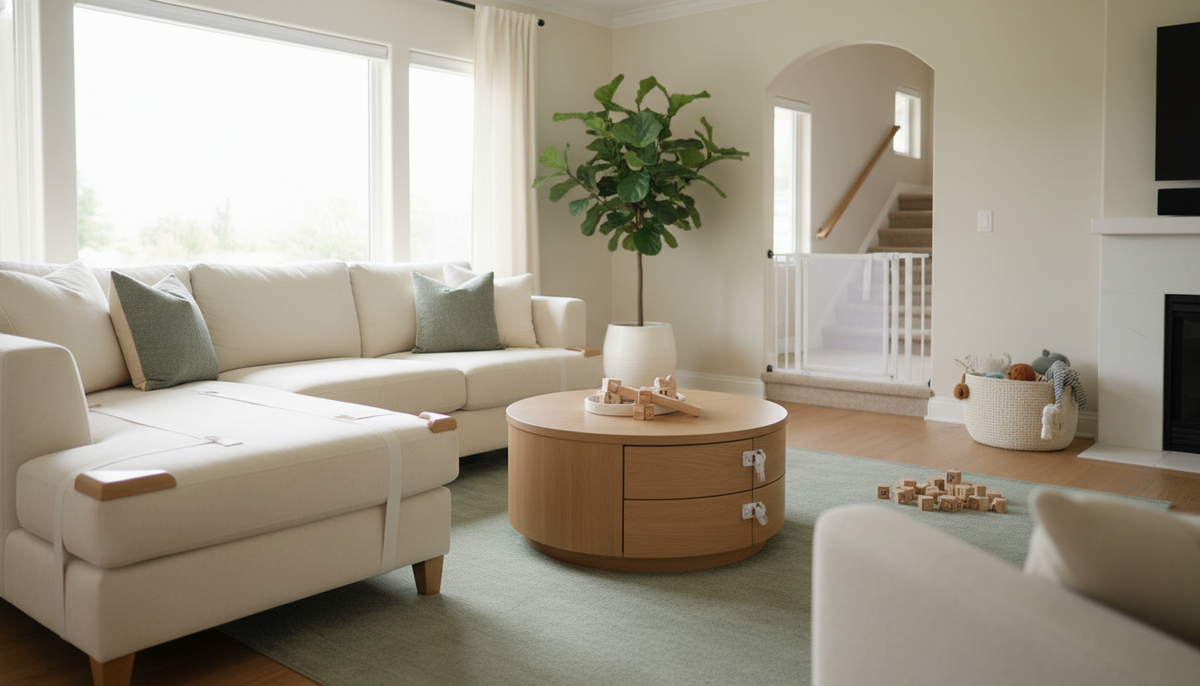
A certified consultant walks your home the way a fire marshal walks a building, looking for hazards in sequence and context, not just the obvious ones. They check whether furniture is anchored against the specific wall material in your home, not just whether you own straps. They test whether cabinet locks hold under repeated lateral force. They look at window cord lengths relative to your crib placement. They check railings for structural stability, not just whether a spindle is loose.
In my experience, adhesive locks have limitations. When my older daughter was about 26 months old, she defeated an adhesive strap lock on our media console in under a week. I had installed it correctly, on a clean surface, following the instructions. What I hadn’t done was consider that the laminate finish on that particular piece of furniture was low-porosity, and adhesive locks simply don’t hold on it. A professional would have caught that on the walkthrough and used a hardware-mounted alternative instead.
The CPSC has documented that unsecured furniture and TVs are among the leading causes of preventable child injury deaths at home. A consultant trained on current CPSC guidelines will identify the specific anchoring risks in your home rather than applying a generic checklist.
Professional Baby Proofing: What’s Typically Included
| Service Tier | Typical Cost | Includes |
|---|---|---|
| Consultation only | $50–$150 | Walkthrough, verbal report |
| Installation only | $200–$500 | Hardware install, no assessment |
| Full-service package | $400–$1,500+ | Assessment, install, follow-up visit |
| DIY supplies | $100–$500 | Hardware only, self-installed |
DIY vs. Professional: The Real Comparison
DIY baby proofing typically runs $100–$500 in supplies: gates, cabinet locks, outlet covers, furniture anchors, door pinch guards. The supplies themselves are not the problem. The problem is installation quality and coverage gaps.
Gates are a good example. ASTM F1004 is the federal safety standard for expansion gates and expandable enclosures, made mandatory under 16 CFR Part 1239, effective 2021. A compliant gate at the top of stairs must be hardware-mounted, not pressure-mounted. Many parents buy pressure-mounted gates because they’re easier to install and don’t require drilling. Professionals know the difference and won’t put a pressure gate at a stair opening.
Beyond installation errors, the bigger DIY risk is incomplete coverage. Parents tend to address the hazards they can see and miss the ones they haven’t thought of. Cord management behind furniture. The gap between a freestanding bookcase and the wall. The bathroom vanity that looks stable but isn’t anchored. A professional is paid to find those gaps. You are not paid to find them, and you’re also managing a toddler while you try.
That said, DIY is a reasonable path for parents in smaller homes, with one young child, who are willing to do thorough research and re-evaluate as their child develops. It’s not inherently inferior. It just requires more from you.


When the Math Favors Hiring a Professional
For some families, the cost-benefit calculation is straightforward.
Renters often can’t drill into walls without risking their security deposit. A professional who works with renters regularly knows which hardware-free solutions hold up and which don’t, and can advise on what your landlord is likely to permit.
Multi-level homes with multiple stair openings, split levels, or open loft railings have more anchor points and more complexity than a single-floor layout. The time required to assess and address all of them correctly adds up fast.
Families with children who have developmental delays or autism spectrum disorder may need a more comprehensive approach. Some consultants specialize in atypical hazard-seeking behaviors, including children who engage with locks differently, who don’t respond to verbal redirection, or who are drawn to specific sensory hazards like water or heights. A general checklist doesn’t cover those situations well.
Families expecting a second child while the first is already mobile are often managing too much to do a thorough job themselves. A professional can assess the home in a few hours and hand you a written report instead of adding another project to your list.
The Insurance and Liability Angle
Many parents don’t think about this until after an incident. Most homeowner and renter insurance policies do not cover injuries from preventable hazards, and medical bills from a fall, a poisoning, or a furniture tip-over can be significant. A professional assessment creates a documented record that you identified and addressed known hazards in your home.
Professional installers also carry liability insurance for their work. If a gate they installed fails and a child is injured, their insurance covers the claim. If you installed it yourself and it fails, that’s a different conversation with your insurance company.
This doesn’t mean you should hire a professional purely for legal protection. But it’s worth factoring into the cost comparison.
What the Written Report Is Worth
Good consultants provide a written hazard report after the walkthrough, documenting what they found, what was installed, and what still needs attention. That document has real ongoing value.
When you move, you have a reference for what to check in the new home. When a new caregiver starts, you can walk them through it. When your younger child hits a new developmental milestone and starts climbing, you can pull it out and see what the consultant flagged for that stage.
In my experience, these reports are especially useful when kids develop new skills faster than expected. My younger daughter cleared the under-sink cabinet in the time it took me to answer the door, at an age when I hadn’t expected her to have the grip strength for the handle. A follow-up visit from a consultant would have caught that transition earlier than I did.
Common Questions About Baby Proofing Costs
How much does professional baby proofing cost on average?
Is DIY baby proofing safe enough?
What credentials should I look for in a baby proofing consultant?
Can renters hire a professional baby proofer?
Does a professional baby proofing assessment cover children with special needs?
What is a written hazard report and do I need one?
How to Vet a Consultant Before You Hire
There is no single national licensing body for baby proofing professionals. That means credentials vary, and you need to ask the right questions.
Look for consultants with training from recognized organizations such as the International Association of Family Child Care Professionals (IAFCP), or manufacturer-specific installation certification from major hardware brands. Ask whether they carry liability insurance. Ask for references from clients with homes similar to yours. Ask which product standards they follow and whether they’re current on CPSC recall notices.
A good consultant will welcome those questions. One who deflects them is a reason to keep looking.
What Professional Proofing Cannot Do
Hiring a consultant does not transfer responsibility for supervision. A locked cabinet is not a substitute for watching a toddler in the kitchen. A gate at the top of the stairs does not mean you stop listening for footsteps at night.
Professional baby proofing is a foundation. It reduces the number of hazards your child can access unsupervised and buys you margin when your attention is divided. The AAP is clear that active supervision remains the most effective child safety measure, and no amount of hardware changes that.
The goal is layered protection: good supervision, a well-proofed environment, and age-appropriate safety education as your child grows. A professional can build the second layer for you. The other two are yours.