Best Baby Proofing Products 2026: Our Top Picks in Every Category

Every home is different. A third-floor apartment with no stairs, no pool, and a single bathroom has a different risk profile than a four-bedroom house with a basement, a garage, and a backyard gate that swings open onto a slope. Before you buy anything, walk your specific space and write down what you see. The products below are the best in each category we’ve tested, but the right order of priority depends entirely on your home.
We’ve installed, lived with, and in some cases watched our kids defeat every type of product here. Where a product failed in testing, we say so.
Safety Gates: Hardware-Mounted at the Top of Stairs, Always
Roughly one child every six minutes is treated for a stair-related injury in a U.S. emergency room (Nationwide Children’s Hospital analysis of CPSC NEISS data, 1999–2008). The same study found the number of these injuries fell about 12% over that decade, and a quarter of injuries to babies under 1 happened while the baby was being carried on the stairs, so a gate is only one part of stair safety. For a crawling or walking child, the gate you choose and where you put it are the part you control.
The federal safety standard for expansion gates and expandable enclosures is ASTM F1004, made mandatory under 16 CFR Part 1239 (effective 2021). Any gate you buy should carry that certification. What it does not tell you, and what matters just as much, is whether you’re using a pressure-mounted gate at the top of stairs. Don’t. Pressure-mounted gates work in doorways and room dividers, where a child pushing against them falls into a room. At the top of stairs, a child pushing against a pressure-mounted gate falls down them. Hardware-mounted gates bolt into wall studs and are the only acceptable option for stair tops.
Our top pick for stair tops: The Munchkin Loft Hardware-Mounted Gate. It has a one-hand open mechanism, swings both directions, and the mounting hardware reaches studs in most standard framing. At the top of stairs a gate must never swing out over the steps, so if yours swings both ways, set its one-way stop or choose a model that opens only toward the landing. I’ve had it installed at the top of our stairs for two years. My older daughter tested it hard at around 28 months. It held.
For doorways and room dividers: The Regalo Easy Step Extra Tall Walk-Through Gate is pressure-mounted, meets ASTM F1004, and installs in under ten minutes. Good for blocking kitchen doorways where you want quick adult access.
One practical note: measure your opening before you order. Extensions are sold separately for most gates, and a gate that’s two inches too narrow is useless.
Cabinet Locks: Magnetic Over Push-Button
In 2024, household cleaning substances topped the list of substances kids under 6 got into, accounting for roughly 1 in 10 (10.1%) of all pediatric poison center cases (America’s Poison Centers). That statistic is why under-sink cabinets are the first place I tell every new parent to lock.
My younger daughter once emptied the cabinet under our kitchen sink in the time it took me to answer the front door. She was 18 months old, fast, and had been watching me open that cabinet for weeks. The push-button adhesive lock that was supposed to stop her had partially failed because I’d installed it on a slightly textured cabinet face. That was an expensive lesson in adhesive surface prep.
Magnetic locks are harder for toddlers to defeat than push-button models because there’s no visible mechanism to manipulate. You mount the lock inside the cabinet, and you open it with a magnetic key that you keep out of reach. The Safety 1st Magnetic Cabinet Lock is our top pick. The adhesive version works on smooth cabinet faces; the screw-mount version works everywhere. Use the screw-mount for any cabinet containing medication, cleaning products, or sharp objects.
For drawers: The Jool Baby Cabinet Locks use a flexible adhesive strap that loops through two adjacent handles. They’re faster to install than magnetic locks and work well on drawers that don’t contain high-risk items. But my older daughter defeated an adhesive strap lock at 26 months by pulling the adhesive pad off the cabinet face. Surface prep matters: clean with isopropyl alcohol, let it dry completely, and press for 60 seconds.
Outlet Covers: Skip the Plug-In Caps
Plug-in outlet covers, the small plastic caps that fill unused receptacles, are a choking hazard. A child who pulls one out has a small, mouth-sized disc in their hand. The CPSC has flagged this issue, and the better solution has been built into the electrical code for years.
Tamper-resistant receptacles (TRRs) have internal shutters that only open when equal pressure is applied to both slots simultaneously, which is what a plug does but not what a finger or a hairpin does. The National Electrical Code has required TRRs in new residential construction since 2008. If your home was built or renovated after that, you may already have them. Look for "TR" stamped between the slots.
If your home has older outlets, sliding plate covers are the safest retrofit. The Dreambaby Outlet Cover with Sliding Plate replaces your existing outlet cover and requires a deliberate two-step motion to open. It’s not removable by a toddler and doesn’t create a choking hazard.
Skip the plug-in caps entirely. They’re cheap, but the risk profile is wrong.


Furniture Anchoring: Studs Only, No Exceptions
Furniture tip-overs send thousands of children to emergency rooms every year. Dressers, bookcases, and televisions are the most common culprits, and the physics are straightforward: a child climbs an open drawer like a ladder, shifts the center of gravity forward, and the piece comes down. A 150-pound dresser falling on a toddler is a life-threatening event.
Anti-tip straps work. But only if they’re anchored to a wall stud. Drywall anchors alone will not hold a falling dresser. The strap needs to reach a stud, which means you need a stud finder before you install anything. Most anti-tip kits include two straps; use both.
Our top pick: The Furniture Anchor by Quakehold. The straps are rated to hold well beyond what any residential dresser or bookcase weighs, the hardware is metal throughout (no plastic buckles), and the instructions include a stud-finding step. I’ve installed these on every tall piece of furniture in our home, including the IKEA KALLAX bookcase in our playroom, which my kids treat as a climbing wall.
For televisions, use the anti-tip strap that came with your TV stand if it included one, and supplement with a dedicated TV strap if the stand strap feels flimsy. The Echogear TV Anti-Tip Strap is our pick for flat-panel TVs up to 80 inches.
One thing people miss: anchor the TV stand to the wall as well as the TV to the stand. A child can pull the whole stand forward if only the TV is strapped.
Window Safety: Cordless Blinds and Window Stops
About 3,300 children age 5 and younger are treated in U.S. emergency rooms each year for window fall injuries (CPSC). Window covering cords are a separate and recognized strangulation hazard for young children. These are two distinct problems that require two distinct solutions.
For window falls, the fix is a window stop or window guard that prevents the window from opening more than 4 inches. Windows in homes with young children should not open more than 4 inches (CPSC and AAP). The Kidco Window Stop is a simple screw-in device that limits opening width. It takes about five minutes per window and doesn’t require tools beyond a screwdriver.
For cord strangulation, the only real solution is cordless window coverings. If you’re replacing blinds, buy cordless. If you’re keeping existing corded blinds, the CPSC recommends cutting looped cords into two separate strands and using tension devices to keep them out of reach. This is a compromise, not a fix. Cordless is always better.
Our top pick for cordless blinds: Bali Blinds Cordless Light Filtering Cellular Shades. They’re available in custom sizes, the lift mechanism holds at any height, and they’ve held up through two kids and four years of daily use in our main living areas.
Window guards (metal bars or grilles) are appropriate for windows above the first floor. They must be the kind that adults can open from the inside in a fire emergency. Fixed window guards that cannot be released are a fire hazard and are prohibited in most jurisdictions.
Door Locks and Handle Covers: Match the Hardware
Bathrooms, garages, and exterior doors each present different risks. Bathrooms: drowning in the tub, medication access, toilet falls. Garages: chemical storage, power tools, vehicles. Exterior doors: wandering, which is a serious risk for children with autism spectrum disorder and for toddlers who wake before their parents.
For round doorknobs, the Safety 1st Grip 'N Go Doorknob Cover is our pick. It fits over the knob and requires an adult-sized hand to compress and turn simultaneously. My younger daughter spent about three weeks trying to defeat the one on our bathroom door. She eventually did, at around 30 months, but it bought us a year of reliable protection.
For lever-style handles, you need a lever handle cover. The Jool Baby Door Lever Lock mounts over the lever and requires pressing a button while lifting to operate. It works on most lever styles, though you should check the mounting dimensions against your specific hardware before ordering.
For exterior doors where wandering is a concern, a simple door alarm is worth adding alongside a lock. The door alarm wakes you; the lock gives you time. The GE Personal Security Door Alarm is loud (120 dB), battery-powered, and installs in seconds with adhesive.
Stove Knob Covers and Oven Locks
Burns are among the most common kitchen injuries in young children. Stove knob covers prevent a child from turning on a burner, and oven locks prevent the oven door from being opened.
Stove knob covers vary significantly by stove model. The Jool Baby Stove Knob Covers fit most standard round knobs and require pressing and rotating simultaneously to operate. Measure your knob diameter before ordering; covers that don’t fit snugly are worse than no covers because they give false confidence.
Oven door locks work similarly to cabinet locks: a latch that adults can release but toddlers can’t. The KidCo Oven Lock is our pick. It mounts with adhesive to the oven door and frame and has held up to high oven temperatures without degrading.
One design note worth knowing: pull-down oven doors (the standard configuration on most ranges) present a tipping hazard. A child who hangs on an open oven door can pull a freestanding range forward. If you’re renovating, a wall oven eliminates this risk entirely. If you’re not, make sure the range has an anti-tip bracket installed and engaged; the CPSC says freestanding ranges and stoves should have one to prevent scalding and crushing injuries. An oven lock adds a second layer by keeping the door shut, but it does not stop a range from tipping.
Corner Guards and Edge Bumpers
Falls onto sharp furniture edges and fireplace hearths are a consistent source of head lacerations in toddlers. The furniture in most homes, coffee tables, hearths, TV stands, has corners and edges that are dangerous to a child who is still developing balance.
Foam corner guards are the most common solution and the least durable. They compress, peel, and get chewed. They’re fine for short-term use or rental situations where you can’t modify furniture.
Silicone corner guards hold up better. The Roving Cove Safe-O-Tronic Edge and Corner Guards are our pick. They’re clear, low-profile, and the adhesive has held on our glass coffee table through two years of daily contact. They don’t yellow the way foam does.
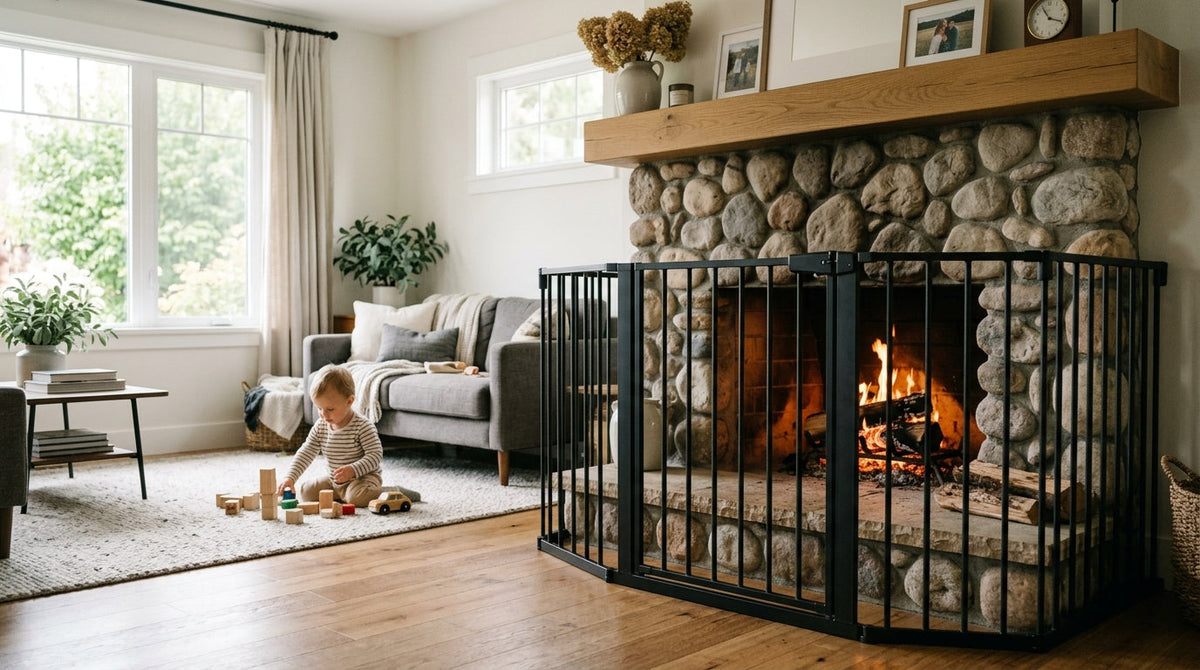
For fireplace hearths, the better solution is a full hearth gate or a padded hearth cover rather than individual corner guards. The North States Superyard Fireplace Hearth Gate creates a full barrier around the hearth and freestanding panels can be reconfigured as your child grows.
Baby Monitors: Encrypted, Local Viewing Available
A baby monitor is a supervision tool, not a safety device in the same category as a gate or anchor. But it matters. And the security of the monitor matters more than most parents realize.
WiFi-connected monitors that store footage in the cloud have been compromised in documented cases. A monitor with local viewing, meaning it stores and displays footage on a dedicated parent unit without routing through a third-party server, is more secure. If you use a cloud-connected monitor, change the default password immediately, use a strong unique password, and enable two-factor authentication if the app supports it.
Our top pick for local viewing: The Infant Optics DXR-8 PRO. It has a dedicated parent unit, no cloud storage, interchangeable lenses, and two-way audio. The range is solid in a two-story home. I’ve used it for both kids and the battery life on the parent unit is good.
For parents who want smart home integration: The Nanit Pro is our pick. It has strong encryption and a good app. Its breathing-motion wear is a convenience, not a safety device: the AAP says there is no evidence that consumer wellness monitors like this lower SIDS risk and warns not to let them give you a false sense of security, so safe sleep practices still do the protecting. You’re trading local-only storage for features; understand that trade-off before you buy.
High-Priority Installs Before Baby Is Mobile
Bed Rails and Guardrails: Check the Gap
Bed rails prevent falls from elevated sleep surfaces, which includes toddler beds, twin beds, and any adult bed a child is transitioning to. The relevant standard is ASTM F2085, which the CPSC made mandatory for portable bed rails under 16 CFR Part 1224.
The critical measurement is the gap between the rail and the mattress. Any gap is an entrapment risk: the CPSC warns that gaps in and around bed rails have entrapped young children and killed infants. The rail must fit snugly against the mattress with no space between them. This is why you cannot always use a rail designed for a twin mattress on a pillow-top king: the mattress depth changes the gap geometry.
Our top pick: The Regalo Swing Down Bed Rail Guard. It meets ASTM F2085, the swing-down mechanism makes getting in and out easy for a child who’s mobile, and it fits mattress depths up to 12 inches. Check your mattress depth before ordering.
One thing to know: bed rails are not for babies or young toddlers. The CPSC says portable bed rails are for children who can get in and out of bed on their own, typically 2 to 5 years old, and should never be used for a child younger than 2. An infant should sleep in a crib that meets current CPSC standards, with no soft bedding, no pillows, and no rail attachments.
Non-Slip Bath Mats and Tub Seats
Bathtubs are slippery when wet, which is a design problem that hasn’t changed. Slip-and-fall injuries during bathing are common in young children, and most of them are preventable.
Non-slip bath mats should cover the full floor of the tub, not just a small center section. The Gorilla Grip Original Patented Bath Mat has strong suction cups, covers a full tub floor, and the textured surface provides real grip. It’s machine washable, which matters because mold growth under a bath mat that doesn’t get cleaned is its own problem.
Tub seats for infants and young toddlers provide stability during bathing. The Summer Infant My Bath Seat has drainage holes in the seat (which prevent water pooling), a wide base, and suction cups that grip the tub floor. The critical rule with any tub seat: it is a positioning device, not a supervision substitute. A child in a tub seat still requires an adult within arm’s reach at all times. Drowning can happen in inches of water in seconds.
For bath spout covers, the Skip Hop Moby Waterfall Bath Spout Cover fits most standard tub spouts and cushions the impact if a child bumps their head. It’s a small addition with a real protective function.
Putting It Together: Audit First, Buy Second
The right approach to baby proofing is a room-by-room hazard audit before you add anything to your cart. Walk each room at your child’s eye level, literally crouch down, and look for what they’ll see: cords, cabinet handles, furniture edges, outlet faces, gaps under doors. Make a list. Then prioritize by severity of potential injury.
Falls from stairs and windows, tip-over injuries, and poisoning from cleaning products and medications are the categories with the highest injury rates. Start there. Gates, furniture anchors, cabinet locks, and window stops should go in before your child is mobile, ideally before they’re born if you have the time.
Products certified by the Juvenile Products Manufacturers Association (JPMA) have been independently tested against applicable ASTM standards. The JPMA certification seal is a useful shortcut when you’re comparing two similar products and can’t find detailed testing data.
Baby proofing is not a one-time project. It’s a moving target. A gate that stopped your child at 14 months may be climbed at 22 months. A cabinet lock that worked last year may have a degraded adhesive pad today. Check your installations every few months, especially after any furniture moves or renovations, and update your approach as your child grows.