
Diaper Changing Safety: Preventing Falls from the Changing Table

Every diaper change is a small, ordinary moment. It is also one of the most common settings for an infant fall.
Changing table falls send thousands of children to emergency rooms each year in the United States. Most of those falls happen in seconds, while a caregiver’s attention shifts, while a hand reaches for a wipe, while someone answers the door. The baby was fine. Then they weren’t. The gap between those two states is smaller than most parents expect, and it shrinks fast once a baby learns to roll.
Why Changing Table Falls Happen So Quickly
Infants can roll unexpectedly starting as early as 3–4 months of age, per CDC developmental milestone data. That is younger than most first-time parents anticipate. A baby who showed no interest in rolling yesterday can surprise you today, and a changing table is an unforgiving place for that surprise.
The falls that end in emergency rooms almost always share the same structure: caregiver present, caregiver distracted, baby moves. The distraction is usually something trivial. Reaching for the diaper cream that got pushed to the back of the shelf. Grabbing a new onesie from the drawer. Turning to answer a question from a toddler in the doorway. None of those things feel like abandonment. But a 30-inch drop onto a hard floor does not care about your intentions.
In my experience, infants can surprise you with rolling ability much earlier than expected. A baby who showed no rolling ability one day can roll the next, which is why keeping your hand on them at all times is non-negotiable.
The One Rule That Prevents Most Falls
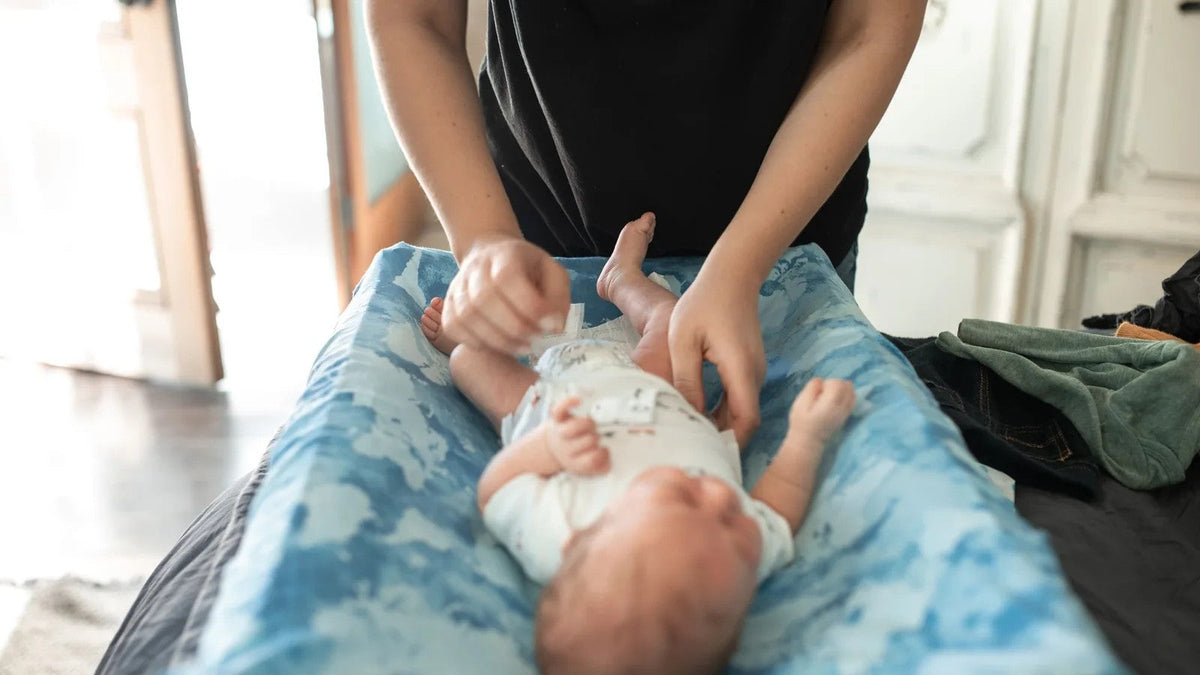
Keep one hand on your baby at all times. Not most of the time. Not when you remember. Every single change, from the moment you set them down until the moment you lift them off.
This is the single most effective prevention strategy because it removes the window in which falls occur. A baby cannot roll off a surface while your hand is on their belly. The hand does not need to be restraining. It needs to be present, making contact, ready to respond to movement.
Pre-organize everything before you put the baby down. Diapers, wipes, cream, a change of clothes, a spare onesie if your baby is a spitter. All of it within arm’s reach before the baby touches the pad. This sounds obvious. It is also the step most caregivers skip when they’re tired at 2 a.m. and assume they’ll just grab what they need as they go. That assumption is where falls begin.
A small caddy placed directly beside the changing pad keeps all supplies within arm’s reach. Returning everything to it after every change takes ten seconds and eliminates the need to reach across the room mid-change.


Choosing the Right Changing Surface
ASTM F2388–21 is the mandatory federal safety standard for baby changing products, covering changing tables and contoured changing pads for children up to 30 lb. When you’re buying a changing table or pad, look for that certification. It is not optional marketing language. It is the baseline.
The AAP recommends a 2-inch (5 cm) guardrail on all four sides of any changing table. That guardrail is not a substitute for your hand, but it does provide a physical barrier against a sudden roll. A flat surface with no edges offers nothing between your baby and the floor.
Contoured pads are worth the small extra cost. The raised edges on a contoured pad slow a roll and give you a fraction of a second more to respond. Pair that with a safety strap, buckle it every time, and you have a reasonable secondary layer of protection. But strap it and then keep your hand on the baby. The strap is a backup, not a replacement.
Avoid soft or sloped surfaces. A baby can sink into a soft pad and wedge themselves in an awkward position, or slide along a sloped one. Firm and flat with raised edges is what you want.
Stability of the Table Itself
A changing table that tips or wobbles is a hazard before the baby even gets on it. Inspect your table every few months. Check the bolts. Look for cracked wood or warped joints. Test the legs by pressing down firmly on each corner. If anything shifts, tighten or replace before the next use.
Keep the base clear. Changing tables with shelves or drawers below the surface are convenient, but they create a temptation to store heavy items at the bottom. Stacked wipes boxes, bulk diaper packs, heavy cream containers. All of that weight shifts the table’s center of gravity and increases tip-over risk. Use lower shelves for lightweight items only, or leave them empty.
If you’re using a dresser-top changing pad rather than a dedicated table, anchor the dresser to the wall with a furniture safety strap before you use it for changes. A dresser loaded with supplies and supporting an active baby can tip. The wall anchor prevents that. Also verify that the pad itself is secured to the dresser surface so it cannot slide when your baby pushes against it.
Surfaces to Avoid Entirely
Beds and couches are not changing surfaces. I know they feel convenient, especially in the middle of the night when the changing table is in the next room. But a bed or couch has no guardrails, no strap, and usually a soft surface that makes it harder to control a squirmy baby. The drop from a bed to a hard floor is significant, and the lack of any edge means there is nothing to slow a roll.
Change your baby on the designated surface, or change them on the floor. The floor is always safe. It is not glamorous, but it is zero fall risk, and there are many nights when that trade-off is worth it.
If your baby is sick, feverish, or unusually squirmy, move the change to the floor. A sick baby is unpredictable, with movements that are harder to anticipate and muscle tone that may differ from normal. In these situations, a floor mat eliminates fall risk entirely.
Clearing the Changing Area of Secondary Hazards
The changing table surface should contain only what you need for the change. Window blind cords, electrical cords, and strings from nearby items should be routed away from the area entirely. An infant lying on their back will grab anything within reach, and a cord or string looped around a baby’s neck or fingers is a serious risk.
Keep small objects off the changing surface. Diaper pins, lotion caps, small toys handed to the baby to keep them calm. All of these can become choking hazards or distraction risks. If you use a small toy to occupy your baby during changes, hold it yourself rather than leaving it on the surface.
Teaching Every Caregiver the Same Rules
Falls often happen with less experienced caregivers, not because they are careless, but because they do not know that a two-month-old can move suddenly, or that stepping away for five seconds is enough time for a fall to happen.
Grandparents, partners, babysitters, anyone who changes your baby needs to hear two things clearly: keep one hand on the baby at all times, and set up all supplies before the baby goes on the table. These are not suggestions. They are the rules for your household.
Walk new caregivers through your setup. Show them where everything is kept. Explain why the caddy is organized the way it is. A brief two-minute orientation before someone’s first solo change is far more effective than hoping they figure it out on their own.
Pre-Change Setup Checklist
A Quick Pre-Change Checklist
Before you place your baby on the changing table, run through this:
Maintaining Your Setup Over Time
Changing pads wear out. Straps fray. Velcro loses its grip. Check your pad and strap every month or so, not just when something feels obviously wrong. A strap that looks fine but has a worn buckle can fail at the worst moment. Replace worn components before they become a problem.
Babies grow heavier and more mobile fast. A setup that worked well at two months may need adjustment at five. As your baby gets stronger and more active, tighten your habits to match. More movement means more vigilance, not less, even though by that point diaper changes can feel routine.
The goal is to make safe habits automatic. One hand on the baby, supplies within reach, stable surface, strap buckled. Do it the same way every time and it stops feeling like a checklist. It just becomes how you change a diaper.