
Do Corner Protectors Actually Work? What They Prevent and Where They Fail
What the CPSC says about corner and edge bumpers, why staying put is the test, and what no corner guard covers.

Do corner protectors work? The CPSC lists corner and edge bumpers among the devices it recommends, to "help prevent injuries from falls against sharp edges of furniture and fireplaces." It attaches one condition: the bumper has to stay securely on the edge. And no source reviewed measures how much a corner guard reduces injuries, so what you have is the type of injury involved and the CPSC’s guidance, not a published number.
A guard that stays on a hard corner is doing its job. A guard that has come off is doing nothing.
What Are Corner Guards For?
Corner guards are padding for hard corners and edges a child can fall against, such as table, counter and hearth corners. The CPSC names furniture and fireplace edges in its wording. That wording covers edges as well as corners, so furniture edge bumpers belong in the same conversation as the round caps that sit on a point.
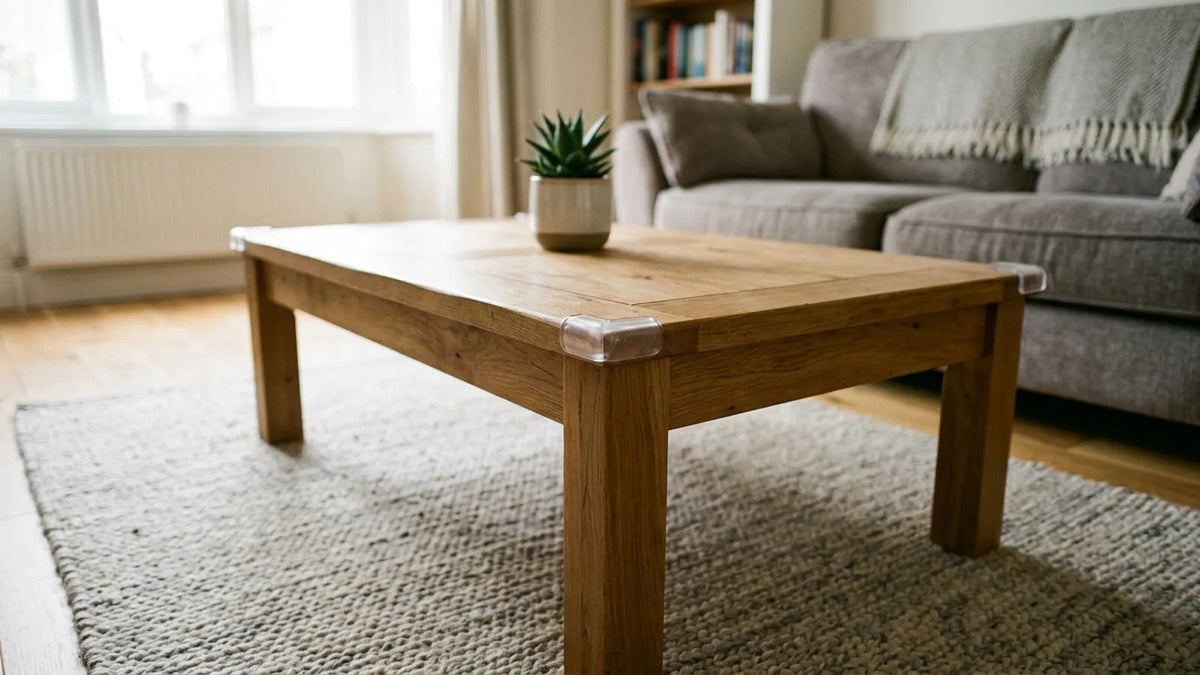
Picture this: it’s a quiet afternoon, and your toddler is cruising along the living-room coffee table, hand over hand. The corners point outward, hard and sharp. A guard is meant to soften that corner if a stumble comes.
It is padding for a fall against a hard edge. It is not a barrier, a lock or a restraint.


Do Corner Protectors Work? The CPSC Recommendation and the Missing Injury Figure
The CPSC’s childproofing guide (Publication 252) says: "Use Corner and Edge Bumpers to help prevent injuries from falls against sharp edges of furniture and fireplaces." The phrase is "help prevent." The CPSC does not say bumpers stop every injury.
The same guide also lists safety latches and locks, safety gates and outlet covers. A corner guard is one layer in a set, not the whole plan. Each device covers a different hazard, and none covers the others.
The CPSC adds a condition: "Be sure to look for bumpers that stay securely on furniture or hearth edges." If you are weighing silicone versus foam guards, that condition applies to both.
Now the gap. The CPSC guide recommends corner and edge bumpers but gives no figure for how much they reduce injuries. The AAP pages reviewed for this article do not address corner guards at all.
That leaves two things to go on: the kind of injury that happens when a child hits a hard edge, and the CPSC’s guidance. That can be reason enough to pad the corners that matter. Do corner guards work for babies who are crawling and pulling up? The same limits apply: they are a recommended layer, and they only help while they stay in place.
The Injury Corner Guards Address: 1982 Data From a 1985 Study
The injury in question is a child hitting a hard corner or edge. One of the few sources reviewed that quantifies furniture injuries is old, so here is its date up front.
A 1985 study by Ruddy and colleagues in Pediatric Emergency Care used CPSC data to estimate about 250,000 furniture-related injuries in the United States in 1982. Of those, 25 percent came from coffee tables. The study said most were lacerations of the head and face. In the authors’ own emergency-department review, square or rectangular coffee tables with sharp edges were usually involved.
It is 1982 data, reported in 1985, and it is not a current count. The abstract frames the study around childhood injuries but does not state the ages behind the 250,000 figure. Treat it as a furniture-injury estimate, not a number of children.
The pattern is still useful: sharp-edged coffee tables were usually involved in the authors’ review, and most of the injuries were cuts to the head and face. That is the kind of injury a padded corner is meant to soften.
Where Corner Guards Fail: Guards That Come Off
The first failure is the one the CPSC points to. A guard that has come off the corner does nothing for that corner.
Picture this: you are vacuuming and find a small clear cap under the couch. You check the coffee table and one corner is bare. You cannot say how long it has been that way.
A guard that has peeled away is easy to miss. That is the second problem. The AAP says small objects can be choking hazards or harmful if swallowed, and it says to check your floors regularly for small objects. A guard that has peeled off a corner can be one of those small objects. That is a conclusion from the AAP’s advice, not a statistic, and it is another reason to look over your guards now and then.
If a child swallows something, the AAP’s HealthyChildren.org poison guidance points to 911 in an emergency and otherwise to Poison Help at 1-800-222-1222 (America’s Poison Centers).
What to Look For in a Corner Guard
When choosing corner protectors, start with the CPSC’s condition and work outward. Four points matter most:
- It stays on. The CPSC wants bumpers that stay securely on the edge. Check it after you place it, and check it again now and then.
- The surface suits it. How well a guard sticks can depend on the surface it sits on. If adhesive is a concern, see corner protection without adhesive.
- It covers the corners that matter. Count the hard corners and edges where your child moves and plays. Count them before you count out guards.
- Its limits are stated. Read the maker’s warnings, not just the claims on the front.
The Clear Table & Counter Corner Protectors are clear round bumpers made from BPA-free, food-grade silicone, with a clear acrylic adhesive (0.5 mm thick). You install them by peeling off the pre-attached film and placing the guard on the corner. For the full steps, see how to install Baby Proof Me corner protectors. They are sold in packs of 12 or 24.

Do Corner Protectors Work on Wood?
No source reviewed examines guards on wood or on any specific finish. The product page does not name wood either. So there is no basis for a yes or a no.
What can be said is that adhesion can depend on the surface. A guard that holds well on one table may not hold on another. Wood varies a lot, from raw to oiled to lacquered, and nothing reviewed says how an adhesive behaves on any of them.
So act on the CPSC’s condition. Place the guard, check that it is holding after you put it on, and check it again now and then. Treat a table you care about as an open question: this page makes no promise about its finish. If you need to take a guard off a surface you care about, see how to remove corner protectors without damaging wood, paint or glass.
What Corner Guards Do Not Cover: Tip-Overs and Supervision
A corner guard does nothing about a tip-over. The AAP says: "You can’t always stop your young child from climbing. But you can stabilize the furniture that could hurt them." It says anti-tip devices cost $5–$25 and take just minutes to install.
The AAP also says that when a piece of furniture or an appliance falls on a small child, it can crush or suffocate them under its weight. No amount of corner padding changes that. For a dresser, bookcase or TV stand, the safety step is anchoring, and furniture tip-over prevention is a separate job from padding corners. Corner guards are for tables, counters, hearths and similar hard edges.
The second limit is supervision. The product’s own page says it "is NOT A TOY" and "is not a substitute for adult supervision." It also says to "STOP using immediately if this product becomes faulty."
Picture this: you step away to answer the door while your crawler is on the living-room floor. A guard softens a corner. It does not watch the child, and it does not replace you being in the room.
Are Corner Protectors Necessary? Deciding by the Hard Corners in Your Home
The CPSC lists corner and edge bumpers as a recommended device. No source reviewed calls them mandatory. So the choice is yours.
A practical way to make it is to look at your home. Get down to your child’s height and look around the rooms where they crawl, cruise and play. Hard corners on a coffee table, a counter or a hearth at that height are the candidates. If your rooms have none, there is little to pad.
If you are tempted by makeshift corner padding, the CPSC’s condition applies to it as well. Whatever sits on the corner has to stay securely in place. Anything that can come loose becomes a small object on the floor.
Walk each room at your child’s height, count the hard corners and edges, and pad the ones in the way. Then check each guard after you place it and again now and then, because only a guard that is still on the corner is doing its job.