
Need corner protection without adhesive? What works, and when adhesive guards are the better choice
What to do about hard corners when you would rather not use adhesive, and when a stick-on guard is the better choice.

If you want baby corner protectors without adhesive, the AAP’s first suggestion is not a product. It is moving the furniture: the AAP says to remove dangerous furniture from traffic areas if possible, particularly when a child is learning to walk. Anchoring furniture to a wall or floor is a separate, no-adhesive step. It addresses tip-over, not bumps. The only corner product the AAP names on its home safety page is the stick-on kind, and Baby Proof Me’s corner guards use adhesive. Which of these fits depends on the corner in front of you. For what stick-on guards do and do not prevent, see do corner protectors actually work.
What Works as Baby Corner Protectors Without Adhesive: Moving the Furniture
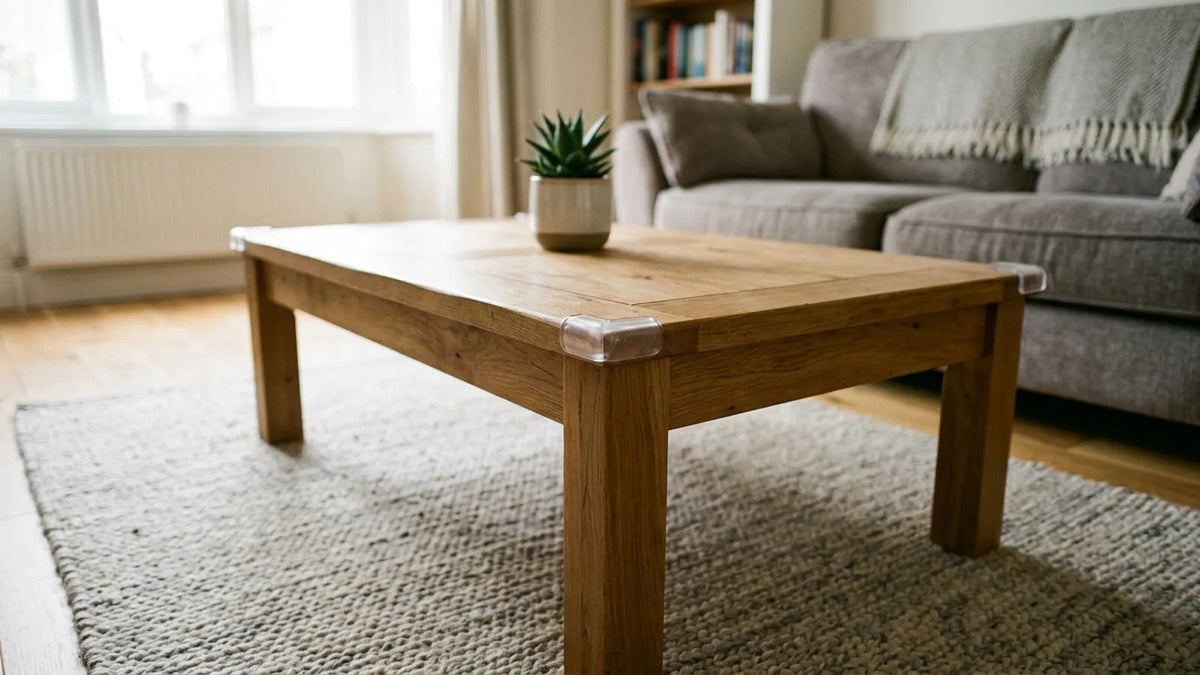
The AAP’s home safety advice starts with a check: look for furniture with hard edges and sharp corners. It names coffee tables as a particular hazard. Then it says what to do about them. If possible, remove dangerous furniture from traffic areas, particularly when a child is learning to walk.
That option needs no adhesive, and it touches nothing. There is no surface to mark and no small object to come loose. The corner is somewhere a baby does not go.
People who search for non adhesive corner protectors may be asking whether the corner needs a product at all. Sometimes the answer is no. The table needs a new spot, or a stretch of the living room needs to be cleared for a few months while a new walker finds their balance. A clear-out like that can be temporary, and the furniture can go back when your child is steadier on their feet.
This is not always practical. A table can be too big, too heavy, or the only workable layout for a small room. And moving a piece only counts if the hard corner leaves the route. Shifting a table a short way along the same path changes nothing. But it is the first question to ask, because it is the only option here that removes the hard corner from the baby’s reach instead of covering it.


Run a Walking-Path Check
The AAP’s advice is aimed at furniture in traffic areas, so the useful question is where the traffic runs. Skip the room-by-room inventory and trace the routes instead.
Picture this: you set a crawler on the rug and watch where they go. They head for the sofa, pull toward the coffee table, and then crawl toward the kitchen doorway. Every hard corner along that line is now a candidate for moving or covering.
Get down to floor level when you do this. A room looks different from a crawler’s height, and corners you walk past without noticing can sit at the level of a baby’s face when they pull up on the furniture next to them.
A few questions make the check concrete:
- Which routes run between the floor play area, the sofa and the kitchen?
- Which hard corners sit right on those routes, at the height of a crawler or a baby pulling up?
- Can any of those pieces move out of the path, even temporarily?
- Which corners must stay where they are?
The last question gives you your short list. A hard corner in a rarely used spot matters less than one a baby passes every few minutes. Recheck the routes as your child changes from crawling to cruising to walking, because the paths change with them.
Anchoring Is a Separate, No-Adhesive Step
Anchoring belongs on the same checklist, but it does a different job. A corner guard works at the corner, against bumps. It does nothing about tip-over.
CPSC says furniture, TVs and ranges can tip over and crush young children. For added security, it says, you anchor these products to the floor or attach them to a wall. That is a no-adhesive step, and it has nothing to do with padding.
Walk the room with that list in hand. Look at the tall pieces, the heavy pieces and the TV, and ask of each one whether it is anchored. Furniture tip-over prevention goes item by item, from dressers to TVs, and it deserves the same attention as the corners. A table with cushioned corners beside a dresser that is not anchored is still a room with an open hazard.
The Guard the AAP Names Is the Stick-On Kind
After its remove-furniture advice, the AAP says you also can buy cushioned corner- and edge-protectors that stick onto the furniture. That is the AAP’s example. It is not a ranking, and the AAP does not say other kinds of guard are worse. But it is the only corner product that AAP page names.
A search for corner guards no adhesive is a reasonable thing to type into a store page. The product the AAP describes, though, is one that sticks on.
CPSC lists corner and edge bumpers among its childproofing steps. It describes them as a way to help prevent injuries from falls against sharp edges of furniture and fireplaces. Then it adds the line that matters for buying: be sure to look for bumpers that stay securely on furniture or hearth edges.
Looking for the best non adhesive corner protectors tends to push that line aside. It should come first. Edge protectors and corner guards come in many forms, but the question for each is the same: once it is on the furniture, does it stay where you put it?
Stay Securely: The Check Any Guard Has to Pass
CPSC’s "stay securely" line applies with or without adhesive. It is the test for any guard.
CPSC does not spell out why, but the reason is plain. A guard that works loose no longer covers the corner. It also becomes one more small object on the floor for a baby to pick up.
Picture this: you come back from answering the door and find a guard on the rug. The corner it covered is bare again, and your crawler is heading toward both. A loose or damaged guard should come off and be replaced, not left in place in the hope that it holds.
The check does not end when the guard goes on. Look at each guard whenever you are in the room, and treat one that has shifted away from the corner as a guard that has failed the test. It is easy to place a guard once and never look at it again.
If a child swallows a guard or a piece of one, call Poison Help at 1-800-222-1222 (America’s Poison Centers) or your pediatrician, and call 911 in an emergency.
The same check applies to anything you improvise. If you are weighing DIY corner protectors, ask whether the material stays securely on the edge, and whether a piece of it could come off in a baby’s hands.
Fireplace and hearth edges
CPSC names hearth edges alongside furniture edges when it talks about bumpers. That is useful, because a hearth is easy to forget when you are covering coffee tables.
A hearth is a place for a guard that stays securely in place, or for keeping a toddler away from the hearth altogether. It is not a place to improvise.
Finish Worries Without a Promise
Some corners are on furniture you care about, like an inherited table or a finish that cannot be refinished. Parents often look for corner protectors that won’t damage furniture, or for no residue corner guards. Those are reasonable wishes, but neither can be promised.
A stick-on guard goes on the surface, and it may affect that surface. No guard can be promised to leave every finish untouched, including any of the corner protectors for every surface you may be comparing. If a finish is one you cannot risk, the contact-free choice is the first step the AAP names, though the AAP gives it for safety, not for finishes: move that piece out of the walking path.
Corner protectors without adhesive may feel like the careful answer for that situation. But the contact-free option is not a different kind of guard. It is a different place for the furniture.
If moving the piece is impossible, you are choosing between a covered corner and a possible effect on the surface. That is your decision to make with the finish in view. Look at what the furniture is made of and how much the finish matters to you, and decide before you put anything on it.
When Adhesive Guards Are the Better Choice
Move the furniture when it is practical and the piece is not essential to the room. That is the AAP’s first suggestion. Because it touches nothing, it also suits a finish you cannot risk.
Use a stick-on guard when a corner has to stay covered every day and moving the furniture is not practical. A stick-on guard is the type the AAP names. Whichever guard you choose, CPSC’s check applies: it has to stay securely on the edge.
Picture this: the only spot for the coffee table is beside the sofa, right on the route between the play area and the kitchen. Moving it would block the room, and your baby passes that corner many times an hour. That is the situation where a covered corner earns its place, as long as you keep checking that the guard stays put.
Do the anchoring regardless. It is a separate job, and a guard does not do it.
None of this means an adhesive guard passes CPSC’s check by design. Whether any guard stays securely is something you check on your own furniture, after you place it.
Baby Proof Me’s Clear Table & Counter Corner Protectors
Baby Proof Me’s Clear Table & Counter Corner Protectors are adhesive guards. The listing describes a pre-attached film that you peel off before placing the guard, and a clear acrylic adhesive. They are not a no-adhesive option, and they are not described as removable.
The listing describes the guards as clear and made from BPA free, food grade silicone. They are sold in packs of 12 or 24. For how silicone corner protectors compare with foam, see the separate guide; the product page has the full listing.
The listing also carries warnings. The product is not a toy. It is not a substitute for adult supervision. You should stop using it immediately if it becomes faulty.
That last line is the working rule for any guard. A guard adds a layer at the corner, and nothing more. The walking-path check, the anchoring and your own attention in the room each do their own part, and a guard does not replace them.