
How to Baby Proof a TV Stand or Entertainment Center: Doors, Open Cubbies, Consoles, Cords and Tip-Over
A TV stand can tip, be climbed, be opened and hide cords and batteries. What to anchor, latch, move and keep out of a baby’s reach.

Picture this: you step into the kitchen for a moment. When you come back, your toddler is at the media console with the remote in one hand and a cabinet door half open in the other.
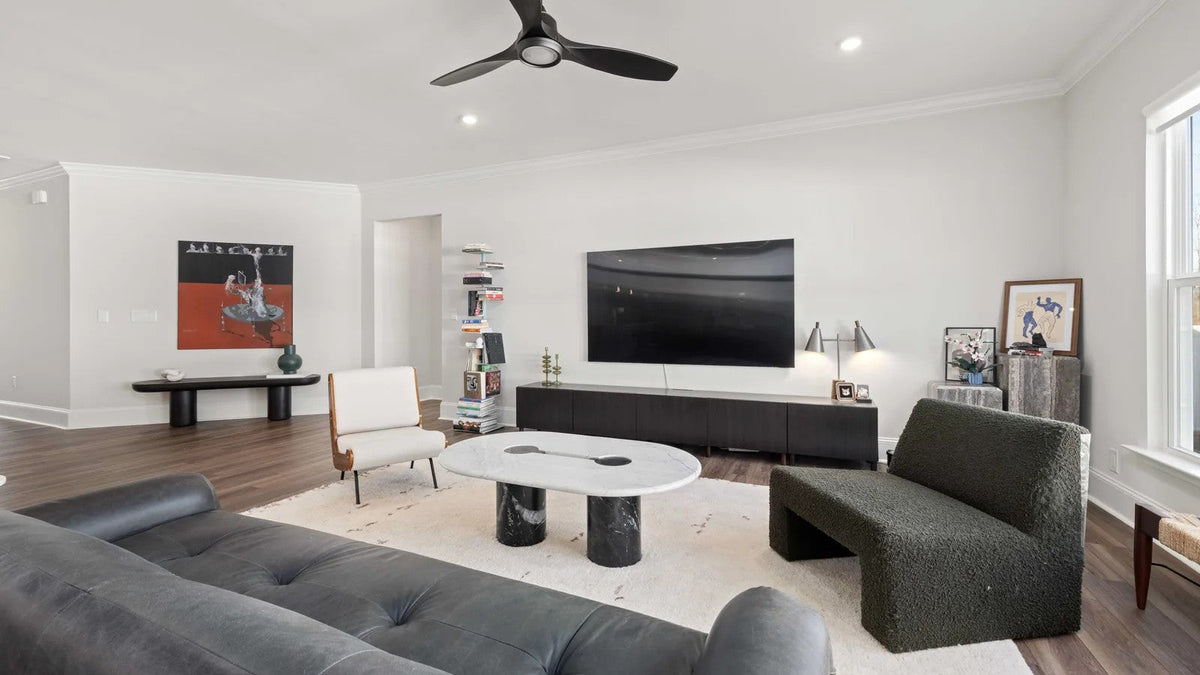
A TV stand is three problems at once. It can tip, it can be climbed or opened, and it has cords and batteries. A baby proof entertainment center answers all three. This guide takes them one at a time.
Three Jobs for a Baby Proof Entertainment Center
The first job is to stop the unit from tipping. The second is to keep a child out of the doors and drawers. The third is to tidy what sits on and behind it: cords, remotes and the batteries inside them.
Each job has its own fix. Anchoring handles the first, a latch handles the second, and moving items out of reach plus cord management handles the third. None of these replaces watching your child. To baby proof a TV stand, you need all three layers working together.
Why Stands Tip and Why Toddlers Climb Them
The CPSC staff’s 2023 Tip-Over Annual Report, published in February 2024, counts people of all ages and tip-overs of TVs, furniture and appliances. It reports that U.S. hospital emergency departments treated an estimated annual average of 17,800 people for tip-over injuries in 2020–2022.
The same report lists 217 reported tip-over deaths, all ages, that occurred from January 2013 to July 2023. Of those 217, 155 (71%) were children under 18. Also among the 217, 49 involved only a television, and 54 involved furniture and a television both tipping over.
Why does a stand draw a toddler? The AAP says children this age are curious, and that they are too short to reach the tops of tall furniture, where items like TVs, tablets and toys may sit. That can lead them to climb dressers, tables, chests, TV stands and bookcases.
Picture this: you are on the sofa, right there in the room, checking a text. Your toddler is at the stand. The AAP notes that no parent can have eyes on a child every moment, and tip-overs happen with an adult in the room too.
To child proof a TV console, it helps to know what makes furniture unstable. The CPSC’s report lists an unstable design (small footprint, top heavy), use on a sloped or unstable surface such as carpet, non-use of a tip-over restraint device, heavy objects on top, and multiple open drawers. The AAP’s list matches: heavy objects such as appliances or TVs on top, multiple open drawers, a heavy-topped design and an unstable surface such as carpet.
A media console with a TV on top, drawers and a soft rug under it can tick several of those boxes at once.
Anchor the Stand and Put the TV on a Sturdy Base
Start here. The CPSC’s Anchor It publication, dated September 2011, says to place TVs on sturdy, low bases, or to anchor the furniture and the TV on top of it. It also says to push the TV as far back on the furniture as possible.
The AAP says to mount flat-screen TVs to the wall or to furniture, and to use anti-tip devices for TVs that are not wall mounted. It also says never to place a TV on top of a dresser, especially in a child’s room or playroom. Flat screens weigh as much as one or two bowling balls, the AAP notes, so they need anchoring too. How to attach the TV itself is covered in a separate walkthrough on TV safety straps.
The stand needs the same treatment. The CPSC says to anchor furniture to the wall or the floor. The AAP adds several specifics:
- Use anti-tip devices on all furniture.
- Consider metal anchors such as L brackets, because plastic can become brittle.
- Use known brand-name products, because counterfeit anchors are a problem.
- Use more anchors on heavier furniture.
The AAP also says this may mean moving the furniture so the wall anchors reach a stud. It puts the cost of anti-tip devices at $5–$25, and says they take just minutes to install.
If you rent and holes in the walls would break the rental agreement, the AAP says to talk to your landlord, because holes in furniture and walls can be fixed.
Keep the Top and the Open Cubbies Clear
A stand’s top surface and open shelves collect the things a toddler wants. The CPSC says to keep remote controls, toys and other items that might be attractive to children off TV stands and furniture. The AAP says to avoid putting items like toys, electronics and remotes in high places no matter where, because this can tempt children to climb.
This page reads the AAP’s word "electronics" to include a game console, a soundbar or a speaker kept on top of the stand. If you are working on a baby proof gaming setup, or trying to child proof speakers, follow the AAP and CPSC rule. Electronics and remotes stay off the stand’s top and out of high places. None of this page’s sources covers how to child proof Xbox power button access, so this rule is the sourced step for a console too. The same goes if you want to baby proof a speaker stand, and the CPSC’s advice to anchor furniture applies to the stand too.
Open cubbies cannot be latched, so the answer is what goes in them and how the stand stands. The CPSC rule covers TV stands without limiting itself to the top, and it is fair to read it as covering the open shelves as well. Leave nothing there that a child would want to reach for. The AAP says young children climb furniture including TV stands and bookcases, so an attractive item on a shelf is an invitation.
The AAP’s guidance is to put heavier objects on the lowest shelves and drawers and lighter ones above. The AAP wrote that for dressers and other clothing-storage furniture. Applying it to a console is this page’s reading, useful if you are deciding what to store where.


Latch the Doors and Drawers on a Baby Proof Media Console
Drawers also tie into stability: the CPSC lists multiple open drawers as a cause of instability.
For drawers, the AAP advises drawer stops or safety straps so a child cannot pull drawers out all the way. It describes the kind that attach to the outside of the drawer and the side of the dresser, and also magnet locks. If you use a magnet lock, keep the key out of sight and reach. The AAP wrote this about dressers; applying it to console drawers is this page’s reading.
For a baby proof TV cabinet with doors, a latch is the layer to add. Baby Proof Me’s Adjustable Safety Strap Lock is listed for cabinets and drawers, and its product page also names refrigerators, microwaves, closets and ovens. It attaches with 3M adhesive, with no drilling, and you apply it by peeling and sticking. The product page says to allow 24 hours for the adhesive to bond. It holds a door or drawer shut. It is not a TV anchor and not an anti-tip device, so it does not replace the anchoring step. The product page also warns that it is not a substitute for adult supervision, and to stop using it immediately if it becomes faulty.

Tidy the Cords Behind the Stand
The CPSC says to keep TV and cable cords out of reach of children. That is the whole rule, and it covers the TV and cable cords that run from the back of the stand to the wall, a cable box and the screen. Outlet covers and cord management are their own topic, and the details are in the guide to baby-proofing outlets and cords.
Remotes and Controllers That Hold Coin Batteries
A remote left on the stand pulls double duty as a lure and a battery source. The CPSC’s Button Cell Coin Battery Information Center says to keep remotes, electronics and products with accessible button cell or coin batteries away from children if the battery compartments do not have a screw closure.
That makes the stand a good place to check. Look at the remotes and controllers you keep near it, find the ones that take button or coin batteries, and see which of those compartments close with a screw. Anything that does not should live somewhere a child cannot reach. A separate guide covers button battery dangers in depth.
If a child may have swallowed a battery, call 911 or Poison Help at 1-800-222-1222 (America’s Poison Centers) right away.
When Something Falls and the Order to Work In
If furniture or a TV falls on a child, call 911 in an emergency. The AAP says to take a child who has had furniture fall on them to the pediatrician or the emergency room right away. The AAP also says to report the tip-over to the CPSC at SaferProducts.gov, even with no injury, because it could keep another child from being hurt by the same type of furniture. More from the AAP is at HealthyChildren.org.
For setting up the stand, a workable order is this: anchor first, then move things out of reach, then latch, then tidy cords, then keep watching.
Suggested Setup Order
The CPSC says to supervise children in rooms where its safety tips have not been followed. The AAP reminds parents that you can be in the room and still be powerless to stop a tip-over.
The CPSC’s wording is for any home where children live or visit. The same steps apply at grandparents’ homes and rentals, and the rest of baby-proofing the living room follows the same logic of anchoring, moving and watching.
Start today: anchor the stand to the wall or the floor, then clear the top of it.