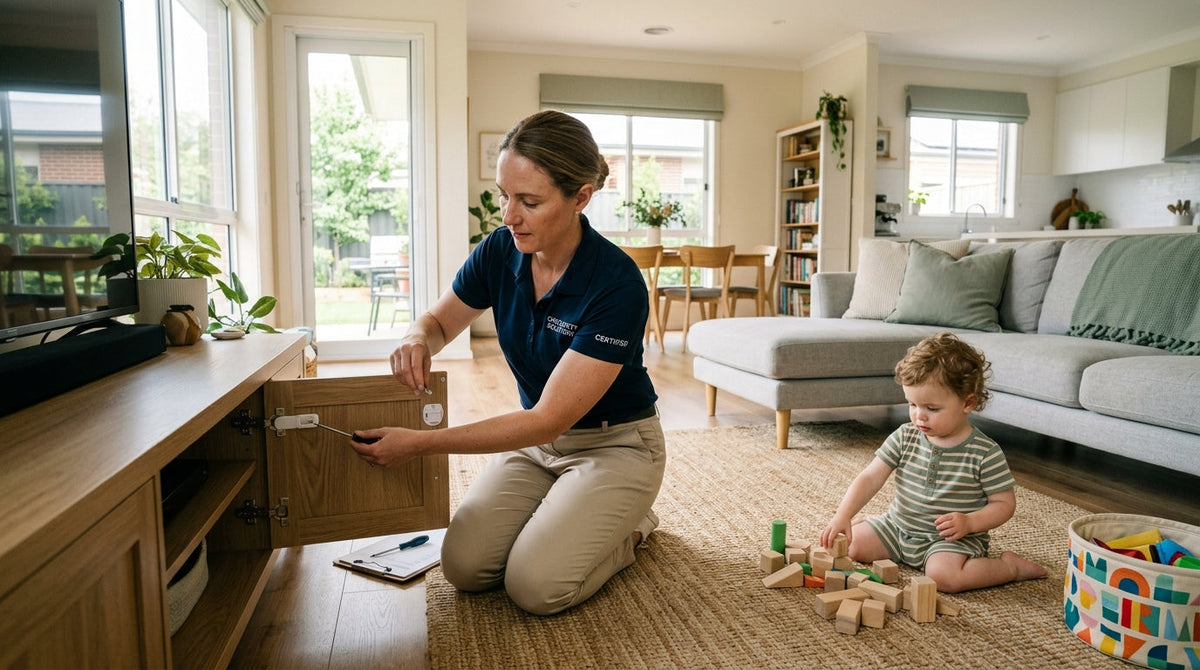

How to Childproof a Water Dispenser or Water Cooler (Hot-Tap Locks)
Why a hot-water dispenser is a scald risk for toddlers, what a lock can and cannot do, and the habits that matter most when a child can reach the tap.

A toddler who can reach the hot spout is a toddler who can reach hot water. That is the reason to child proof a water dispenser before the day a small hand finds the spout. Hot water injures skin fast, and a young child’s skin is thinner than yours.
Why a Hot-Water Dispenser Matters to a Toddler
Two things shape a scald: how hot the water is and how long it touches skin.
The CPSC gives figures for most adults. Third-degree burns follow two seconds in 150°F (66°C) water. Burns also occur after a six-second exposure at 140°F (60°C), or a thirty-second exposure at 130°F (54°C). Even at 120°F (49°C), a five-minute exposure could cause third-degree burns.
Those are adult numbers. In a 2025 abstract in the Journal of Burn Care & Research, Froehlich and colleagues note that the youngest children are susceptible to deeper burns given their thin skin.
The CPSC reports that most injuries and deaths from tap water scalds involve the elderly and children under five. The scale for babies and toddlers at home is large. That abstract, published in the American Burn Association’s journal, used NEISS data for 2013 to 2022. It estimated 125,133 scald burns nationally in children aged 0 to 3 across that whole period, not per year. Most of them, 81%, happened at home.
Hot liquids are one source of burns in a house. Home fire safety for kids covers the flame and smoke side. Heat from a wall-mounted unit is another source, so see how to baby proof baseboard heaters.
Why Reach Changes From Month to Month
Picture this: for months, the dispenser sat above your toddler’s head and never crossed your mind. Then a growth spurt arrives, or a step stool gets left near the counter. One afternoon a small hand is on the spout, and nobody planned for that.
A dispenser at counter height that was out of reach last month may not be next month. Judge reach by what your child can do this week, and recheck as they grow.
The same abstract points to a trend. Burns from appliances fell over the study period, while burns from grabbing or pulling things other than appliances rose. Its authors conclude that education should focus on safe placement of hot liquids to prevent pulling and grabbing burns. The same goes for a hot cup within reach, not only the spout.
If you’re working through the rest of the house, home safety basics for babies is a good place to set your priorities. Reach is the thread that connects every room. Radiators are another hot surface a toddler can reach, and there is a separate guide on how to baby proof radiators and radiator pipes.


How to Child Proof a Water Dispenser Using the Manual
The hot outlet’s temperature on your model is in the manual, or the maker can tell you. Look it up rather than guessing. The same goes for the lock.
To baby proof a water dispenser, start with the paperwork, not the hardware store. Find the manual, or contact the maker with the model number. Ask three things:
- Does the hot outlet have a lock or a hot-water switch?
- How do you turn that lock on?
- How does an adult turn it off for a moment and back on?
A water cooler child lock, where a model has one, is described only by that model’s maker. Designs differ, and no one source can describe them all.
The search for a fridge water dispenser child lock works the same way. The manual for that fridge says whether a lock exists and how it is switched. If the manual is gone, the maker’s support line or website may have a copy.
One rule applies to every model. A lock that is left off is no lock.
Turning the Child Lock Off and Back On
The question comes in two forms. One is how to stop a child from using the hot tap. The other is how an adult turns the child lock off and back on. Both get the same answer: use the manual for your model.
Procedures differ by model, and guessing at one can leave the hot outlet open. So read the exact steps for your dispenser, and practice them once while no child is nearby.
Then build the habit. Turn the lock off only when you are at the dispenser and ready to fill a cup. Turn it back on before you walk away, even if the walk is five steps.
Carrying Hot Water to the Cup
Filling the cup is only the first half. Moving hot water from the dispenser to a table or counter is a hot-liquid carry, and it has its own risks.
Picture this: you have a toddler on one hip and a full cup in your free hand. A phone buzzes, you turn, and the cup tips. The AAP says that whenever you walk with hot liquid, you should know where your child is and not carry your child at the same time.
For practical purposes, that means setting your child down in a safe spot before you fill. Place the filled cup well back from the counter edge and well above a small child’s reach. The rest of the kitchen follows the same logic, and kitchen hot water safety covers the other spots where hot liquid shows up.
Supervision First, Locks as One Layer
In its bathing advice, the CPSC says an adult’s presence at all times is the best defense against accidents and scalding to infants and young children.
That line was written about bathing. It applies here by the same logic, because a dispenser is also a source of hot water a toddler can reach. Preventing bathroom scalds uses the same principle at the tub.
Hot water dispenser child safety rests on layers, and the first layer is you. A lock on a hot tap adds a second layer. It helps, and it does not replace an adult in the room.
The layers worth stacking:
- An adult who is in the room whenever the child is near the dispenser
- A lock that is switched on, using the steps in the manual
- A dispenser placed where a growing child still can’t reach the outlet
- Hot cups set down away from edges
Plumbed Taps and the Water Heater
The next two measures apply to the plumbing, not to the dispenser.
The first is an anti-scald device on a plumbed tap. That is a fitting for taps, not for a dispenser’s hot outlet, so don’t alter the dispenser to fit one.
The second measure is the water heater. The CPSC urges lowering water heaters to 120°F and says to always hand-test hot water before using it, especially when bathing infants and young children. The CDC likewise recommends a water heater thermostat setting of 120°F or lower. Setting the water heater is a plumbing decision. It tells you nothing about the temperature at a dispenser, which you’ll find in the manual.
Keep in mind that 120°F is not a guarantee. The CPSC states that a five-minute exposure at 120°F could still cause third-degree burns.
Emergency Calls and a Habit Checklist
If a child is burned by hot water, call 911 or call your pediatrician. For burn information from the American Academy of Pediatrics, go to HealthyChildren.org.
The habits worth keeping, in one place:
- Get the manual for your model, or contact its maker, and learn whether the hot outlet has a lock or switch.
- Look up the hot outlet’s temperature in the manual instead of guessing.
- Learn how an adult turns the lock off and back on, and switch it back on every time.
- Treat a lock that is left off as no lock.
- Stay in the room when a toddler is near the dispenser.
- Set your child down before you fill a cup, and never carry a child while carrying hot liquid.
- Keep hot cups back from counter edges and out of a child’s reach.
- Recheck reach as your child grows.
- Keep the water heater at 120°F or lower, and hand-test water before bathing a child.