
Baby Proofing Myths Debunked: 15 Things Parents Get Wrong

Somewhere between the first cabinet lock and the seventeenth outlet cover, most parents start to feel like they have this figured out. The house looks safer. The checklist feels done. And then a toddler pulls a dresser onto themselves, or a crawling baby gets into the under-sink cabinet you forgot to lock, and the whole framework collapses.
The problem is that babyproofing mythology is everywhere. It travels through parenting groups, Pinterest boards, and well-meaning grandparents. Some of it is harmless. Some of it creates a false sense of security that leaves real hazards unaddressed. Here are fifteen things parents commonly get wrong, and what keeps kids safer.
Myth 1: Corner Guards Prevent Serious Head Injuries
Corner and edge bumpers do something. They soften the blow from a minor bump against a coffee table corner. What they do not do is prevent the serious head injuries that come from falls at height onto hard floors. The danger is less about the sharp edge and more about the fall itself, and the hardness of the surface a child lands on.
If your baby is pulling to stand near furniture, the floor underneath matters as much as the furniture padding. Foam play mats and thick rugs where babies spend floor time reduce the impact of minor tumbles. The corner guards are a reasonable add-on, not a primary protection strategy.
Myth 2: A Gate at the Bottom of the Stairs Is Enough
About 93,000 children under 5 are treated in U.S. emergency rooms each year for stair-related injuries, per a Nationwide Children’s Hospital analysis of CPSC NEISS data. A gate at the top of the stairs is essential. A gate at the bottom matters too, but it does not replace the top gate.
Bottom gates have their own limit: once a child can climb, any gate becomes something to climb. My older daughter figured out how to climb a pressure-mounted bottom gate at around 22 months. She was halfway up the stairs before I caught her. The gate had given me a false sense of coverage. Top-of-stairs gates should be hardware-mounted and meet ASTM F1004, the federal safety standard for expansion gates and expandable enclosures. The AAP advises gates at both the top and bottom of stairs. Once your child can climb over or dislodge a gate, stop using it, as the gate’s required warning label says, and stay close whenever your child is near the stairs.
Myth 3: Outlet Plug Covers Are the Standard Solution
Those small plastic plug inserts have been in parents’ junk drawers for decades. They are also a choking hazard. Children can and do remove them, and a small plug cover is exactly the size and shape of something a toddler puts in their mouth.
Tamper-resistant outlets are the safer standard for homes with young children. These outlets have internal shutters that only open when equal pressure is applied to both slots simultaneously, which a child’s finger or a single object cannot do. Replacing standard outlets with tamper-resistant ones costs roughly the same as a pack of plug covers and eliminates both the electrical hazard and the choking risk.


Myth 4: Your Furniture Is Stable Enough Without Anchoring
This one is the most dangerous myth on the list. Dressers, bookcases, and televisions look stable. They are not stable when a toddler climbs the open drawers, which they will. Tip-over incidents send thousands of children to emergency rooms each year, and the injuries are severe.
The fix is straightforward: wall straps and anti-tip brackets. They are inexpensive, and installation takes about fifteen minutes per piece of furniture. Every dresser, every bookcase, every freestanding shelf in a room a child accesses should be anchored. The weight of a climbing toddler is enough to bring down furniture that has stood in place for years without incident.
Myth 5: Crib Bumpers Protect Babies from Injury
Crib bumpers were designed to prevent babies from getting limbs stuck between crib slats. Modern cribs built to current standards have slat spacing that makes this largely a non-issue. What bumpers do introduce is a suffocation and strangulation risk.
A bare sleep environment is recommended: firm, flat mattress, fitted sheet, nothing else. No bumpers, no pillows, no positioners, no loose blankets. The belief that bumpers prevent injury contradicts evidence on SIDS and sleep-related suffocation. A padded crib looks safer. It is not.
Myth 6: Corded Blinds Are Fine If You Keep the Cord Out of Reach
Corded window coverings cause strangulation incidents every year. Children are resourceful. They move furniture, they stack objects, they find ways to reach things adults have placed "out of reach." The cord does not need to be at eye level to be accessible.
Breakaway mechanisms and cord safety features are now required on new window coverings. The problem is hand-me-down blinds and shades, which may predate these requirements entirely. Any corded window covering in a nursery or child’s room that was manufactured before current standards should be replaced. Cordless options are widely available at every price point.
Myth 7: High Shelves Are Sufficient for Chemicals and Medications
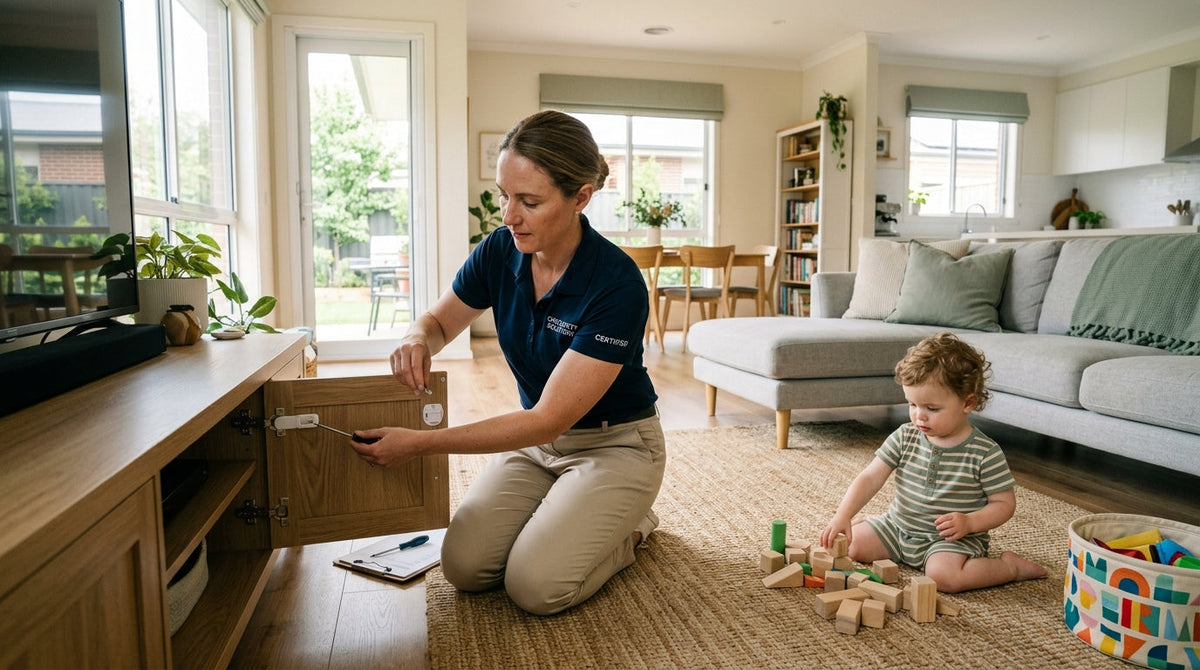
I learned this one firsthand. My younger daughter emptied the cabinet under the kitchen sink in the time it took me to answer the front door. We had cleaning supplies stored there without a lock because the "dangerous" chemicals were on a high shelf. She was not interested in the high shelf. She was interested in what she could reach.
Children climb. A toddler who cannot reach a shelf today will find a step stool, a chair, or a sibling’s help tomorrow. Locked storage is the standard for medications and cleaning supplies, not height. Cabinet locks cost a few dollars each and take minutes to install. High shelves are not a substitute.
Myth 8: Baby Walkers Help Infants Learn to Walk
Walkers do not accelerate walking development. Walkers do not help babies learn to walk and may delay motor development by reducing the time infants spend on the floor building the muscle strength and balance they need.
What walkers do is give a baby who cannot yet walk the mobility to reach hazards they would otherwise be nowhere near: stair edges, hot oven doors, counters with hot liquids. The injury risk is well-documented. Canada banned the sale of baby walkers in 2004. The AAP recommends against them entirely.
Myth 9: Foam Mats Prevent Serious Falls
Foam play mats and soft rugs reduce the sting of minor tumbles. They do not prevent serious injuries from significant falls. The two factors that determine injury severity are the height of the fall and the hardness of the surface below. A foam mat on a concrete basement floor is better than bare concrete. It is not a safety solution for a play area near elevated furniture or stairs.
Soft flooring is a reasonable part of a play space, but it does not replace fall prevention. Keep play areas away from elevated hazards, and do not treat floor padding as a reason to reduce other precautions.
Myth 10: Closed Doors Are Enough to Protect Fingers
Door-related finger injuries are among the most common household injuries in toddlers. The hinge side of a door is particularly dangerous because the gap closes as the door swings shut. Children do not anticipate this. They also do not anticipate the weight of a door swinging back on them.
Pinch guards that wrap around the door edge and hinge-side foam guards are inexpensive and widely available. Door knob covers prevent toddlers from entering rooms they should not be in. These are easy installations that most parents skip because a closed door seems like a sufficient barrier. It is not.
Myth 11: New Blind Cord Safety Rules Cover Everything You Own
Breakaway mechanisms and improved cord management are now required on new window coverings sold in the U.S. This is meaningful progress. It applies to new products. It does not apply retroactively to the blinds that came with your house, the shades you inherited from a previous tenant, or the hand-me-down window coverings from a family member.
If you have older corded blinds or shades in any room a child uses, assume they lack current safety features and replace them. This is especially urgent in nurseries and children’s bedrooms, where children spend unsupervised time.
Myth 12: Supervision Alone Is Enough Near the Stove
Supervision is essential, but it is not a substitute for physical barriers. Young children move faster than parents expect, and a moment of distraction is all it takes. Stove knob covers prevent children from turning on burners accidentally. Oven locks prevent them from opening a hot oven door. These are the backup when supervision lapses.
Burns from stoves and ovens are serious injuries. The combination of a physical barrier and active supervision is the actual standard, not one or the other.
Myth 13: Babyproofing Is a One-Time Project
Parents often babyproof when a baby starts crawling and consider it done. Children’s abilities change fast. A cabinet lock that defeated a nine-month-old will not defeat a twenty-month-old. A gate that worked at floor level becomes irrelevant when a child learns to climb. A drawer that was too heavy to open becomes easy once a toddler’s strength develops.
Reassess your home every few months during the first three years. What stopped working? What new hazards have appeared as your child’s mobility and problem-solving have developed? Babyproofing is an ongoing process, not a project with a completion date.
Myth 14: Toilet Locks Are Overkill
Toddlers are drawn to toilets. They are also top-heavy and have poor balance. A child who leans over the rim of a toilet to look inside can fall in headfirst and cannot right themselves. Drowning can occur in very small amounts of water and happens silently.
Toilet locks are simple spring-latch devices that an adult can open with one hand. They are not overkill. Bathroom doors should also be kept closed and ideally locked from the outside when not in use.
Myth 15: If It Passed the Newborn Stage Safely, It Is Still Safe
Products that were safe for a newborn are not necessarily safe for a six-month-old, and products safe for a six-month-old are not necessarily safe for a toddler. Weight limits, developmental stages, and mobility all change what a product does and what risks it introduces. A bouncer seat safe for a three-month-old becomes a tip-over hazard when a five-month-old starts pushing with their legs.
Check weight and age limits on every product your child uses, and retire products when your child reaches those limits, even if the product still looks functional. The hazard is not always visible.
Room-by-Room Safety Checklist
The Real Work of Babyproofing
The most dangerous myth of all is that babyproofing is about products. Products help. But the actual work is understanding how your specific child moves through your specific home, and updating that understanding as they grow. Walk through every room at your child’s eye level. Open every cabinet. Pull on every drawer. Lean against every piece of furniture. The hazards that are obvious from that vantage point are the ones worth fixing first.