
Nursery Design Trends That Are Actually Dangerous for Baby

The nursery you spent three months planning might be working against you. The danger isn’t usually the thing you’d flag immediately. It’s the shiplap accent wall, the trailing canopy, the gorgeous chunky shag rug you found on sale. These photograph beautifully and quietly create real hazards for the baby sleeping inside them.
Here are twelve nursery design trends worth reconsidering before your baby comes home.
Dark Accent Walls and Low-Visibility Paint Colors
Moody nurseries are everywhere on Pinterest right now. Deep forest greens, charcoal grays, inky navy. They look stunning. They also make it significantly harder to see your baby at 2 a.m.
During nighttime caregiving, you need to read your baby’s color, their breathing pattern, whether their chest is rising normally. A dark wall behind a dark crib in a dim room makes that harder.
Lighter, neutral tones reflect ambient light and give you a better visual baseline. This matters most in the early months, when you’re checking on a sleeping infant multiple times a night. Save the dramatic color for a room that isn’t a monitoring environment.
Floating Shelves and Unsecured Wall Décor Above Sleep Zones
The floating shelf trend has produced some beautiful nurseries. It has also produced some dangerous ones. Shelves loaded with plants, books, and ceramic animals, positioned directly above a crib or changing table, with no visible anchoring into studs.
The CPSC is explicit: any furniture or shelving near a sleep or care zone must be anchored to wall studs. Not drywall anchors. Studs. Vibration from a passing truck, a toddler pulling on a lower shelf, or a minor seismic event can bring an unsecured shelf down.
In my experience testing dozens of nursery shelving systems, the ones that failed my pull test were almost always the ones installed by someone who eyeballed it. Use a stud finder. Use lag bolts. Check the load rating on the shelf before you stack anything on it.
Shag Rugs and Layered Textiles on the Floor
A thick shag rug feels luxurious underfoot during a 3 a.m. feeding. It is also a tripping hazard for a new walker, a surface that traps allergens and bacteria at exactly the height your crawling baby will be breathing, and a fire risk if it’s near a space heater or lamp.
Unintentional suffocation kills roughly 1,000 infants under age 1 each year in the United States (CDC). While floor textiles aren’t the primary driver of that number, any soft, loose surface near a baby’s sleep or play zone deserves scrutiny.
Low-pile, washable rugs are the practical answer. They’re easier to sanitize, less likely to bunch under small feet, and far easier to inspect for dropped small objects.
Mood Lighting and Dimmer-Only Setups
Dimmer switches marketed as "sleep-friendly" are useful for settling a baby. They are a problem when they’re the only lighting option in the room.
You need real task lighting at the changing table, bright enough to see skin tone changes, rashes, and the exact contents of a diaper (which tells you a lot about an infant’s health). A dimmer for the overhead is fine. A bright, dedicated light at the changing station is non-negotiable.


Decorative Crib Bumpers, Pillows, and Stuffed Animals
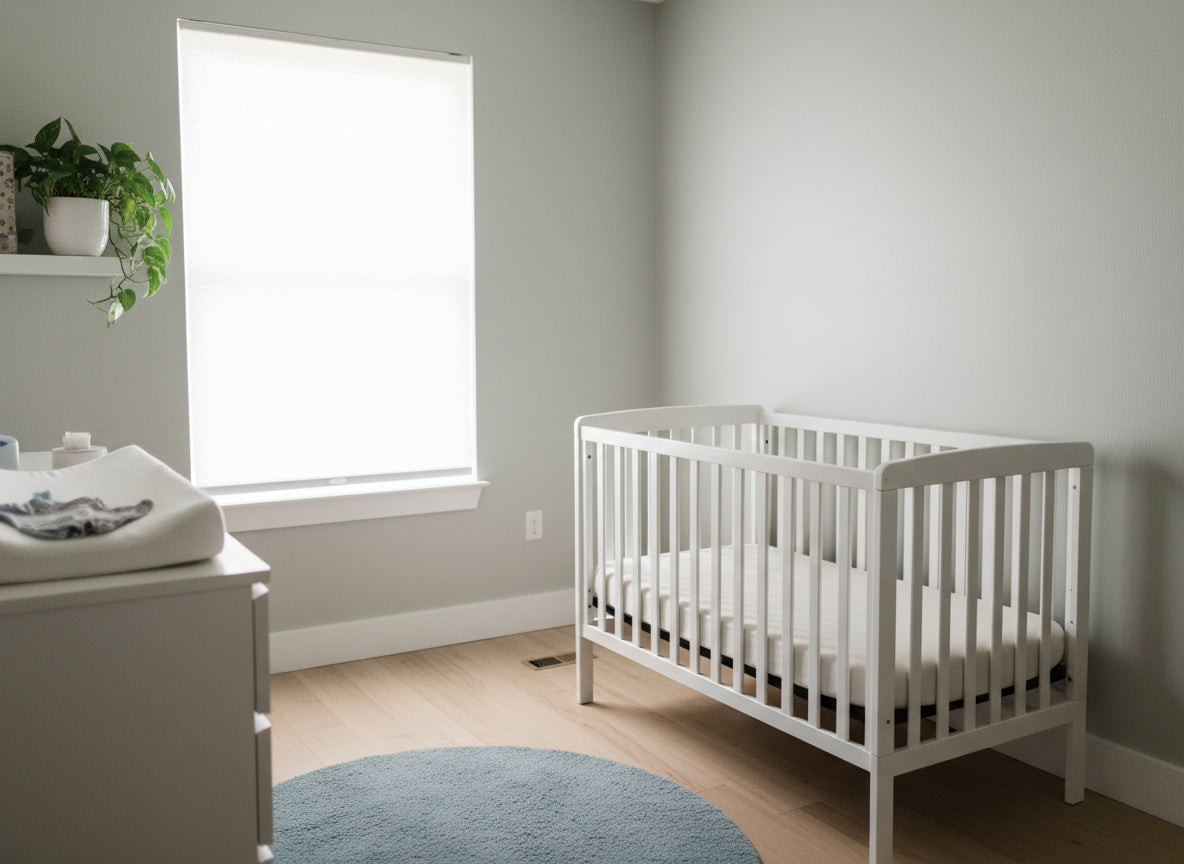
This one has the clearest evidence behind it. The AAP recommends a bare crib: fitted sheet only, no bumpers, no pillows, no loose blankets, no stuffed animals. A wearable sleep sack replaces the blanket. That’s it.
Soft bedding and crib bumpers are consistently implicated in sleep-related infant deaths. The bumpers that are sold in matching nursery sets, the ones that make a crib look finished and cozy, are the same ones the AAP has warned against for years. They look like décor. They function as a suffocation hazard.
Wallpaper with Lead-Based Inks or Problematic Adhesives
Vintage and imported wallpapers are having a moment. Some of them carry risks that aren’t obvious from the product listing. Lead-based inks, high-VOC adhesives, and papers that peel at the seams can all become ingestion hazards once a baby starts pulling up and mouthing surfaces.
If you’re in an older home, any existing wallpaper should be tested before you layer new paper over it. For new installations, use low-VOC, lead-free products and inspect the seams regularly. Babies in the teething stage will mouth anything at mouth height, and a peeling corner of wallpaper is exactly the kind of thing they find first.
Hanging Mobiles, Canopies, and Decorative Drapes Over the Crib
A mobile above a crib is developmentally appropriate for a young infant. It becomes a hazard the moment a baby can push up, reach, or pull. Keep every cord, including baby monitor cords, at least 3 feet from the crib, as the CPSC advises, and take mobiles down by 5 months or as soon as a baby can push up on hands and knees, whichever comes first.
Canopies are a bigger problem. They’re beautiful, they’re popular, and they introduce fabric, ties, and cords directly into the sleep zone. A baby who can pull to stand will grab anything within reach, including a canopy panel or a decorative drape. If you want the aesthetic, mount it well above the crib and ensure there are no hanging cords or ties anywhere near baby’s reach.
Scented Diffusers and Essential Oil Products
The wellness-nursery trend has brought a lot of diffusers into baby rooms. Essential oils, plug-in fragrance units, scented wax warmers. These products are marketed as calming and natural. They can irritate developing airways, trigger respiratory responses, and some essential oils are contraindicated for infants entirely.
Infant lungs are not adult lungs. The safest environment for a baby’s respiratory development is an unscented one. If you want to use a humidifier for dry air, use a plain cool-mist unit with no additives. Save the lavender diffuser for your own bedroom.
Sharp Corners and Ornamental Hardware on Trendy Furniture
Geometric shelving, angular credenzas, and furniture with decorative metal hardware are all over nursery design accounts right now. They are also a reliable source of lacerations and eye injuries for babies learning to pull up and cruise along furniture.
Rounded-edge furniture and recessed, smooth hardware aren’t exciting design choices. They are the right ones for a room where a small person will be falling repeatedly while learning to walk.
Nursery Safety Checklist
Blackout Curtains with Long Cords or Insecure Mounting
Blackout curtains are useful for infant sleep. The cord situation on many of them is not. Long blind cords and curtain pull cords are a strangulation risk. The CPSC has issued repeated guidance on this: all window covering cords must be kept well out of a child’s reach, and cordless options are strongly preferred in any room where a baby sleeps or plays.
Beyond cords, check the mounting hardware. A curtain rod that’s been pressure-mounted rather than screwed into studs can come down if a toddler grabs the panel.
In a nursery, everything at or below standing height should be treated as something a child will eventually grab and pull.
Soft, Thick Flooring Like Memory Foam Mats
Memory foam play mats and thick carpet padding feel safe because they’re soft. Thick, uneven foam surfaces create instability for new walkers and crawlers. They trap bacteria and allergens in ways that sealed hard flooring does not. Foam mats that aren’t locked together tightly create edge gaps that catch small feet.
Sealed hardwood or LVP with a thin, washable mat is easier to sanitize, more stable for a baby learning to move, and far simpler to inspect for dropped small objects.
A Pediatrics analysis of CDC data found that from 2001 to 2016 there were 305,814 nonfatal choking injuries and 2,347 choking deaths among U.S. children and teens ages 0–19, with children under five accounting for about three-quarters of fatalities. The floor is where small objects land and where babies find them.
Themed Décor with Small Items at Baby Height
A woodland nursery with tiny ceramic mushrooms on a low shelf. A nautical theme with small rope-and-wood ornaments at crib rail height. These look charming. They are choking hazards.
Any decorative object small enough to fit in a child’s mouth should be above 48 inches or in sealed storage. This includes figurines, decorative knobs, small picture frames with removable parts, and anything with a component that could detach.
Babies find small objects with extraordinary efficiency. The nursery you design for a newborn will be the same room your seven-month-old is pulling up in, and your ten-month-old is cruising in, and your thirteen-month-old is climbing in. Design for who they’re becoming, not just who they are today.
What a Safe Nursery Looks Like
None of this means your nursery has to be clinical or joyless. It means the safety decisions get made first, and the aesthetic decisions get made inside those constraints. Light walls, secured shelving, cordless window coverings, bare crib, bright task lighting at the changing station, low-pile washable flooring, no fragrance, no small objects below 48 inches. Everything else is decoration, and there’s plenty of room for beauty inside those parameters.