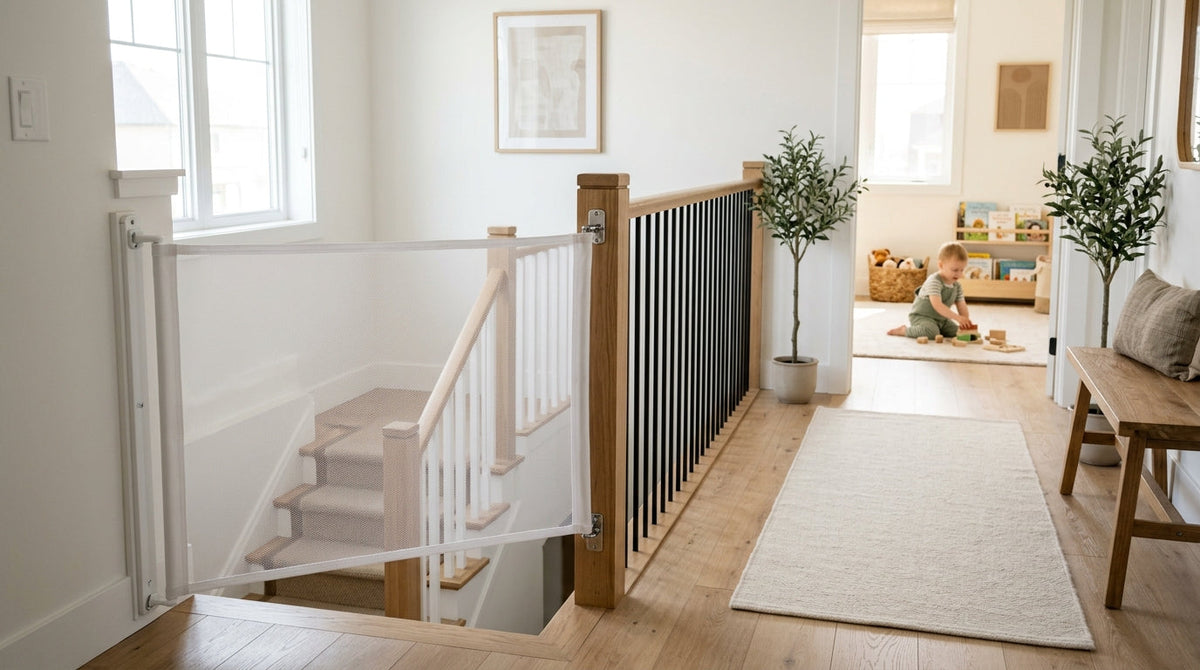

Retractable Baby Gate vs Pressure Mount: Which Style Is Safer

About 93,000 children under 5 are treated in U.S. emergency rooms each year for stair-related injuries, according to a Nationwide Children’s Hospital analysis of CPSC NEISS data. That number is why the gate question matters so much. Not "which style looks nicer" or "which one fits my aesthetic." Which one will hold when a determined two-year-old decides the stairs look interesting at 6 a.m.
I’ve installed both types in my own home, tested them in rental properties, and watched my older daughter defeat a pressure-mount gate before her third birthday by simply leaning into it until the tension gave. That experience changed how I think about gate selection entirely.
The Core Difference: How Each Gate Holds in Place
Pressure-mount gates work by friction. You expand the gate until it presses against both sides of a doorway or hallway, and that tension is what keeps it in place. No screws, no wall anchors, no tools required. The tradeoff is that the gate is only as secure as the surfaces it’s pressing against and the pressure you’ve applied.
Retractable gates are hardware-mounted. You drill screws into studs or solid door frames, and the housing is fixed to the wall. The mesh or fabric panel rolls out from that housing and latches on the opposite side, also screwed in. The gate cannot move because the mounting points cannot move.
This distinction drives every other comparison.
Stair Safety: The Rule Is Not Negotiable
Per CPSC guidance, any gate used at the top of stairs must be hardware-mounted. Pressure-mount gates are explicitly unsuitable for staircase protection. This is not a preference or a general recommendation. It is the clearest safety directive in the baby gate category, and it exists because a fall down stairs is a severe injury event.
ASTM F1004 is the federal safety standard for expansion gates and expandable enclosures, made mandatory under 16 CFR Part 1239 (effective 2021). Hardware-mount designs meeting this standard are tested for the structural loads a child can realistically apply.
If you have stairs, you need a hardware-mounted gate at the top. A retractable gate designed for stair use qualifies. A pressure-mount gate does not, regardless of how tightly you install it.
At the bottom of stairs, pressure-mount gates are acceptable, since a fall from the bottom step carries far less risk than a fall from the top. But I’d still recommend hardware-mounting there if you have the option.


Where Pressure-Mount Gates Work Well
Pressure mounts are useful in the right context. Doorways between rooms, kitchen entrances, hallways on a single level. Anywhere the consequence of a gate giving way is that a child walks into a room rather than falls down a flight of stairs.
They’re also the practical choice for renters. You install them without drilling, and you remove them without patching walls. For families who move frequently, that flexibility has real value.
The installation requirements are specific, though. Pressure mounts need parallel, smooth wall surfaces on both sides. Textured finishes, angled door frames, or walls that aren’t plumb can compromise the seal and create gaps. The gate should be at least three-quarters of your child’s height, and the gap between the bottom of the gate and the floor should be no more than 1 to 2 inches. Get either measurement wrong and you’ve created a gate a child can climb over or slip under.
Ease of installation cuts both ways. Because no tools are required, parents sometimes install pressure-mount gates quickly and imprecisely. I’ve seen gates installed with the tension just slightly too loose, or positioned against a baseboard that creates a gap at the bottom. A gate that looks installed is not always a gate that’s installed correctly.
Retractable vs. Pressure-Mount: Feature Comparison
| Feature | Retractable (Hardware-Mount) | Pressure-Mount |
|---|---|---|
| Safe at stair top | Yes | No |
| Safe at stair bottom | Yes | Yes |
| Installation tools needed | Drill, anchors | None |
| Self-closing | No (pull across and latch each time) | No |
| Dual-lock option | Yes, on better models | Rarely |
| Renter-friendly | No | Yes |
| Typical cost | $80–$200 | $30–$60 |
| Pinch-point risk | Yes, at housing | No |
| Mesh wear over time | Yes, inspect regularly | Not applicable |
| JPMA certification available | Yes | Yes |
Retractable Gates: What the Hardware Mount Buys You
When a retractable gate is screwed into studs, it is structurally fixed to the house. A toddler throwing their full weight against it is not going to move the mounting points. That’s the core advantage.
Retractable gates do not close themselves. When you release the latch, the spring rolls the mesh back into the housing and leaves the opening clear, so you have to pull the gate across and latch it every time you pass through. For parents managing a child, a bag of groceries, and a dog at once, that is the step most likely to be skipped, so check the latch every time.
The dual-locking mechanisms on better retractable models add another layer. If the top latch fails or a child figures out how to release it, the bottom latch holds. Single-lock pressure mounts don’t offer that redundancy.
The installation is more involved. You need a drill, wall anchors if studs aren’t perfectly positioned, and some patience. But you do it once, and then you have a fixed barrier for as long as you need it.
The Pinch-Point Issue with Retractable Gates
This is the part retractable gate marketing tends to underplay. The retracting mechanism creates a pinch point. When the mesh rolls back into the housing, fingers caught in that motion can be injured. I noticed this risk the first week I had a retractable gate installed in my kitchen: my younger daughter reached for the housing while I was pulling the gate open, and her fingers were close enough to the edge that I stopped using it without supervision from that point forward.
Supervise the gate’s operation whenever small children are nearby. This is especially true for toddlers who are curious about how things work, which is most of them.
The mesh or fabric panel itself also degrades over time. Inspect it regularly for tears, holes, or worn edges. A gap in the mesh large enough for a child’s head to pass through is a head entrapment hazard. Rigid-bar pressure-mount gates don’t have this failure mode, though their connection points can loosen with repeated use and need regular checking.
Fit and Clearance Requirements
Retractable gates need clearance for the mesh to roll out fully. If furniture, a wall corner, or a door frame interrupts that path, the gate won’t operate correctly. In narrow hallways or tight spaces with nearby obstacles, this can be a real constraint.
Pressure-mount gates are more spatially flexible. They fit into tight spaces without needing a clear deployment path. If your kitchen doorway has a cabinet that juts out on one side, a pressure mount may fit where a retractable gate can’t.
Measure before you buy either type. Check not just the width of the opening but also what’s adjacent to it. A gate that doesn’t fit correctly is a gate that won’t be used correctly.
Cost and Long-Term Value
Pressure-mount gates are less expensive. You can find solid options for $30–$60. They require no tools and no installation expertise. For temporary barriers or low-risk doorways in rental homes, they represent good value.
Retractable gates cost more, typically $80–$200 depending on width and features. The hardware installation adds time. But in a home where you need a permanent stair barrier, the retractable gate’s durability and structural security justify the price difference.
A gate you use correctly for three years is a better investment than a cheaper gate installed imprecisely that you replace twice. Factor in the application, not just the sticker price.
Weekly Gate Inspection Checklist
Checking Your Gate Weekly
Both types require regular inspection. For pressure mounts, test the tension by pressing firmly against the gate at the center. It should not flex or shift. Check that the bottom gap hasn’t widened and that the gate is still level. For retractable gates, test both locks, inspect the mesh for wear, and check that the housing mounting screws are still tight.
The JPMA certification program provides an independent verification that a gate has been tested against relevant safety standards. Look for JPMA certification when you’re comparing specific products, and check that the gate’s stated use (stair-top, doorway, etc.) matches your application.
Both gate types require ongoing inspection. Gate failures typically occur when parents install the gate correctly and then never check it again.
Which Style Is Safer
The honest answer is that it depends on where you’re installing it.
At the top of stairs, a hardware-mounted retractable gate is the correct choice. A pressure-mount gate at the top of stairs is not an acceptable option, regardless of brand or price.
For doorways and room transitions on a single level, both types can work safely when installed correctly. A pressure mount in the right doorway, installed with proper tension and correct height placement, is a reliable barrier. A retractable gate in the same location adds structural permanence, but requires the clearance, the installation effort, and latching every time.
The gate that’s installed correctly, checked regularly, and matched to the right location is the safe gate. According to Nationwide Children’s Hospital’s analysis of CPSC NEISS data, roughly one child every six minutes is treated for a stair-related injury in U.S. emergency rooms. The gate at the top of your stairs is doing real work. Make sure it’s the right one for the job.