
Small Parts and Choking Hazards: Organizing Toys by Age in the Playroom

You turn around for thirty seconds and your toddler is sitting happily on the playroom floor, mouthing something that belongs to her older sibling’s building set. No crying, no choking, just a small plastic piece disappearing behind curious lips while you sprint across the room. Toy organization is a safety system, not a tidiness preference. Choking is one of the leading causes of injury death in young children, and most of the hazards aren’t mysterious. They’re sitting in your playroom right now, mixed into bins that hold toys for multiple age groups. Getting organized means physically separating what belongs where, and keeping it that way.
How the CPSC Defines "Small Part"
The CPSC uses a physical test cylinder to determine whether an object poses a choking or aspiration risk to children under 8. If an object fits entirely inside the cylinder, it’s classified as a small part and must be kept away from young children. This isn’t a guideline. It’s the standard that governs toy labeling and retail sale.
The cylinder itself approximates the diameter and depth of a young child’s throat. Anything that fits can be swallowed, inhaled, or lodged. The age threshold of 8 matters because the CPSC’s testing accounts for developmental stages, including the tendency of children under 3 to mouth objects, and the slower development of judgment and motor control in children under 8.
What this means practically: the "3+" label on a toy box is a small-parts warning, not just a complexity rating. Buttons, beads, magnetic pieces, tiny figurine accessories, puzzle pieces smaller than a golf ball, all of these are flagged because they pass through the test cylinder. They belong out of reach of any child under 3, and ideally out of reach of any child under 8 who isn’t actively supervised.
Why Supervision Alone Doesn’t Work
In my experience, I watched my younger daughter empty the under-sink cabinet in the time it took me to answer the doorbell, maybe ninety seconds. Children move faster than our attention does. That’s developmental reality. Toddlers are built to explore, and their exploration is hands-first, mouth-second. Relying on supervision as your primary barrier means the barrier disappears every time you look away, take a call, or step into another room. The AAP’s guidance on toy safety at HealthyChildren.org is explicit: age-appropriate toy selection and physical storage separation are the primary defenses against choking. Supervision is a backup, not a substitute. Build your playroom around that principle.
Magnetic Toys Deserve Their Own Locked Container
This category requires special attention because the injury mechanism is different from standard choking. When a child swallows two or more small magnets, or a magnet and a metal object, they can attract each other across intestinal walls. The resulting pressure causes perforations, blockages, and internal injuries that require surgery and can be fatal.
The CPSC has issued multiple recalls and warnings on high-powered magnetic sets for exactly this reason. These are not fringe cases. The injuries are serious, they happen quickly, and they are not always obvious until the child is already in crisis.
Magnetic building sets, magnetic tiles with exposed magnetic pieces, and any small-magnet toy must be stored in a locked container, separate from the main toy area, and inaccessible to any child under 8. Not on a high shelf. Locked. A high shelf is defeatable by a determined five-year-old with a step stool. A locked cabinet or a high closet shelf with a childproof latch is not.
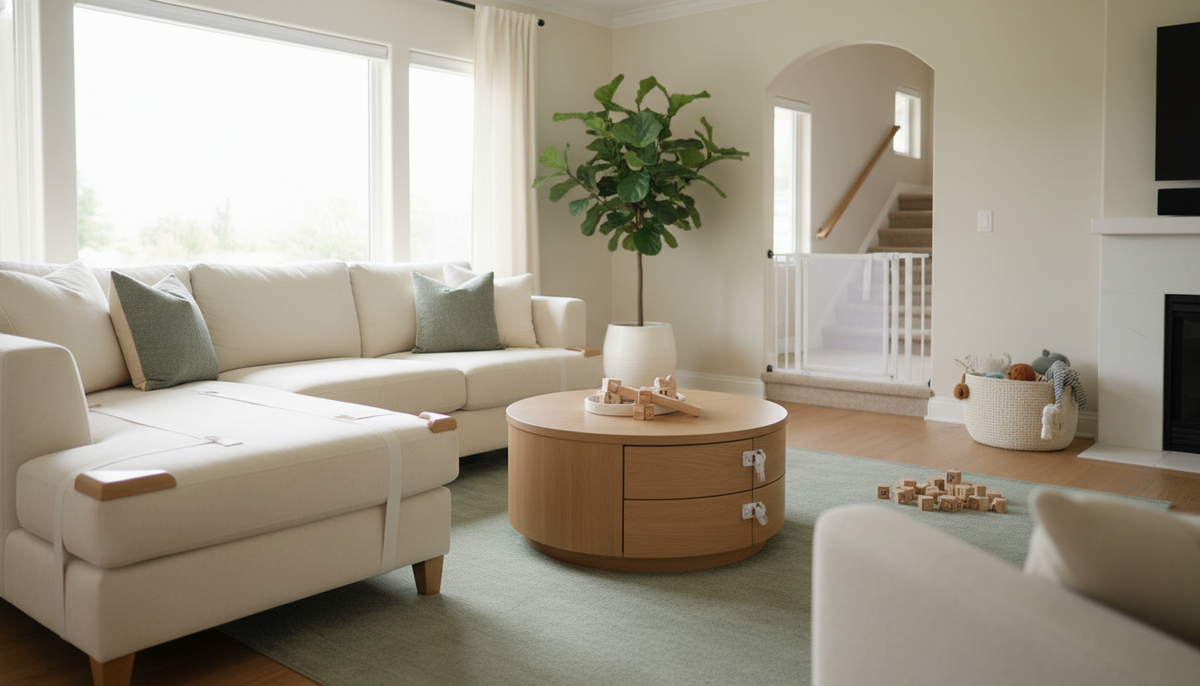
In my experience, my older daughter defeated an adhesive strap lock at 26 months in about four minutes. I replaced every adhesive lock on anything containing a hazard with a screw-mounted cabinet lock. Magnetic toys went into a locked craft cabinet at adult shoulder height.


Building Your Storage Zones
A functional playroom safety system uses distinct physical zones based on age range, not just labeled bins.
Zone 1: Floor level and low shelves (12–36 months). This space holds only toys designed for children under 3. No exceptions. Soft blocks, board books, large-piece puzzles with pieces too big to swallow, push toys, stacking rings. Nothing that passes the test cylinder. Nothing with button batteries, small wheels that detach, or removable parts smaller than a golf ball.
Zone 2: Upper shelves, 4–5 feet high (3–6 years). Toys labeled 3+ live here. Accessible to older children with adult awareness, but out of reach of toddlers. These shelves should have no step-stool access nearby. The 3+ toys in this zone still get audited regularly because "3+" is a floor, not a ceiling, and some sets have pieces that require even older children to handle safely.
Zone 3: Locked cabinet or high closet (6+ and hazard items). Magnetic sets, small-bead craft kits, action figures with tiny accessories, and anything with a complexity or hazard level beyond Zone 2. This zone also holds balloons.
Storage Zone by Developmental Stage
Infant zone only
Dedicated basket, separate from all sibling toys. No small parts, no detachable pieces.
Zone 1 only
Floor-level shelf with large-piece, soft, and mouthable-safe toys. Nothing passing the CPSC test cylinder.
Zone 1 and Zone 2 with supervision
Upper-shelf 3-plus toys accessible with adult awareness. Audit based on individual mouthing behavior.
Zone 2 and supervised Zone 3
Small-parts toys with demonstrated care. Magnetic sets still locked until consistent safe handling is confirmed.
All zones with judgment
Full access appropriate once child reliably keeps small parts away from younger siblings.
Balloons Are Not a Toy Storage Item
Uninflated and deflated balloons are among the most dangerous choking hazards for children under 8. The material conforms to the airway in a way that makes it nearly impossible to dislodge with back blows or abdominal thrusts. Both latex and foil balloons belong in adult-only storage, meaning a high cabinet or closet that children cannot access, not in the toy area.
This includes the ribbon-tied mylar balloons that come home from birthday parties, the bag of party balloons in the craft drawer, and the deflated balloon your child carried home from the restaurant. They are not keepsakes to store at child level. Throw them away or put them in a locked space.
Monthly Audits Catch What Initial Setup Misses
A toy that was safe at purchase can become hazardous over time. Wheels detach from toy cars. Battery covers crack and expose button batteries. Foam pieces break into smaller chunks. Painted surfaces chip. Seams split on stuffed animals and release pellet fill.
In my experience, I do a monthly sweep of every zone in the playroom, looking for anything that has broken off a larger toy, any battery that has come loose from an electronic toy, any cap or cover that has separated from its housing. Button batteries in particular are a serious hazard. They cause chemical burns to the esophagus within two hours of ingestion, and children often show no symptoms until damage has occurred. The audit takes about twenty minutes. I go through each bin, check the structural integrity of anything with moving parts, and pull anything that looks compromised. Broken toys get fixed or discarded, not returned to the bin.
Labeling for Everyone Who Uses the Playroom
Your organizational system only works if everyone who supervises your children understands it. Babysitters, grandparents, older siblings, and family visitors all need to be able to identify which toys are off-limits for younger children without reading the fine print on every box.
Clear visual labels on storage zones make this possible. Use color coding, large-print age ranges, or both. "AGES 3 AND UP, NOT FOR BABY" in large print on a shelf label communicates the rule immediately. A locked cabinet communicates it physically.
Keep a master list, either photographed or written, of every toy in your home that contains small parts, its age range, and where it’s stored. This takes about an hour to create and becomes invaluable when a younger child visits, when you add new toys to the collection, or when a caregiver needs to make a quick decision about what’s safe to hand a child.
Monthly Playroom Safety Audit
Shared Playrooms and the Rotation System
When older and younger children share a playroom, the organizational challenge is ongoing because older children’s toys migrate. A Lego piece ends up in the toddler bin. A small figurine falls behind the couch cushion. A magnetic tile gets left on the floor.
The most reliable solution for shared spaces is a rotation system. When older children are playing with small-parts toys, younger children’s toys are stored in a dedicated, lockable cabinet. The two collections are never out at the same time in the same space. This requires buy-in from older children, which takes time and consistency, but it eliminates the mixing problem entirely.
For families where rotation isn’t practical, the physical separation of zones needs to be more aggressive. A baby gate or room divider that creates a physically separate toddler space within the playroom gives younger children a zone where only age-appropriate toys can reach them, regardless of what’s happening on the other side.
Infant Toys Stay Separate From Everything Else
Pacifiers, teething toys, soft toys, and any item intended for children under 12 months require their own storage area, separate from older children’s toys. The risk isn’t just small parts. It’s contact contamination. An older sibling’s toy that has been on the floor, in a bin with other toys, or handled by multiple children carries bacteria, small debris, and potential hazard items that should never reach an infant’s mouth.
Infant items belong in a dedicated basket or bin that older children don’t access. It doesn’t need to be locked, but it should be clearly designated and positioned away from the main toy area.
Reassessing as Children Grow
A toy labeled 3+ doesn’t automatically become appropriate for your 3-year-old. Some sets in that category have pieces that require the fine motor control and judgment of a 5- or 6-year-old to handle safely. Storage placement should be reassessed as your children mature, not set once and forgotten.
Watch how your child interacts with a new toy before deciding where it lives in your storage system. A 4-year-old who still mouths objects under stress belongs in Zone 1 for storage purposes, regardless of what the box says. A 7-year-old who has demonstrated consistent care with small pieces can access Zone 2 toys with less supervision. The label is a starting point. Your child’s actual behavior is the deciding factor.
Organize the playroom for who your children are right now, and audit that organization every few months as they change.