Baby Proofing for Crawlers: The First Safety Sweep Your Home Needs

Most parents picture baby-proofing as something they’ll get to eventually, maybe after the first crawl. That’s the wrong order. By the time your baby is pulling across the floor toward the dog’s water bowl, you’ve already lost the window.
The AAP notes that most babies begin crawling between 6 and 10 months, though some start as early as 4 months. That’s a narrow runway. Crawling means your baby can reach new things and is actively, relentlessly searching for things to reach. Every cord, every cabinet gap, every outlet at baseboard height is suddenly a destination.
This is the sweep you do before that happens.
The Floor Is a Different World
Get down on your hands and knees in every room you use regularly. I mean this literally. Do it in your living room, your kitchen, your hallway. The view from 18 inches off the ground is not the view you have standing up. You’ll see the frayed lamp cord running under the couch. The coin that rolled under the coffee table six weeks ago. The gap between the cabinet door and the frame that a small hand fits into perfectly.
The CPSC uses a toilet paper tube as a rough guide for choking hazards: if an object fits through the tube, it’s a risk for a child under 3. Do a floor-level sweep with that standard in mind. Coins, button batteries, pen caps, small toy parts, pet kibble. All of it. Crawlers mouth everything they pick up. That’s not curiosity gone wrong. That’s developmentally normal behavior that requires the environment to be safe, not the baby to know better.
In my experience, button batteries are one of the most dangerous small objects in a home. A button battery can cause severe internal burns within two hours of ingestion. Get them off the floor and out of reach entirely.
Corner Guards and Edge Protection
Coffee tables, fireplace hearths, low bookshelves, TV stands. These are the hard surfaces at exactly head height for a cruising or newly crawling baby. Falls onto sharp corners cause real head injuries, and crawlers don’t have the motor control to catch themselves the way older children do.
Install corner guards and edge bumpers before your baby is mobile. The foam and silicone options available now are far less obtrusive than they were a few years ago, and many are clear enough to be nearly invisible on glass or light wood. In my experience, adhesive-backed corner guards fail most often on textured or painted surfaces. If your coffee table has a matte or textured finish, use the kind with a mechanical clip or a secondary adhesive strip rather than relying on a single foam pad.
Fireplace hearths deserve special attention. The edge is often brick or stone, and the surface area is wide, meaning a baby can fall onto it from multiple angles. A full hearth pad that covers the entire raised edge is worth the investment.
Furniture Tip-Over: The Hidden Risk
Dressers, bookcases, freestanding shelves, and televisions on stands are all tip-over risks. Crawlers become pullers. Once your baby can grab a drawer edge or a shelf lip, they will use furniture as a climbing assist, and an unsecured piece can come down on them.
Secure everything that could tip to wall studs using anti-tip straps or L-brackets. This is not optional for furniture in rooms where your baby spends time. Furniture tip-overs injure thousands of young children in the United States every year. The strap hardware costs a few dollars. The installation takes 20 minutes. Do it for every dresser, every bookcase, every TV that isn’t wall-mounted.
In my experience, drywall anchors instead of studs will fail under real load. Find the studs. Use the studs.


Cabinet Locks at Floor Level
Your baby will reach every low cabinet within their crawl radius. Under-sink cabinets, kitchen base cabinets, bathroom vanities. These spaces often hold cleaning products, medications, plastic bags, and sharp objects. A crawler doesn’t know the difference between a safe drawer and a dangerous one.
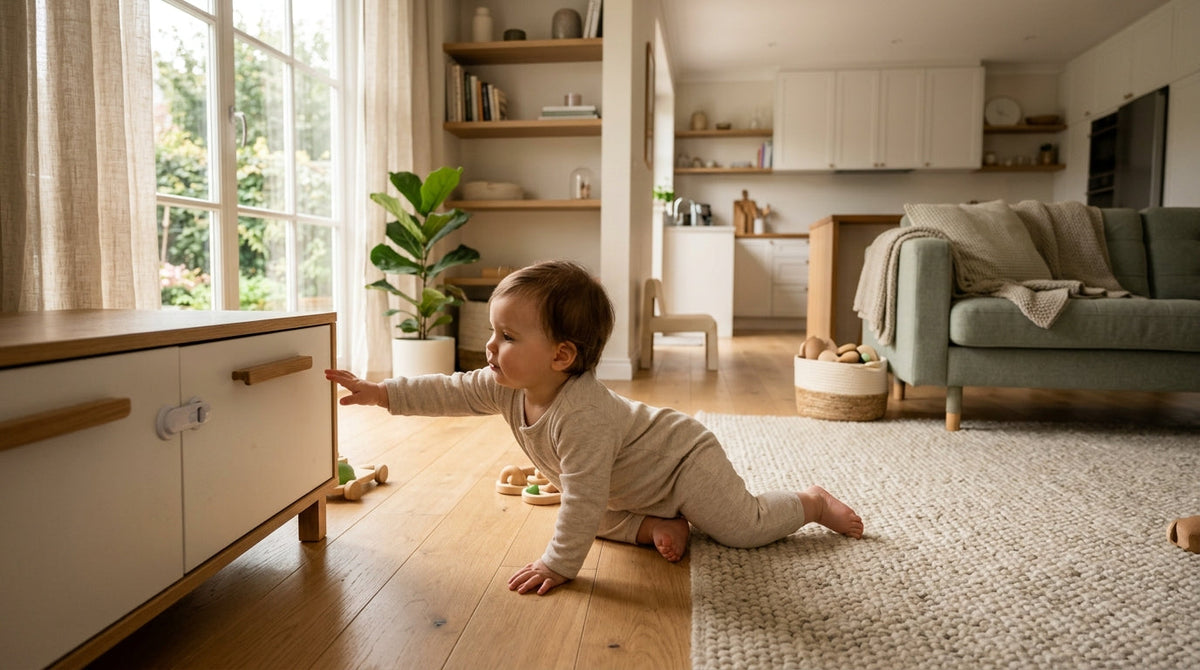
Install safety latches on all low cabinets and drawers before your baby is mobile. There are several latch styles: magnetic key locks, spring-loaded latches, and adhesive strap locks. Magnetic locks are the most defeat-resistant because there’s nothing visible to manipulate from the outside. Spring-loaded latches mounted inside the cabinet are reliable but require drilling. Adhesive strap locks are convenient but have a documented failure history.
A 2012 CPSC recall pulled 900,000 Safety 1st Push 'N Snap cabinet locks after reports of children as young as 9 months opening them. Three of those children reached toxic cleaning products. Verify your latches are latched, and test them with real force after installation. In my experience, if a cabinet lock gives even slightly under hard pulling, it should be replaced.
Strap locks can lose adhesion over time. Magnetic locks are more reliable for low cabinets.
Stair Gates: Top and Bottom
Stairs are a consistent source of serious injury for young children. About 93,000 children under 5 are treated in U.S. emergency rooms each year for stair-related injuries, per CPSC NEISS data.
You need gates at both the top and bottom of every staircase your baby can access. The top gate must be hardware-mounted to wall studs or solid banisters. Pressure-mounted gates are not appropriate at the top of stairs because a crawler testing the gate with their full body weight can dislodge them. At the bottom, a pressure-mounted gate is acceptable as a secondary deterrent, but hardware-mounted is always stronger.
Look for gates that meet ASTM F1004, the federal safety standard for expansion gates and expandable enclosures, made mandatory under 16 CFR Part 1239 effective 2021. That standard exists for a reason. Older gates or off-brand imports may not meet it. Check the packaging or the manufacturer’s spec sheet before you buy.
Outlets, Cords, and Electrical Hazards
Outlets sit at exactly the height a crawler notices. The openings look like something worth investigating. Standard plastic plug covers are better than nothing, but tamper-resistant outlet covers that require simultaneous pressure on both slots are meaningfully harder for small fingers to defeat.
If your home was built or renovated after 2008, your outlets may already be tamper-resistant under NEC requirements. Check by trying to insert a single object into one slot. If it doesn’t go in without pressure on both sides simultaneously, you have TR outlets. If it does go in, replace the covers.
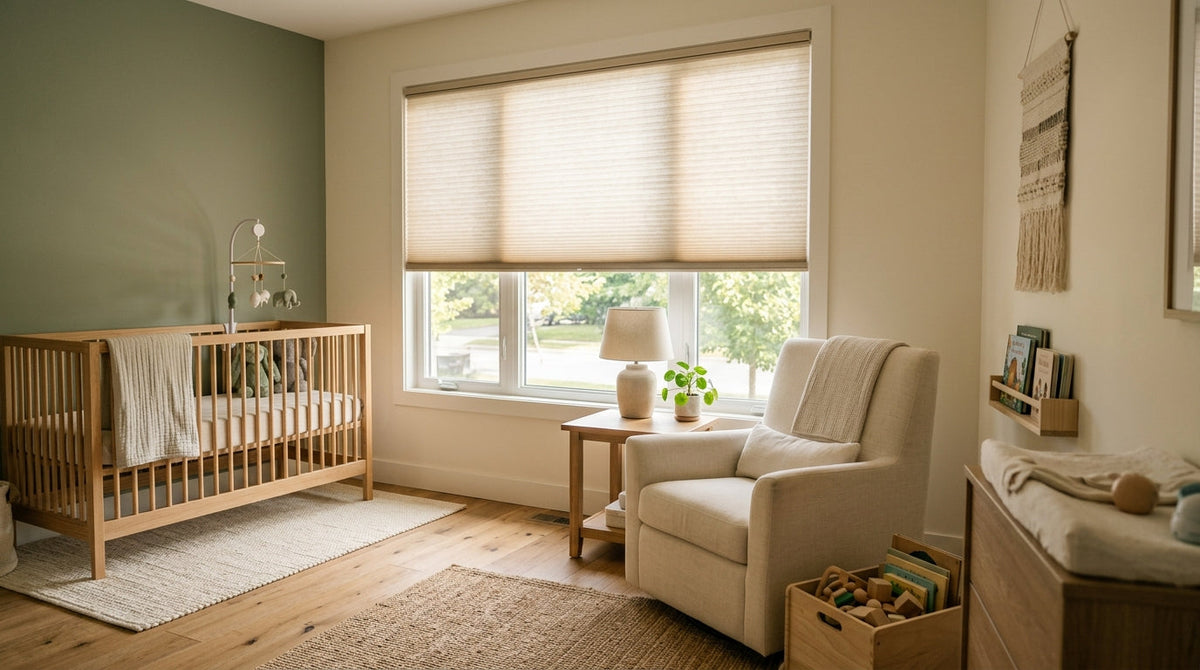
Cords are a separate problem. Window blind cords, phone chargers, lamp cords, TV cables are tripping hazards for adults and strangulation risks for infants and crawlers. The guidance is straightforward: secure cords out of reach with clips or cord shorteners, route them behind furniture, or replace looped blind cords with cordless alternatives. Looped cords from window coverings are particularly dangerous because they form a fixed loop at a predictable height.
Water Hazards at Crawling Level
A child can drown in as little as one to two inches of water, per the AAP. For a crawler, that means a toilet, a bathtub with standing water, a bucket left on the floor, or a pet’s water bowl all present real risk.
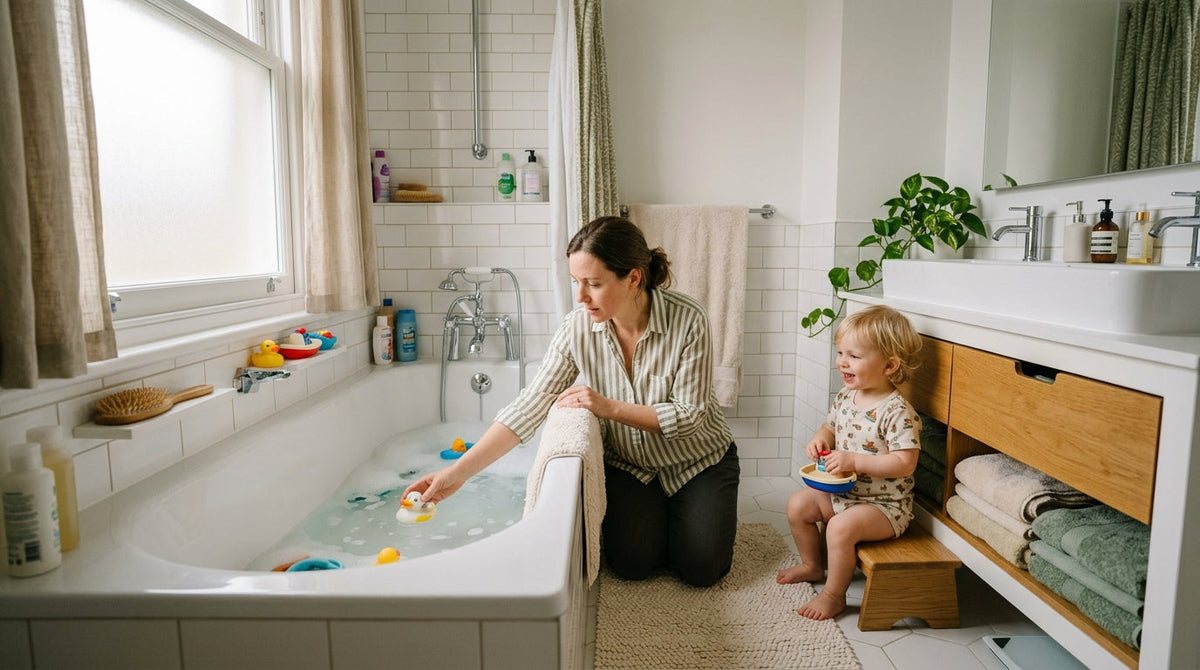
Install a toilet lid lock on every toilet your baby can reach. Empty the bathtub immediately after use. Never leave a bucket of water, a mop bucket, or a kiddie pool unattended. Drowning is the leading cause of unintentional injury death in children ages 1 to 4, per CDC data. The prevention is not complicated, but it requires consistent habit change, not just a one-time sweep.
Pre-Crawl Safety Sweep Checklist
Poisons, Pet Bowls, and Floor-Level Hazards You Might Miss
Pet food and water bowls are on the floor by design. Dry kibble is a choking hazard. The water bowl is a drowning risk for a very young crawler. Move them to a location your baby can’t access, or feed pets in a closed room during meal times.
Medications are a particular concern because many are kept in low bathroom cabinets or left on counters. America’s Poison Centers logged nearly 2.1 million human poison exposures in 2024. Children are a significant portion of those calls. Every medication in your home should be in a locked cabinet or on a high shelf, not in a low drawer or a bag on the floor.
Unfamiliar Spaces Require Active Supervision
Grandparents’ homes, childcare settings, and friends’ houses are often not baby-proofed to the standard you’ve set at home. When you’re in an unfamiliar space with a crawler, you cannot rely on the environment. You have to be the barrier.
Before you put your baby down to crawl in a new space, do a fast floor-level visual sweep. Look for cords, small objects, open cabinets, and low furniture edges. It takes two minutes. It matters every time.
Build a Safe Zone While You Finish the Rest
You won’t complete your full home sweep in one afternoon. While you work through rooms, designate a safe crawling zone: a gated or enclosed play area with non-toxic flooring or a clean rug, age-appropriate toys with no small parts, and clear sightlines so you can see your baby from wherever you’re working nearby.
This isn’t a permanent solution. It’s a practical one. Your baby needs floor time to develop. You need time to do the sweep properly. A safe zone gives you both.
The goal of this sweep isn’t to create a sterile environment. It’s to remove the hazards that cause real, preventable injuries so that your baby’s natural drive to explore doesn’t cost them. Do the sweep before the first crawl. Then do it again at 9 months, and again when they start pulling to stand. The hazard profile shifts as they get taller. So does the work.