Baby Proofing Kitchen Checklist: Every Hazard Every Solution

The kitchen is the most dangerous room in your house for a child under five. Not the bathroom. Not the garage. The kitchen, where you spend hours every day, where the hazards are hot and sharp and toxic, and where your attention is divided by a dozen competing demands at once.
I learned this the hard way when my younger daughter, at around 18 months, emptied the entire under-sink cabinet in the time it took me to answer the doorbell. Dish soap, drain cleaner, a spare sponge, a bottle of furniture polish. All of it on the floor. She hadn’t opened anything, but she could have. That afternoon I went through every cabinet, every drawer, every surface, and made a list. Below is that list, expanded and organized so you can work through it systematically.
The Stove and Oven
Start here, because heat injuries are among the most preventable and the most serious.
A stove guard is your first line of defense. These plastic or metal barriers mount along the front edge of the stovetop and block small hands from reaching burners or grabbing pot handles. Install one before your child is pulling to stand. Once they’re upright, the stovetop is at eye level and intensely interesting.
Always turn pot handles inward, toward the back of the stove. A handle pointing out over the edge is a lever a toddler can grab from the floor.
Establish a no-play zone of at least three feet around the stove while cooking. Tape it on the floor if you need to make it concrete. My older daughter understood "hot zone" by about 26 months, but understanding it and respecting it are different things, and I never relied on her judgment alone.
Oven knobs are a separate problem. Many stoves come with removable knob covers, but if yours don’t, buy aftermarket covers. A child who turns a burner on without you noticing creates a fire hazard and a gas hazard, in addition to burn risk. Never leave a child in the kitchen unattended while the stove is on. And avoid carrying hot liquids, soup, coffee, boiling water, while holding a child. One stumble ends badly.
Cabinet and Drawer Locks
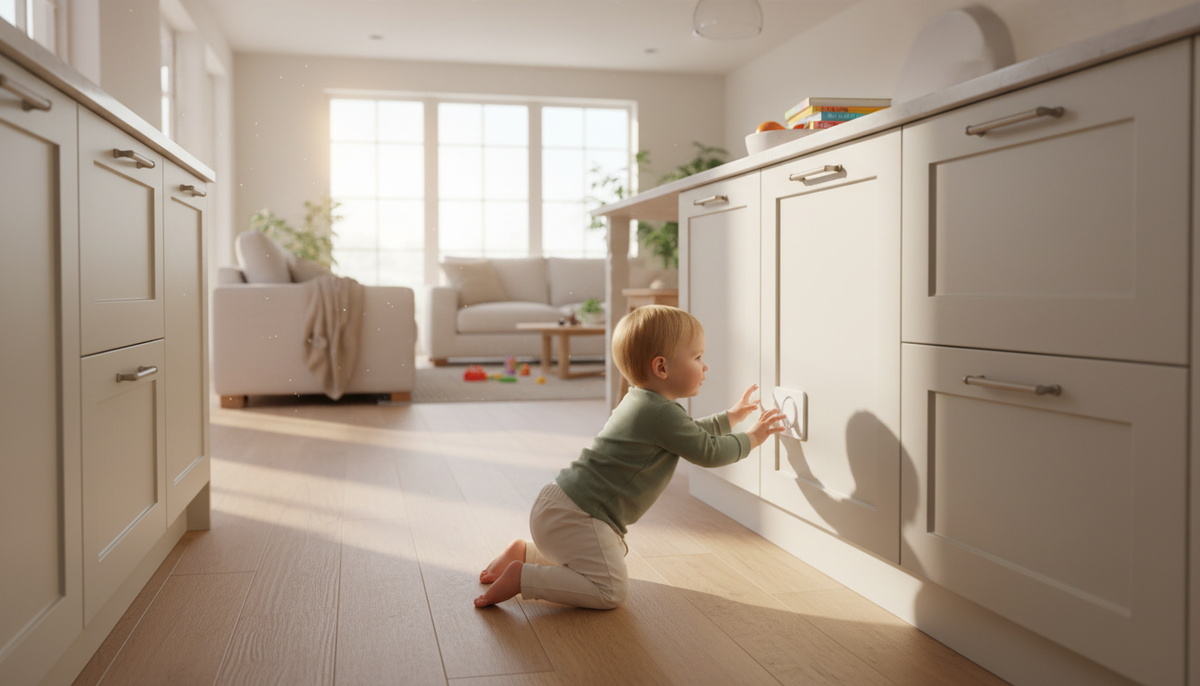
Every low cabinet and drawer in your kitchen needs a lock. That’s not an overstatement. The CPSC recommends securing all low cabinets and drawers containing hazardous items, and in a kitchen, nearly every cabinet qualifies: cleaning supplies, knives, heavy pots, small appliances, medications.
The lock type matters more than most parents realize. Simple spring latches are better than nothing, but older toddlers defeat them quickly. In my experience, a push-release latch was figured out by 26 months, it was just a puzzle to solve.
Magnetic locks are more tamper-resistant. The cabinet appears to have no hardware at all from the outside. You open it with a magnetic key that you keep on top of the refrigerator or in a high drawer. They require installation inside the cabinet, which takes more time upfront, but they resist tampering longer than spring latches.
A 2012 CPSC recall pulled 900,000 Safety 1st Push 'N Snap cabinet locks after reports of children as young as 9 months opening them, and three children reached toxic cleaning products as a result. The lesson isn’t that all locks fail. It’s that lock selection and installation quality both matter, and you should periodically test every lock in your kitchen.
Cleaning Supplies, Chemicals, and the Under-Sink Cabinet
This deserves its own section because the under-sink cabinet is where the most dangerous items in your kitchen typically live.
Dish soap, drain cleaner, oven cleaner, dishwasher pods. These are not mild irritants. Dishwasher detergent pods are a leading cause of poisoning calls to poison control centers involving young children, according to the American Association of Poison Control Centers. They’re colorful, squishy, and look like something a toddler might want to put in their mouth.
The only acceptable solution is a locked cabinet. Not a cabinet with a simple latch. Not a cabinet where you "always remember" to close the door. A locked cabinet, with a magnetic lock or a key-based lock, installed and tested before your child is mobile.
Store all cleaning supplies, pesticides, and chemicals in that locked cabinet or in a locked pantry. If you run out of space, move non-hazardous items to make room. Reorganizing your Tupperware is a much smaller problem than a poisoning.


Sharp Objects
Knives, box graters, mandolines, food processor blades, and kitchen shears all need to live in locked drawers or high cabinets. The countertop knife block that looks nice on your kitchen island is a hazard once your child can reach the counter.
The dishwasher is a specific trap. Parents load sharp knives point-down for safety during the cycle, then unload them while a toddler stands nearby. The child reaches into the silverware basket before you do. Store knives separately from the silverware caddy, and unload the dishwasher when your child is not in the kitchen or is secured in a high chair.
Keep countertops clear of sharp items as a default, not just when you remember to. A grater left on the counter after dinner prep is still there at 6 a.m. when you’re half-awake and your toddler is not.
Small Appliances and Dangling Cords
A cord hanging over the edge of a counter is an invitation. Children pull on cords. What comes down can be a toaster, a blender, a coffee maker, or a full pot of coffee, the appliance and its contents are both hazards.
Unplug small appliances when not in use and store them in a locked cabinet or at the back of a high shelf. This applies to blenders, food processors, stand mixers, and anything else with a blade or a heating element. A coffee maker that lives on the counter should have its cord routed away from the edge and secured with a cord clip so there’s nothing to grab.
Avoid using appliances while a child is underfoot if you can. When you can’t, position yourself between the child and the appliance.
The Refrigerator
The refrigerator contains choking risks (whole grapes, nuts, hard candy, raw carrots), alcohol, medications that some families store cold, and the entrapment risk of the appliance itself.
A refrigerator door latch costs about ten dollars and takes five minutes to install. It prevents a toddler from standing in front of the open refrigerator pulling items out, and it prevents the more serious scenario of a child climbing inside an older or chest-style refrigerator.
Never store medications, vitamins, or alcohol in the refrigerator. These belong in a locked cabinet, at height. The refrigerator feels like a secure location because adults think of it as food storage, but a toddler doesn’t make that distinction.
Per AAP guidance, avoid giving children under four years old high-choking-risk foods including whole grapes, nuts, popcorn, and raw carrots. Store these items in high, locked cabinets or in the back of a high refrigerator shelf, not in the crisper drawer a toddler can reach.
The Dishwasher
Two hazards, both serious. First, the detergent. Dishwasher pods and powder are highly caustic and should never be stored under the sink or in any unlocked low cabinet. Locked cabinet, always.
Second, the door. A dishwasher door that falls open creates a step a toddler will immediately use to climb. It also exposes the interior, including sharp utensils and residual detergent. Install a dishwasher lock or latch. Most are adhesive and take under a minute to apply. Test it monthly, because adhesive locks on appliances that vibrate and get wet can lose grip over time.
Don’t run the dishwasher and leave the kitchen with a toddler present. The cycle sounds are interesting, the door is warm, and the whole thing is an attractive nuisance.
Trash, Recycling, and Food Waste
A trash can with a lid is not secure against a determined toddler. Trash contains food waste, broken glass, sharp can lids, cleaning product residue, and small items that are choking hazards. Recycling contains broken glass and sharp metal edges.
Store trash and recycling in a locked cabinet or a closed pantry. If your kitchen layout doesn’t allow for that, use a trash can with a locking mechanism, not just a step-open lid, and treat it as a temporary solution while you figure out a better one. The under-sink cabinet with a magnetic lock is a common solution for trash storage.
Compost bins left on the counter are also a hazard. Fermenting food waste can make a child sick. Keep them lidded and out of reach, or move them to a location outside the kitchen.
Countertops, Chairs, and Climbing
Children use chairs, step stools, and open dishwasher doors to reach countertops. Once they’re up there, everything on the surface is accessible. Keep countertops clear of knives, medications, small items, and anything heavy that could fall.
Remove tablecloths from any table a toddler can reach. A tablecloth is a handle. Whatever is on the table comes down with it.
Check whether any chairs or stools in your kitchen can be pushed to the counter and used as a climbing platform. If yes, store them away from the counter when not in use, or replace them with heavier items that are harder to move.
Any freestanding shelving unit, pantry cart, or baker’s rack needs to be anchored to the wall. These tip when a child climbs the shelves, which they will. Use anti-tip straps rated for the weight of the unit plus the weight of whatever is on it.
Kitchen Baby-Proofing Checklist
Flooring and Slip Hazards
Spills happen constantly in a kitchen. A wet tile floor is a fall risk for adults and children both. Clean spills immediately. Use non-slip mats under any rugs in the kitchen, and check that the mats themselves don’t curl at the edges and create a tripping hazard.
If you’re renovating, textured or matte-finish flooring reduces slip risk compared to polished tile. If you’re not renovating, anti-slip floor treatment products can be applied to existing tile. Neither is a substitute for cleaning up spills when they happen.
Keep pathways through the kitchen clear. A child running through a kitchen cluttered with bags, boxes, or a pet’s water bowl will fall. Falls onto hard kitchen floors can cause serious head injuries.
Pantry Organization and Security
The pantry is often where cleaning supplies, pesticides, and non-food items end up sharing shelves with cereal boxes and canned goods. A child who can open the pantry door can reach anything on a low shelf, and they won’t distinguish between pasta and drain cleaner if both are at eye level.
Use a locked pantry door, or install a door knob cover that prevents a toddler from turning the handle. Move all non-food items to high shelves or out of the pantry entirely. Keep the pantry organized so small items, vitamins, medicine packets, seasoning packets that look like candy, can’t be pulled down easily.
Check the pantry floor. Bags of flour, sugar, or rice stored on the floor are climbing opportunities, as are stacked cases of water or soda. Reorganize so nothing on the floor creates a step up to higher shelves.
A Practical Approach to the Whole Kitchen
Work through the kitchen in zones: stove, under-sink, drawers, refrigerator, dishwasher, trash, countertops, pantry, floor. Check each zone before your child becomes mobile, because installation is harder and more urgent when a crawling child is underfoot. Revisit every zone at 12 months, 18 months, and 24 months, because what held at one developmental stage may not hold at the next.
Keep the Poison Control number (1-800-222-1222) posted on your refrigerator and saved in your phone. If a child ingests something, call immediately rather than waiting to see if symptoms develop. Time matters with chemical exposures.
The kitchen will never be a zero-risk environment. You cook there, you store things there, you live there. But a kitchen where every cabinet is locked, every sharp item is stored properly, every cord is managed, and every hazard has been addressed is a kitchen where the most serious injuries simply don’t happen.