Best Cabinet Locks for Baby 2026: Magnetic Adhesive and Strap Picks

Every year, thousands of parents install cabinet locks, feel relieved, and then discover their toddler has already figured out the one they bought. I know this firsthand. My older daughter defeated an adhesive strap lock at 26 months. She didn’t pry it off. She just watched me open it twice, then copied the motion with both hands. The lock was rated for children up to age 3. She was not impressed.
Cabinet locks are not a set-it-and-forget-it solution. They are a layered defense that works best when you choose the right type for each location, install it correctly, and check it regularly.
Why Cabinet Locks Belong on Your Priority List
In 2024, household cleaning substances topped the list of substances kids under 6 got into, accounting for roughly 1 in 10 (10.1%) of all pediatric poison center cases, according to America’s Poison Centers. That is more than 87,000 cases in a single year. More than 99% of those exposures were unintentional, per the same data. Children are not trying to get into the cabinet under your sink. They are just curious, fast, and have no concept of what "corrosive" means.
CPSC Pediatric poisoning deaths in children under 5 reached 97 in 2022 and 90 in 2023. Narcotic-medication fatalities specifically doubled from 33 in 2021 to 66 in 2023, which is why the bathroom medicine cabinet deserves the same attention as the cabinet under the kitchen sink.
ASTM F3492–21 is the voluntary consumer safety standard that applies to cabinet locks and latches in the U.S. It exists because the risk is real and documented. Locks that meet it must withstand an average breaking force of at least 45.3 lbs across a 30-sample test, which gives you a baseline for comparing products.
Start your audit before you buy anything. Walk through your home and open every cabinet and drawer at toddler height. Cleaning supplies, medications, sharp utensils, heavy pots, and anything with small parts all go on the list. Then prioritize: the under-sink cabinet in the kitchen and the bathroom medicine storage are your highest-risk locations. Work outward from there.
Magnetic Cabinet Locks
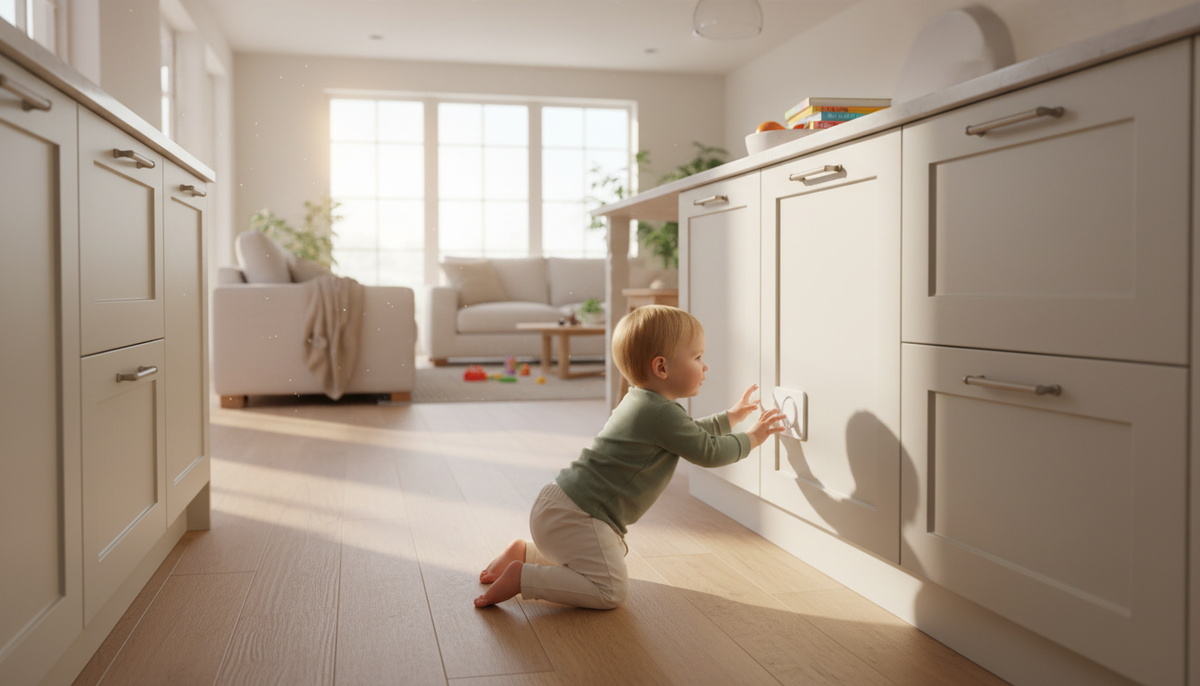
Magnetic locks are the gold standard for kitchen cabinets, and for good reason. The locking mechanism mounts entirely inside the cabinet, invisible from the outside. A magnetic key held against the cabinet face releases the catch. There is nothing for a child to see, touch, or manipulate from the outside.
The safety advantage over traditional key locks is significant. A physical key left on the counter becomes a toy. A magnetic key that lives in a high drawer or on top of the refrigerator stays out of reach and out of sight. The tradeoff is consistency: if you do not return the magnetic key to its designated spot every single time, you will spend ten minutes hunting for it while dinner burns. Pick one location and commit to it.
Installation requires drilling, which makes magnetic locks a better fit for homeowners than renters. Most systems use two screws per catch, and the catch must align precisely with the door frame for the magnet to release cleanly. In my experience, the alignment step is where most people struggle. Measure twice. The catch position matters more than the magnet strength.
What to look for: Locks rated to ASTM F3492–21, a magnetic key strong enough to work through cabinet doors up to 3/4-inch thick, and a catch that holds firmly when a child pulls with both hands. Some premium systems include a secondary release for emergencies, which is worth having if you ever lose the magnetic key.
Multi-cabinet systems that use one magnetic key to release multiple catches throughout the kitchen are efficient and cost-effective. The limitation is that you cannot unlock a single cabinet without the key nearby. If you want to leave one cabinet accessible to an older child while keeping others locked, individual locks give you more flexibility.


Adhesive Strap and Latch Locks
Adhesive locks are the first thing most parents reach for, and they work well under the right conditions. They require no drilling, install in minutes, and come off without damaging most surfaces. For renters, they are often the only practical option.
The catch is in the word "adhesive." These locks depend entirely on the bond between the mounting plate and the cabinet surface. On painted wood, the bond is strong. On laminate, veneer, or textured surfaces, it is less reliable. On cabinets near the stove or under the sink where surfaces get wet, the adhesive degrades faster than the packaging suggests.
CPSC recalled 900,000 Safety 1st Push 'N Snap cabinet locks in March 2012 after 140 children defeated them, and three of those children reached toxic cleaning products. The recall is a useful reminder that adhesive lock failure is not hypothetical. It happens, and it happens with products that were widely sold and trusted.
Before you install adhesive locks:
- Clean the surface with isopropyl alcohol and let it dry completely. Any residue, grease, or moisture will compromise the bond.
- Wait the full cure time before testing. Most manufacturers specify 24–72 hours. Skip this and the lock will pull off under a child’s first serious attempt.
- Press the mounting plate firmly for 30–60 seconds. A quick press is not enough.
In my experience, adhesive locks on under-sink cabinets degrade faster than expected. After about four months of repeated exposure to moisture, the bond can soften enough that a child can pull the lock off. Monthly checks on every adhesive lock in the house catch this before it becomes a problem.
Strap locks wrap around two cabinet handles and use a buckle or latch that requires two-handed coordination to open. Most toddlers cannot manage this until age 3 or older, which makes strap locks effective for that critical 12–36 month window. They work on cabinets with handles or knobs but are useless on handleless push-to-open designs.
| Lock Type | Drilling Required | Best For | Key Weakness |
|---|---|---|---|
| Magnetic | Yes | Kitchen cabinets, homeowners | Key must be stored consistently |
| Adhesive strap | No | Renters, handled cabinets | Bond degrades near moisture |
| Slide-to-open | Yes | Infrequent-access cabinets | Visible mechanism can be copied |
| Push-button/combo | Yes | Medications, cleaning supplies | Caregiver fatigue, shortcuts |
Slide-to-Open and Push-Button Locks
Slide-to-open locks require a specific motion, usually a simultaneous push and slide, that is counterintuitive to young children. They mount inside the cabinet like magnetic locks but do not require a separate key. The tradeoff is that older toddlers and preschoolers can often figure them out by watching caregivers, especially if the mechanism is visible.
Push-button and combination locks add another layer of complexity. A four-digit code or a multi-step button sequence deters most children through age 4 or 5. The risk is caregiver fatigue. In a busy household, a combination lock on the cabinet you open twenty times a day becomes a source of shortcuts. Shortcuts become habits. Habits become gaps. If you use a combination lock, keep the code simple enough that you never skip it.
These locks work best on cabinets you access less frequently, like the one storing medications or cleaning supplies, where you can afford the extra seconds the combination requires.
Locks for Specific Cabinet Types
Universal locks fit most situations but not all. If your kitchen has soft-close drawers, a standard tension-based lock may interfere with the closing mechanism or pop loose over time. Soft-close hardware uses a hydraulic damper that pulls the drawer closed with force, and some locks are not built to handle that repeated stress. Look for locks specifically rated for soft-close applications.
Glass-front cabinets present a different challenge. The door is lighter, the hinges are often decorative rather than heavy-duty, and adhesive locks can leave marks on glass surfaces. Magnetic locks work well here because the mechanism is internal and does not contact the glass. For frameless glass-front cabinets, consult the manufacturer before drilling anything.
Corner cabinets with lazy Susans or pull-out shelves are awkward to lock because the door configuration does not lend itself to standard catches. A strap lock around the two door handles is often the simplest solution, even if it is not the most elegant.
What ASTM F3492–21 Means for Your Purchase
ASTM F3492–21 is a voluntary standard, not a federal mandate. A manufacturer can sell a cabinet lock in the U.S. without meeting it. That matters when you are comparing a $4 lock to a $14 one. The relevant standard for interior-mounted child-safety cabinet latches is ASTM F3492–21, published in 2021, and it covers breaking strength, cycle durability, labeling requirements, and specific provisions for magnetic locks.
The 45.3-lb average breaking strength requirement is a meaningful benchmark. A determined 2-year-old can generate significant pulling force, and a lock that fails at 20 lbs is not doing its job. Cycle durability matters too. A lock rated for 20,000 opening cycles will hold up through years of daily use. A lock rated for 3,000 cycles may start to loosen within months if you open that cabinet ten times a day.
When evaluating a lock, check for:
- Explicit ASTM F3492–21 compliance on the packaging or product listing
- Cycle rating (look for 10,000 or higher for frequently used cabinets)
- JPMA certification, which indicates independent third-party testing
- Clear installation instructions with a specified cure or set time
If a product does not mention ASTM F3492–21 and cannot be found in the JPMA certification database, treat it as unverified. That does not mean it will fail, but you have no independent data confirming it will not.
Installation Details That Matter
The height and angle of a lock affects how long it stays effective. Install magnetic lock catches low on the cabinet door, near the bottom corner, rather than centered. A child pulling at the door will apply the most force at the top. A catch near the bottom requires more leverage to defeat.
Keep the magnetic key out of sight during use. Children as young as 18 months will watch you unlock a cabinet and begin experimenting with the same motion. If they never see the key, they cannot replicate the sequence.
For adhesive locks, the angle of the strap matters. A strap that runs parallel to the door gap is easier to defeat than one that creates a perpendicular tension. Most strap lock instructions show the correct angle, but it is easy to rush through installation and get it wrong.
After installation, test every lock yourself before considering it active. Pull hard. Twist. Apply sustained pressure for 10–15 seconds. If an adhesive mount flexes or shifts, the bond is not strong enough. Redo it.
Monthly Cabinet Lock Check
Maintenance and Realistic Expectations
A cabinet lock that was working three months ago may not be working today. Adhesive bonds degrade. Plastic latches develop play. Magnetic catches accumulate grime that reduces their holding force. Monthly checks take about five minutes for an entire house, and they are worth it.
Monthly check routine:
- Pull firmly on every adhesive-mounted lock to confirm the bond is solid
- Test each latch mechanism for smooth operation and full engagement
- Look for cracks in plastic components, especially near the hinge points
- Check that magnetic catches align correctly and release cleanly
Replace any lock that shows visible wear, reduced holding force, or adhesive separation. A lock that looks intact but has developed play in the mechanism is not providing full protection.
No lock is permanent protection. Children grow stronger and more observant every month. A lock that stumped your child at 18 months may be trivial for them at 30 months. Plan to reassess your entire setup around the time your child turns 2, and again at 3. The goal is to stay ahead of their problem-solving, not to install one lock and consider the job done.
Building a Complete Cabinet Safety Plan
Locks are one layer. Out-of-reach storage is another. For medications especially, a locked cabinet is good. A locked cabinet that is also out of reach is better. Anything containing narcotics, prescription medications, or concentrated cleaning chemicals should have both.
Combine locks with consistent habits. Return the magnetic key to its spot every time. Do not leave cleaning products on the counter while you answer the door. Keep the bathroom medicine cabinet locked even when you think your child is napping. The 99.2% of exposures that are accidental in children under 6 happen in ordinary moments, not extraordinary ones.
The best cabinet lock is the one installed correctly, checked regularly, and backed up by storage habits that do not create gaps. Start with your highest-risk cabinets, choose locks that meet ASTM F3492–21, and build the checking routine into your monthly schedule before you need it.