Christmas Tree Baby Proofing: Lights Ornaments and Tree Stability

The holiday season is the one time of year most parents willingly bring a large, climbable, needle-shedding, cord-covered object into their living room and surround it with breakable glass and small shiny pieces. If you have a crawler, a toddler, or a determined preschooler, you already know where this is going.
Start With the Tree Itself: Stability Before Decoration
Before you hang a single ornament, secure the tree so it cannot fall. This is the foundational step, and most parents skip it.
A falling Christmas tree is heavy, disorienting, and covered in hard branches. A child who pulls on a low branch or attempts to climb is applying force at exactly the angle most likely to tip an unsecured tree. The fix is simple: run a length of clear fishing line or a small L-bracket from the upper trunk to a wall stud or a piece of heavy furniture that will not move with it. Two anchor points are better than one. The line should be taut enough to prevent any sway.
I learned this the hard way in my older daughter’s second December. She was 14 months old, pulling up on everything, and the tree was in a standard weighted stand with no wall anchor. I walked into the room one afternoon to find her gripping a low branch with both hands, the tree tilted at a 20-degree angle, and my heart somewhere near my throat. We anchored it that night. It stayed anchored every year after.
For artificial trees, check that the center pole locks securely at each section. Wobbly pole connections are common in older or budget trees, and no amount of wall anchoring compensates for a trunk that separates mid-fall. If yours wobbles, replace the tree or reinforce the connection before you decorate.
Lights: Cords, Heat, and Placement
Keep all lights at least 5–6 feet above the floor if your child is under 3. Below that line, lights become something to grab, chew, and pull.
Inspect every strand before use. Look for frayed insulation, cracked sockets, and broken bulbs. A damaged cord near a water source, like a tree stand, is a shock risk. If a strand has visible damage, discard it. Do not tape over fraying and call it fixed.
Use only lights rated for indoor use. The rating is printed on the box and often on the tag at the plug end of the strand. Outdoor lights run hotter and are not designed for the air circulation patterns inside a home.
LED lights are the right choice for homes with young children. Standard incandescent bulbs can get hot enough to cause a contact burn if a child touches a bulb during use or shortly after the tree is unplugged. LED bulbs stay cool to the touch. The difference is meaningful when your child’s instinct is to grab and hold.
Never leave lights plugged in when you are not in the room. This applies whether or not your child is awake. Unplug before you go to bed. Unplug when you leave the house. A timer switch can help build this habit automatically.
Ornaments: Zone Your Tree
Think of your tree in two zones: everything below 4 feet, and everything above it.
The lower zone is where curious hands will go. Stock it exclusively with soft, unbreakable ornaments: fabric, felt, solid wood, or hard plastic with no small detachable parts. Before hanging anything in the lower zone, hold it in your hand and tug. Pull the hanger loop. Pull any decorative element. If anything comes loose, it does not belong where a toddler can reach it.
The upper zone can hold your glass, ceramic, and sentimental ornaments, with one caveat: make sure they are secured. A glass ball that falls from the top of a 7-foot tree onto a hardwood floor will shatter into fragments small enough to be a hazard for days. Use ornament hooks that close rather than open wire hooks, and consider tying fragile pieces to branches rather than hanging them.
Keep all loose hardware, replacement hooks, and decoration supplies in a sealed container stored out of reach. Ornament hooks are the right size to be swallowed and the wrong shape to pass easily. My younger daughter got into a bag of spare hooks I had left on the coffee table during decorating. She was 18 months old. I found her with three of them in her fist and one already in her mouth. We now do all decorating after both kids are in bed.


Tree Stand Water: A Hazard Most Parents Miss
If you have a real tree, the stand holds water. That water can harbor bacteria, mold, and any preservative or additive you have mixed in. Children who drink from it can get sick.
Cover the stand completely. A tree skirt alone is not enough if your child is motivated. Use a physical barrier: a small section of baby gate, a decorative fence insert designed for tree stands, or a playpen panel arranged around the base. The goal is to make the water inaccessible, not just inconvenient.
Check water levels daily, and do it yourself rather than leaving the stand uncovered for any period. A tree that dries out also becomes a fire risk, so this daily check serves two purposes.
Tinsel, Garland, and String Decorations
Skip these entirely if your child is under 5.
Tinsel is a choking hazard and, if swallowed, can cause intestinal obstruction. The same applies to thin metallic garland, bead strands, and any decoration made of long flexible material. These items are designed to drape loosely, which means they detach easily and end up on the floor where small children find them.
If you are not willing to skip them, reserve them for the top third of the tree only, check the floor around the tree daily for fallen pieces, and understand that you are managing an ongoing hazard rather than eliminating it.
Creating a Physical Boundary
If your child is mobile but not yet old enough to reliably respond to "no," a physical boundary around the tree is the most effective single intervention you can make.
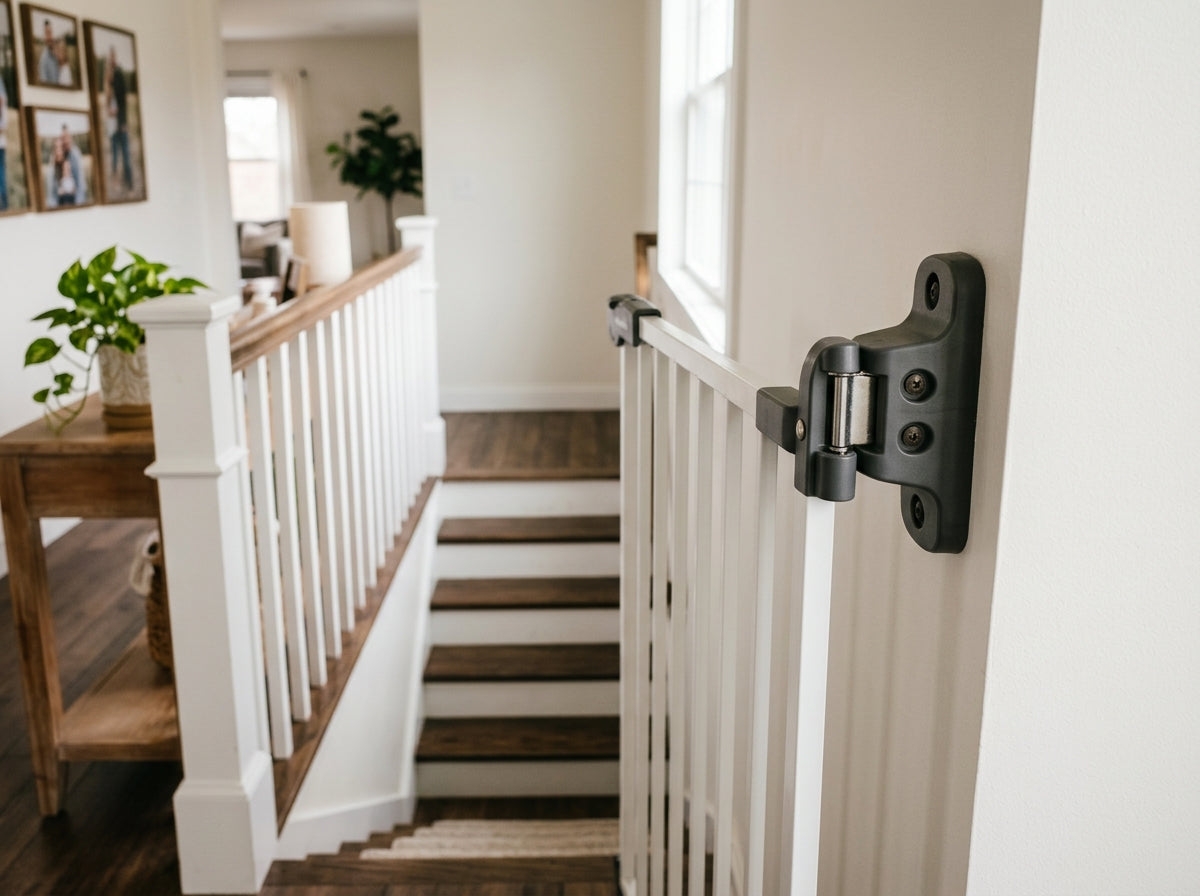
A playpen panel, a freestanding baby gate arranged in a semicircle, or a strategic arrangement of furniture can create a buffer zone that keeps your child from reaching the tree at all. This is not a permanent installation. Most families use it through the toddler years and phase it out as children develop the judgment to leave the tree alone.
If you are using a gate product as a tree barrier, check that it meets ASTM F1004, the federal safety standard for expansion gates and expandable enclosures. Many inexpensive decorative "tree fences" do not.
The boundary also reduces the temptation to climb. A tree is an irresistible climbing structure to a 2-year-old. Removing access is simpler than trying to supervise your way through the entire month of December.
Fire Safety and Tree Placement
Position the tree at least 3 feet from any open flame, including fireplaces, candles, and incense. Real tree needles dry out over the course of the season, and a dry tree near an open flame is a fire risk. This applies to artificial trees as well, though the risk profile is different.
Keep the tree away from radiators, heating vents, and space heaters. Heat sources accelerate needle drop in real trees and can warp or degrade artificial ones over time.
Never place candles on or near the tree. This should be obvious, but it comes up every year in fire incident reports. Candles belong on surfaces away from the tree, away from curtains, and away from anywhere a child can reach them.
60-Second Morning Tree Check
Artificial vs. Real Trees
Neither type is inherently safer. Both are manageable if installed and maintained correctly.
Artificial trees shed fibers and small plastic needles, particularly older trees with degrading branch tips. Vacuum the area around the base frequently, and keep the tree in a room where you can supervise play. Artificial trees do not need water, which eliminates the stand water hazard, but they can tip just as easily as real ones if not anchored.
Real trees shed natural needles continuously, especially as they dry. Fallen needles are a choking hazard for infants and young toddlers. Sweep or vacuum daily. A well-watered real tree in a cool room will shed less than a dry one near a heat source.
The choice comes down to your household’s specific situation. If the stand water hazard is a major concern, artificial is simpler. If needle shedding is the bigger issue, a well-maintained real tree in a cool, supervised space is fine.
The Daily Safety Check
Build a 60-second check into your morning routine for the duration of the season.
Look at the cords: any new fraying, any strand that has been pulled loose from its position on the tree. Check that the anchor line or bracket is still taut. Confirm the stand barrier is in place and has not been moved. Scan the floor around the base for fallen needles, ornament pieces, hooks, or anything else that landed overnight. If you added water to the stand, make sure the skirt or cover is back in position.
This routine catches problems before they become incidents. A cord that gets nicked by a branch, a hook that falls off an ornament, a barrier that a determined toddler has nudged out of position: none of these are serious if you catch them in the morning. All of them can become serious if they sit unaddressed for three days.
Keeping the Season Manageable
The goal is not a childproofed tree that looks like a safety installation. It is a decorated tree that is secure, with hazards addressed systematically rather than ignored.
Anchor the tree first. Zone your ornaments. Use LED lights and unplug them when you leave the room. Cover the stand. Skip the tinsel. Put up a barrier if your child is in the climbing phase. Check it every morning.
A few deliberate decisions at the start of the season mean you spend December enjoying the tree rather than watching it nervously.