Newborn Essentials on a Budget: Affordable Safety Must-Haves

Every year, new parents spend thousands of dollars on products they’ll use for six weeks. The baby industry is extraordinarily good at making everything feel essential, urgent, and safety-critical. Most of it isn’t. Here’s what matters, what it costs, and where you can safely cut corners without cutting safety.
A Safe Sleep Surface Comes First
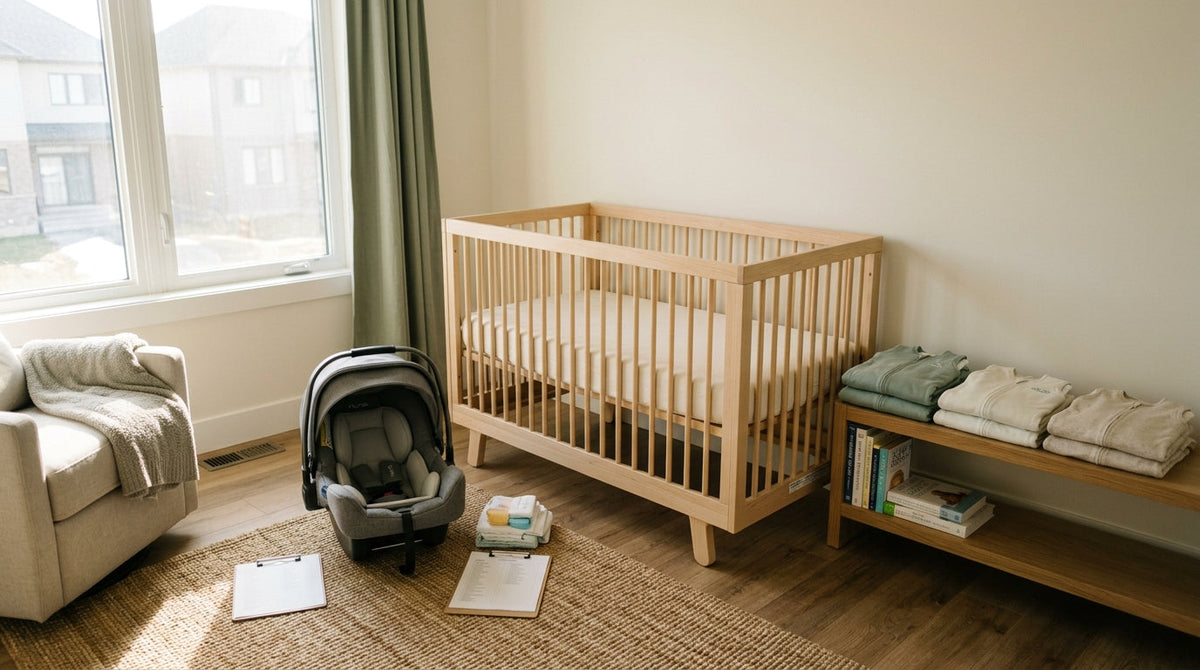
This is the one area where "budget" thinking has to stop at "good enough." A firm, flat sleep surface that meets current CPSC standards is non-negotiable. That means a crib, bassinet, or play yard with a snug-fitting mattress and nothing else inside. No pillows, no bumpers, no positioners, no stuffed animals.
Unintentional suffocation kills roughly 1,000 infants under age 1 each year in the United States (CDC). Many of those deaths involve soft bedding that parents added because it looked cozy or because they received it as a gift. The crib bumper that came with a beautiful nursery set is a hazard, not a feature. Leave it in the box.
The good news: a safe sleep surface does not have to be expensive. Many hospitals and community health programs offer free or subsidized bassinets and play yards to families in need. Check any product against the CPSC recall list at cpsc.gov/recalls, and look for a label showing it meets the current federal standard for its category. A secondhand crib is fine if it was manufactured after June 2011 (when new federal safety standards took effect), has no missing hardware, and has not been recalled. Check cpsc.gov before you buy anything used. A fitted sheet, a firm mattress, and a sleep sack are all you need.
Car Seats Are the One Thing You Cannot Compromise On
A car seat is legally required before you leave the hospital. It is also one of the most misunderstood purchases in the newborn category.
Here is the rule: never buy a used car seat unless you can verify its complete history. A seat that has been in a crash may show no visible damage but can fail to protect in a subsequent collision. If you cannot confirm the seat has never been in a crash, do not use it. Full stop.
Budget alternatives that are safe: some hospitals, health departments and community programs offer free or low-cost new car seats. If you do consider a used seat, the AAP says to avoid it unless you know its full history, and never to use one that has been in a moderate or severe crash, was recalled, is past its expiration date, has visible cracks, or is missing parts or its date-and-model label. Call your local health department. Many parents don’t know these programs exist until someone tells them. A new, basic infant seat from a reputable brand runs $60–$100 and meets the same federal standards as a $350 model. The price difference buys convenience features, not safety.
Clothing: Size Up and Keep It Simple
In my experience, newborns outgrow newborn-size sleepers quickly, often within three weeks. It’s worth buying a few in newborn size and immediately stocking the next two sizes up.
Fitted, snug sleepwear reduces loose fabric near the face. Sleep sacks replace blankets entirely and are safer for that reason. Decorative outfits with buttons, bows, and separate pieces are charming in photos and impractical everywhere else.
Secondhand infant clothing is almost always fine. It has been washed repeatedly, which removes manufacturing residues. Speaking of which: wash everything new before it touches your baby’s skin. Fragrance-free, dye-free detergent costs the same as scented versions and is less likely to cause skin irritation or diaper rash.


Diapers: Where the Real Money Goes
A baby goes through roughly 2,500–3,000 diapers in the first year. That math adds up fast. The good news is that diaper safety and hygiene are not brand-dependent. Store-brand diapers from major retailers meet the same absorbency standards as premium brands and cost significantly less per unit.
Buying in bulk when diapers are on sale is one of the highest-return budget moves available to new parents. Subscribe-and-save programs through major retailers often discount 15–20% off regular price. Cloth diapers have a higher upfront cost but lower long-term cost, and modern all-in-one styles are not much more complicated than disposables. If you have access to a washer and dryer, they are worth pricing out.
One practical note: size up before you think you need to. A diaper that fits too snugly leaks more, not less.
A First-Aid Kit Costs Less Than One Urgent Care Visit
A basic infant first-aid kit runs $20–$30 and covers most of what you’ll need in the first year. A digital rectal thermometer is the most accurate option for infants and costs under $15. Mercury thermometers have no place in a home with children. A bulb syringe for nasal congestion, nail clippers designed for infants, and a few gauze pads round out the basics.
Infant acetaminophen is dosed by weight, not age. Your pediatrician will walk you through the correct dose at your first well visit. Keep the number for Poison Control (1-800-222-1222) in your phone before you need it. It is free, available 24 hours a day, and staffed by toxicologists who will talk you through any ingestion concern calmly and quickly.
Secondhand Gear: What’s Safe and What Isn’t
Strollers, swings, bouncers, and play mats are excellent secondhand purchases. They are expensive new, depreciate fast, and are used for short windows of time. A gently used swing that retails for $180 can be found for $30 at a consignment sale.
Before you use any secondhand item, do two things. First, look it up on cpsc.gov/recalls. The CPSC maintains a searchable recall database. Second, inspect the item physically for missing parts, frayed straps, cracked plastic, or structural damage. If anything looks wrong, pass on it.
The categories where secondhand is riskier: car seats (covered above), cribs manufactured before 2011, and any item where you cannot verify the recall status or structural integrity.
Feeding Supplies: Budget for Your Actual Plan
If you are breastfeeding, the biggest cost is a pump. Many insurance plans cover a breast pump at no cost under the ACA. Call your insurer before you buy one. You will also need storage bags or containers and, eventually, a few bottles for when you introduce one. Total cost, with insurance covering the pump: under $50 to start.
If you are formula feeding, the costs are higher but manageable. Store-brand formula meets the same FDA nutritional standards as name-brand formula. The ingredients are regulated. The price difference is marketing, not nutrition. Buy the store brand. Mix and store formula exactly per the label instructions, and do not stretch it by adding extra water. That is a safety issue, not a budget one.
Bottle sterilization does not require a $60 electric sterilizer. Boiling bottles in a pot of water for five minutes works. A drying rack costs $10.
Bathing a Newborn: Simplest Is Best
In my experience, specialized baby tubs are often unnecessary, a folded towel in the kitchen sink works just as well.
A clean sink or a small plastic basin is all you need. Warm water and a mild, fragrance-free cleanser are the only products required. The AAP recommends sponge baths until the umbilical cord stump falls off, which means you do not even need a tub initially. Specialized baby wash, shampoo, lotion, and powder are marketing, not safety items. A single fragrance-free wash does everything.
If you use the sink, be extra careful: it can be slippery, the faucet and handles stick out, and the faucet should stay off while your baby is in the water. Test the water with the inside of your wrist or elbow; it should feel warm, not hot. Never leave your baby alone in the bath, even for an instant; if you must step away, take your baby with you.
Nursery Safety: Anchors and Outlets, Not Aesthetics
The nursery items that matter for safety cost almost nothing. Outlet covers run $5–$10 for a pack of a dozen. Furniture anchor straps for dressers and bookshelves cost $10–$20 per piece and take 20 minutes to install. These are not optional once your baby becomes mobile. Unsecured furniture tips over onto children every year in the United States, and the injuries are severe.
A clear crib interior, a firm mattress, and a room-darkening curtain are the functional nursery. The gallery wall, the coordinated bedding set, and the decorative mobile above the crib are extras. If your budget is tight, the extras go last.
Three out of five home fire deaths occur in homes with no smoke alarms or non-functioning ones (National Fire Protection Association). A working smoke alarm in or near the nursery is a $20 purchase that belongs on the list before any other nursery item.
The Support Network You’re Not Buying
The most underused resource for new parents is free. Your pediatrician’s office will answer questions between visits. Local parent groups, often organized through hospitals or community centers, offer hand-me-downs, advice, and the specific relief of talking to someone who has been through the same week you’re having.
Community programs through WIC, local health departments, and nonprofit family resource centers often provide diapers, formula, and gear to families who qualify. Many parents who would qualify never ask. Ask.
The pressure to buy premium versions of everything is loud in the newborn phase. Most of it is noise. A baby needs warmth, food, a safe place to sleep, and you. The rest is negotiable.