Nursery Baby Proofing Checklist: From Crib to Closet

Every nursery looks safe the day you set it up. The furniture is new, the crib is assembled, the little onesies are folded in the drawer. Then your baby starts moving, and you realize the room you designed for sleeping and diaper changes has quietly become an obstacle course.
I learned this the hard way when my younger daughter, at around ten months, pulled herself upright using the bottom dresser drawer and sent the whole thing lurching forward before I caught it. The anti-tip strap was still in the box. I had meant to install it. That was the last time I left any nursery furniture unanchored.
This checklist covers the room from floor to ceiling, corner to closet. Work through it before your baby comes home, then revisit it every month as they grow.
The Crib: Where Safety Starts
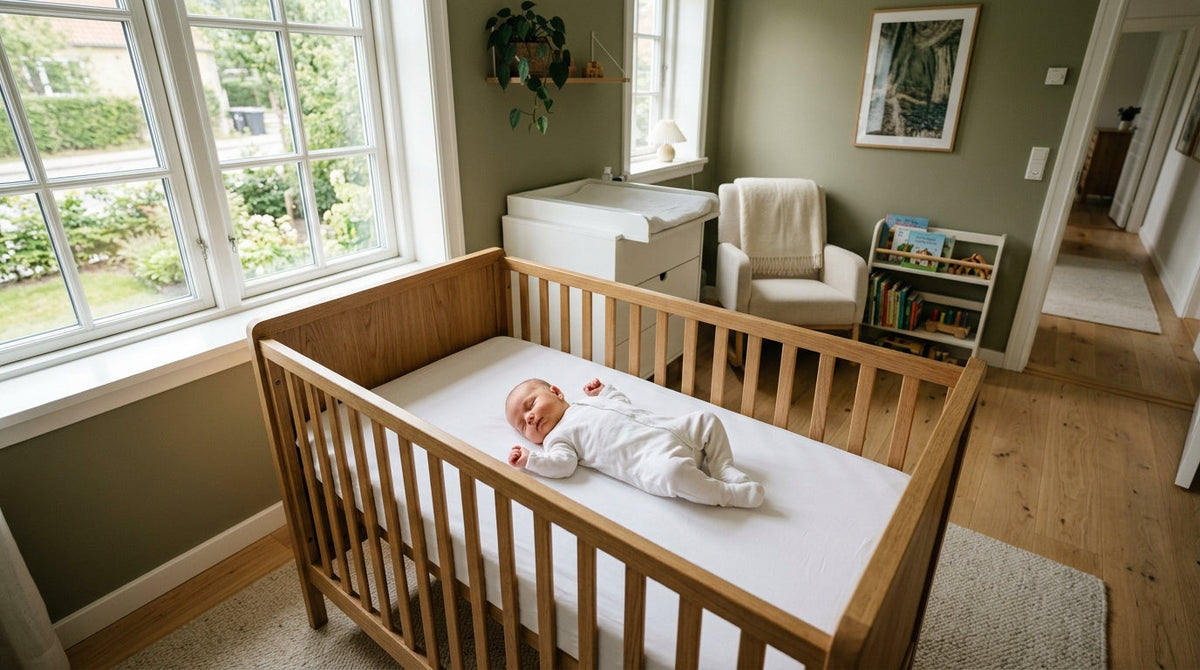
The crib is where your baby spends the most hours, which makes it the most consequential piece of furniture in the house. Start with the mattress. Crib mattresses sold in the U.S. must meet the 2022 CPSC firmness standard (16 CFR 1241), so any mattress bought new from a legitimate retailer should comply. What you’re checking is fit: press the mattress into each corner and run two fingers along the gap between the mattress edge and the crib rail. If more than two fingers fit, the mattress is too small. A gap that size can trap a baby’s face or body.
Crib slats must be no more than 2 3/8 inches (6 cm) apart (CPSC standard, 16 CFR 1219). On a new crib this is a given, but if you’re using a hand-me-down or a vintage piece, measure every gap. Old cribs were built to different standards, and some have decorative cutouts in the headboard that can entrap a head or a limb.
Remove everything soft from the sleep surface. No pillows, no loose blankets, no positioners, no stuffed animals, no bumpers. The Safe Sleep for Babies Act (2022) bans padded crib bumpers and infant inclined sleep products with a sleep surface angle greater than 10 degrees. The reason these products are banned is the same reason you don’t want anything soft in the crib: unintentional suffocation kills roughly 1,000 infants under age 1 each year in the United States (CDC SUID data). Those numbers are why the bare-crib rule is not optional.
Use a wearable sleep sack instead of a blanket. It keeps your baby warm without the suffocation risk.
Furniture Anchoring: The Non-Negotiable Step
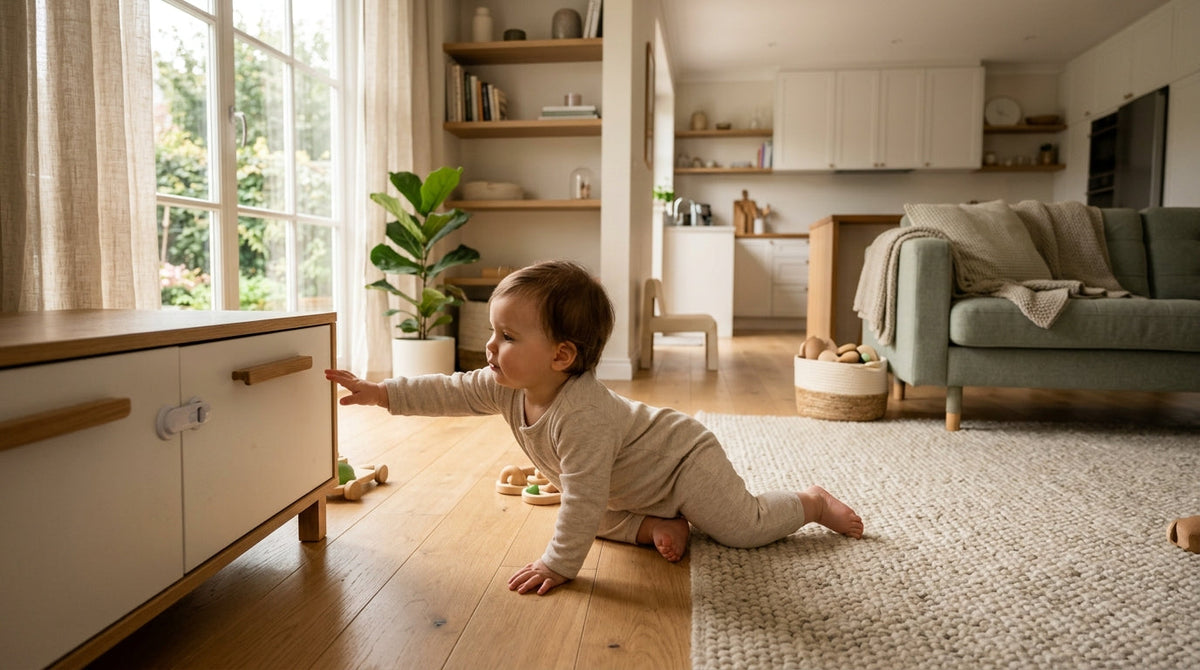
Dressers, changing tables, bookcases, and nightstands all need to be secured to wall studs with anti-tip straps or L-brackets. This is not a precaution for toddlers only. Babies become mobile faster than most parents expect, and a dresser with partially open drawers is an irresistible ladder.
Anti-tip straps are rated for specific weights, so match the strap to the piece. For a heavy solid-wood dresser, use a strap rated well above the dresser’s actual weight. Install into studs, not just drywall. Drywall anchors are not adequate for a piece of furniture that a 25-pound child might pull on with their full body weight.
Check the hardware on your changing table too. ASTM F2388–21 is the mandatory federal safety standard for baby changing products, covering changing tables and contoured changing pads for children up to 30 lb. If your changing table or pad was bought before that standard took effect, inspect it carefully for wobbly legs, cracked plastic, and a functional safety strap. If the strap is missing or broken, replace it before the next diaper change.
Window Coverings: The Cord Hazard Nobody Talks About Enough
Window blind cords are a strangulation hazard, and the risk is not limited to long, dangling loops. A cord that forms any loop, even a short one, can tighten around a child’s neck in seconds. The fix is straightforward: replace corded blinds with cordless models, or if replacement isn’t immediate, install cord cleats at least 5.5 feet from the floor and wind all excess cord length onto the cleat so no loop can form.
Move the crib away from windows entirely if possible. A baby who can pull to stand can reach a cord that looked safely out of range when the crib was first positioned. The same logic applies to the cords from a baby monitor, a sound machine, or a humidifier. Any cord within reach of the crib is a hazard.


Outlets and Electrical Safety
Standard plastic plug covers, the kind you press into an outlet, have a real problem: children can remove them. A 2012 CPSC recall pulled 900,000 Safety 1st Push 'N Snap outlet covers after reports of children as young as 9 months opening them. Plug covers follow the same principle. A child who can pull out a plug cover has just created a choking hazard and an open outlet at the same time.
The better solution is tamper-resistant outlets with built-in shutters that only open when equal pressure is applied to both slots simultaneously. The CPSC recommends these over plug covers for exactly this reason. If your nursery has older outlets, replacing them with tamper-resistant versions is a one-time fix that costs less than ten dollars per outlet in parts. An electrician can swap an entire room in under an hour.
Keep all electrical devices, monitors, humidifiers, sound machines, and fans, at least 3 feet from the crib. This keeps cords out of reach and reduces the risk of a device being pulled into the crib if a cord is grabbed.
Temperature and Air Quality
Infants cannot regulate their body temperature the way older children can. Keep the nursery between 68°F (20°C) and 72°F (22°C). A room thermometer is worth having; your own comfort level is not a reliable guide to what a swaddled infant is experiencing.
Don’t place the crib near a heating vent, a radiator, or a window that gets direct afternoon sun. All three can create localized hot spots that the room thermometer won’t catch. In winter, a cold window can also create a chilly zone around the crib even when the room feels warm overall.
For air quality, maintain humidity between 40–60 percent. A cool-mist humidifier helps in dry climates, particularly in winter when forced-air heating pulls moisture out of the air. But humidifiers require daily cleaning. A dirty humidifier disperses mold and bacteria into the air your baby breathes. Follow the manufacturer’s cleaning instructions without skipping steps, and keep the unit at least 3 feet from the crib so the mist doesn’t settle directly on your baby’s bedding.
The Changing Table: Eyes and Hands On, Always
Falls from changing tables happen in seconds. I mean that literally: the time it takes to grab a fresh diaper from a shelf two steps away is enough. My rule, which I followed after one close call with my older daughter at about three months, is that everything needed for a diaper change goes into a caddy mounted on or attached to the changing table before the baby goes on it. Diapers, wipes, cream, a spare onesie. All of it within arm’s reach so I never have to step away.
Use the safety strap every time. It is not redundant. A baby who seemed perfectly still a moment ago can roll with surprising speed. The strap is not a substitute for your hand on the baby, but it adds a layer of protection if you’re distracted for a moment.
Keep the changing area clear of small objects. Babies grab whatever is within reach and move it toward their mouths immediately.
Flooring and Fall Zones
Hard floors are a reality in many nurseries. A foam play mat or a washable area rug under the play area cushions falls and provides traction. Make sure any rug has a non-slip backing, or use a rug pad underneath. A rug that slides when a baby pulls up on a nearby piece of furniture is a fall risk.
Inspect the floor regularly for small objects. Buttons, small toy parts, coins, and anything under 1.25 inches in diameter are choking hazards. They migrate into rooms in ways that are mysterious. My younger daughter once had a penny in her fist that I am confident was not on the nursery floor when I last swept it. Check corners, under furniture, and along baseboards.
Crib Safety Checklist
Closet Organization and Storage
The nursery closet tends to become a catch-all for things that don’t belong near a baby: cleaning products moved there "temporarily," old medications, spare hardware, and anything else that got displaced during the nursery setup. Clear it out before the baby arrives and keep it cleared.
Hanging rods should be at adult height only. Low rods create a climbing structure for toddlers. Secure all shelving to the wall, not just resting on brackets. A shelf loaded with folded clothes is heavy, and a toddler who grabs a low shelf edge while trying to pull up can bring the whole thing down.
Store any hazardous items, cleaning products, medications, vitamins, even diaper cream in quantities large enough to be dangerous, in a locked cabinet or in a separate room. The closet is not a safe storage location for these items unless it has a working lock that your child cannot defeat.
Lighting
Nighttime feedings and diaper changes happen in a half-awake state, and bright overhead lights make that worse for everyone. Use a dimmable fixture or a low-wattage nightlight positioned away from the crib. The goal is enough light to see clearly without waking your baby fully or disrupting your own ability to fall back asleep.
Make sure all light fixtures are securely mounted. A ceiling fixture that’s been loose since you moved in is easy to ignore until a baby is in the room. Check that the globe or cover is secured, not just resting in place.
Monthly Safety Audits
The nursery that was safe at two weeks is not automatically safe at six months. Babies change fast. A child who couldn’t reach the monitor cord last month can reach it now. A dresser drawer that was always closed is now being opened and used as a step.
Walk through the nursery once a month with fresh eyes. Look for loose hardware on the crib and changing table. Check that anti-tip straps are still taut and anchored. Look for new objects on the floor. Check whether your child’s developmental stage has created any new hazards, new reach, new mobility, new ability to climb, that your current setup doesn’t account for.
Check for recalled products too. The CPSC recall database is searchable by product type and brand. A product that was fine when you bought it may have been recalled since. This takes five minutes and is worth doing every few months.
The nursery is not a set-it-and-forget-it project. It’s a room that needs to grow with your child, and the monthly audit is how you stay ahead of the hazards instead of discovering them the hard way.