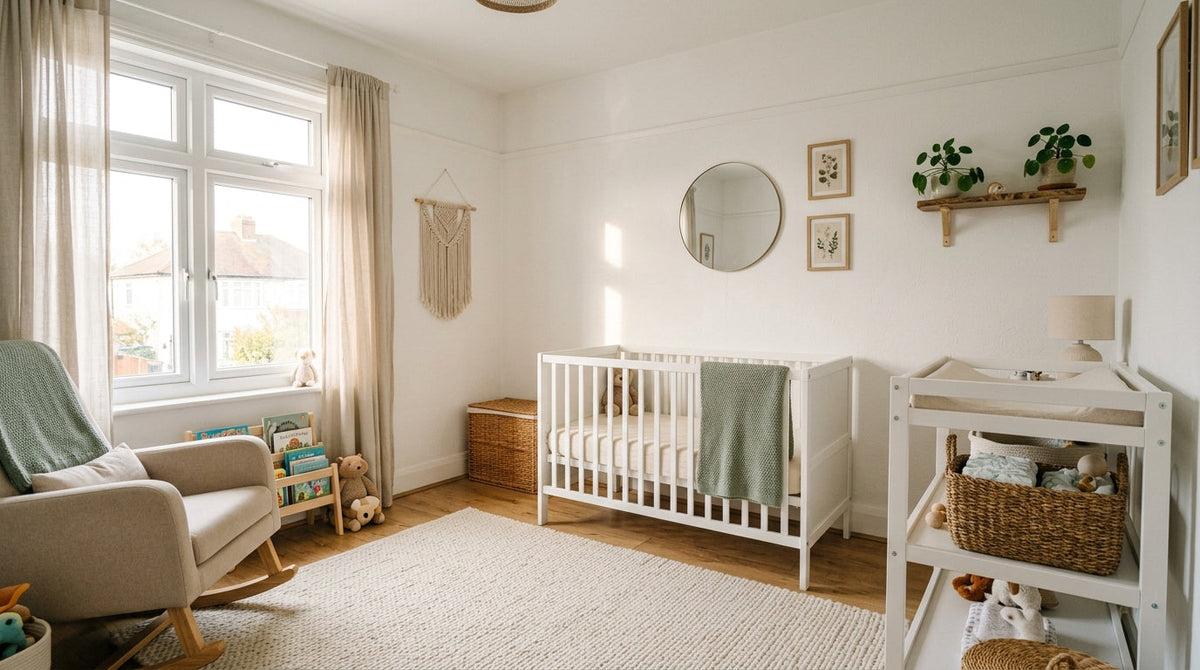
Nursery Decor Safety: Wall Art Shelves and Mobiles That Won't Fall

The nursery is the room parents spend the most time decorating and the least time stress-testing. That’s a problem.
A beautiful gallery wall above the crib, floating shelves lined with soft toys and succulents, a dreamy mobile spinning overhead. It looks intentional. It looks safe. But the gap between how a nursery looks and how it’s secured is where real accidents happen.
I’ve been in that gap. When my older daughter was about 18 months old, I watched her grab the edge of a low shelf I’d installed in her room and pull herself up on it. The shelf held, but only because I’d hit a stud. The decorative bracket on the left side? Drywall anchor. It had started to pull. I caught it during a routine check, but I still think about what would have happened if I hadn’t.
Here’s what you need to know to make your nursery beautiful and secure.
Why Nursery Decor Falls and What It Hits
Nursery walls hold a lot: framed art, floating shelves, mobiles, macramé hangings, letter sets, growth charts. Most of these items are installed once, admired, and never touched again until something goes wrong.
The physics are simple. A wall anchor rated for 20 pounds in a static pull test can fail under far less force when the load is dynamic, meaning a toddler yanking a shelf, a door slamming and sending vibration through the wall, or a child pushing up against a low-mounted piece. Drywall anchors are not designed for nursery shelving. They are a convenience fastener for picture frames in adult spaces. Every shelf in a child’s room should be anchored into wall studs with hardware rated for at least twice the combined weight of the shelf and everything on it. That margin accounts for dynamic stress, not just the weight of the objects sitting still.
Glass frames, heavy wood plaques, and ceramic art pieces create a secondary hazard. If they fall, they shatter, splinter, or land edge-first. Wall art hung above cribs, changing tables, or play areas should be impact-resistant or made of soft materials. A fabric hoop or a lightweight foam letter is a very different risk profile than a framed print behind glass.
Anchoring Shelves Correctly
The rule is simple: find the stud, use the stud. A standard stud finder takes two minutes. Driving a 2.5-inch screw into a stud takes another two. Skipping this step to avoid patching a hole later is not a trade worth making in a room where a child sleeps.
Before you load any shelf, test it. Push down on the front edge with firm pressure. Then push outward. There should be zero visible movement. Any flex or give means the installation needs reinforcement before anything goes on it. I do this test every time I add weight to a shelf, not just at installation.
A few other specifics:
- Shelf lips matter. A lip or rail of at least 1 inch high keeps lightweight items from sliding off when a door slams or a toddler bumps the wall.
- Load shelves low-to-high. Heavier items go on lower shelves. If something falls from a lower shelf, it has less distance to travel and less momentum when it lands.
- Don’t overload. A shelf rated for 15 pounds should hold 10. The rating is a maximum, not a target.


Mobile Safety and the AAP Timeline
Mobiles are one of the most common nursery items and one of the most commonly misused. The AAP is specific: mobiles should be positioned at least 16 inches above the crib mattress surface and removed entirely once a baby can push up on hands and knees or reaches 5 months old, whichever comes first. The hazard is entanglement and suffocation, not just falling.
That timeline is shorter than most parents expect. Five months goes fast. My younger daughter was pushing up on her arms at four and a half months, and I had already taken the mobile down by then because she kept reaching for it during tummy time. Once a baby has that kind of mobility, a mobile above the crib is a tether waiting to happen.
When a mobile is in use, check the attachment hardware at the crib rail or ceiling mount every week. The spinning mechanism puts repetitive rotational stress on the mount. That’s different from the static load a shelf bears, and it loosens hardware faster.
Cords, Strings, and Ribbons
Any cord, string, or ribbon attached to a mobile, wall hanging, or decorative item is a strangulation and entanglement hazard if it can reach the crib or play area. This includes the pull cord on a mobile’s wind-up mechanism, the hanging ties on fabric wall art, and the decorative ribbon on a wreath.
The standard is straightforward: if it dangles and a child can reach it, it needs to be secured or removed. Tie off excess cord length. Use a cord wind-up clip. Mount items high enough that no trailing element can fall into the crib. Check this every time you check the hardware.
String lights and night lights deserve their own attention. Electrical decor in the nursery should be positioned away from the crib and changing table, with cords run behind furniture or secured along baseboards with cord clips. A loose cord at floor level in a nursery is a trip hazard for you and an entanglement hazard for a crawling baby.
Wall Art Above the Crib and Changing Table
The area directly above the crib is the highest-consequence zone in the nursery. Anything mounted there will fall onto a sleeping infant if the fastener fails. The rule I follow: nothing above the crib that I wouldn’t be comfortable holding over my own face. That eliminates glass frames, heavy wood pieces, ceramic tiles, and anything with sharp hardware on the back.
Soft materials, lightweight foam, fabric art, and knit wall hangings are appropriate above sleep surfaces. If you want framed art near the crib, mount it to the side wall, not directly overhead, and use stud anchors.
The same logic applies above the changing table. Keep wall-mounted items soft, light, and secured.
Adhesive Mounts and Rental Nurseries
Adhesive-mounted hooks and removable wall decals are legitimate options, especially in rental spaces where drilling isn’t permitted. But they have real limitations.
Check the weight rating on every adhesive product before you use it. Most removable hooks are rated for 1–5 pounds. A framed print, a small shelf with a plant on it, a ceramic letter: these can easily exceed that. Test adhesion on a small area of your wall surface before full installation, because adhesive performance varies significantly on textured paint, older plaster, and wallpaper.
I’ve had adhesive hooks fail on textured walls even when the posted weight limit wasn’t exceeded. The surface matters as much as the load. For anything heavier than a lightweight fabric piece, adhesive alone is not sufficient in a child’s room.
Nursery Safety Inspection Checklist
Regular Inspection: What to Check and When
Installation is a one-time event. Maintenance is ongoing. Every six months, and after any visible movement or wall impact, go through every mounted item in the nursery:
- Screws and bolts: Check for loosening. Tighten anything that turns more than a quarter rotation.
- Anchors: Look for any gap between the anchor and the wall surface. A visible gap means the anchor is pulling.
- Hardware: Check for rust, especially in humid climates. Rust compromises load ratings.
- Adhesive mounts: Press the base firmly and check for any peeling at the edges.
- Mobile hardware: Check the mount, the arm, and the attachment point at the crib rail.
Write it in your phone’s calendar. Six months from installation, six months after that. It takes 15 minutes and it’s the most useful thing you can do after the initial install.
Keeping Decor Simple and Intentional
There’s a design principle that also happens to be a safety principle: fewer items, better secured, is always safer than a densely decorated wall with more potential failure points.
Every item you mount is a fastener you need to maintain, a potential fall hazard if it fails, and a surface a curious toddler will eventually try to reach. Decorative items with small detachable parts, beads, or embellishments should not be placed on low shelves or anywhere within a toddler’s reach. Once a child is mobile, anything below about 36 inches is accessible.
The nurseries I’ve seen hold up best over time, through the infant stage and into the toddler years, are the ones where parents made deliberate choices about what to mount and where. A few well-placed pieces, anchored correctly, checked regularly. That’s the standard. It’s not complicated, but it does require doing the work before anything goes on the wall.