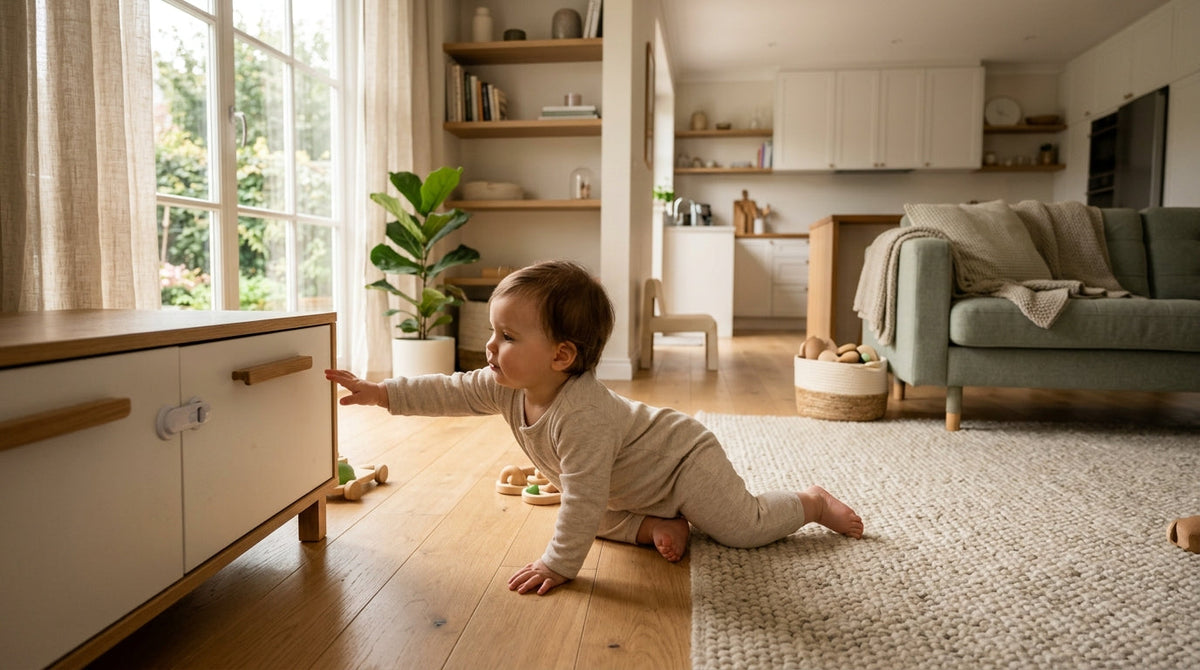
Tummy Time Safety: How to Practice Safely and When to Start

The phrase "Back to Sleep" is familiar to most new parents. The other half of that guidance, "Tummy to Play", is equally important and starts just as early.
Tummy time is not a milestone you work toward. It is a daily practice you begin in the first days home from the hospital. Done safely, it builds the neck, shoulder, and core strength that eventually leads to rolling, sitting, and crawling. Done carelessly, on the wrong surface or without supervision, it creates real risk for a baby who cannot yet lift or turn her own head. The safety rules here are simple, but they matter.
When to Start
You can begin tummy time the day you bring your baby home. You do not need to wait for the umbilical cord stump to fall off. You do not need to wait until your baby has any head control at all.
The American Academy of Pediatrics (HealthyChildren.org) advises starting supervised, awake tummy time 2 to 3 times a day for 3 to 5 minutes from the day baby comes home, working up to 15 to 30 minutes a day by 7 weeks of age. That is a total daily amount reached gradually, not a single session goal. For a newborn, three two-minute sessions spread across the day is a perfectly reasonable start.
The AAP’s 2022 safe sleep policy statement in Pediatrics reinforces this, recommending that supervised, awake tummy time begin soon after hospital discharge and increase to at least 15 to 30 minutes total daily by 7 weeks of age, specifically to support development and minimize positional plagiocephaly. A 2013 cohort study of 440 healthy infants published in Pediatrics estimated the prevalence of positional plagiocephaly at 7 to 12 weeks of age to be 46.6%, with most cases (78.3%) classified as mild. Regular tummy time is one of the simplest things you can do to reduce that risk.
The One Rule That Overrides Everything Else
Constant, hands-on supervision. Every single session.
Your baby cannot roll herself off her stomach if she struggles. She cannot turn her head reliably if her face drops toward the surface. She cannot call for help. This is why tummy time is strictly an awake, alert, someone-is-watching activity. The moment you need to leave the room, even for thirty seconds, you pick her up and put her on her back.
In my experience, the risk becomes clear quickly. A baby without head control can drop her face into the mat in seconds. The surface may be safe, but a moment of inattention is all it takes. That is the reality of early tummy time.
Supervision means eyes on the baby, hands within reach, and your full attention on her breathing and color. Not your phone. Not the stove. Not the door.
Surface Matters More Than You Think
Firm and flat. That is the entire surface requirement.
A play mat on the floor is ideal. A folded blanket on a hard floor works. Your own chest or lap, with you reclined slightly, is excellent for newborns who resist being placed on the floor. What you cannot use: the couch, a pillow, a Boppy lounger, a padded play yard insert, or any soft surface that could conform around your baby’s face.
Soft surfaces create a pocket around a baby’s nose and mouth if her head drops, and she cannot generate enough force to push away from them. The CPSC has been consistent on this point in its baby safety guidance: sleep and supervised rest surfaces for infants must be firm and flat, and that applies to tummy time too.
The floor is the safest choice. Put down a thin blanket or a foam play mat and get down there with her. That also makes the session more engaging.


Clear the Area Before You Put Her Down
Before every tummy time session, scan the surface and the immediate surroundings. Remove loose blankets, pillows, stuffed animals, rolled towels, and anything else within arm’s reach. Babies doing tummy time move more than you expect, even very young ones. They can inch forward or sideways. And they cannot move away from an object that drifts against their face.
This is especially true for older babies who have started pushing up and then collapsing. They can end up face-down on whatever is nearby. Keep the tummy time zone clear and flat every time.
Reading Your Baby During a Session
Watch her face and her breathing throughout. Signs that you need to stop and reposition her on her back immediately include labored or irregular breathing, a change in skin color (pale, mottled, or bluish around the mouth), and escalating distress that does not settle within a few seconds of repositioning her head.
Some fussing is normal, especially in the early weeks. Tummy time is hard work for a baby with almost no neck strength. But there is a difference between the grumpy protest cry of a baby who would rather be held and the escalating distress of a baby in real difficulty. You will learn to tell the difference quickly. When in doubt, flip her over.
Per the CDC’s Learn the Signs. Act Early. milestones, most babies (75% or more) roll from tummy to back by 6 months. Until your baby can do that reliably, she depends entirely on you to reposition her.
Tummy Time Is Not Sleep
This needs to be said plainly because exhausted parents sometimes make this mistake. Tummy time ends the moment your baby falls asleep. If she dozes off on her stomach, roll her onto her back immediately.
About 3,500 infants die each year from sleep-related causes in the United States, per CDC SUID data. The AAP’s safe sleep guidance is unambiguous: babies sleep on their backs, on a firm flat surface, for every nap and every nighttime sleep, until age one. Tummy time builds the strength that eventually makes back sleeping safer and supports developmental progression, but it does not replace back sleeping. These are two separate practices with two separate purposes.
If your baby falls asleep during tummy time on your chest, that is a common scenario. Move her to her back on a firm surface before you put her down.
When Tummy Time Is Harder: Reflux, Recent Feeding, and Medical Conditions
Timing matters. Putting a baby on her stomach right after a feeding is uncomfortable at best and a recipe for spit-up at worst. Wait at least 20–30 minutes after a feeding before starting a session.
Babies with gastroesophageal reflux often resist tummy time because the position increases discomfort. If your baby has diagnosed reflux or consistently arches and cries during sessions in a way that seems pain-related rather than just effortful, talk to your pediatrician before pushing through. There are modified positions, including more inclined chest-to-chest contact, that may work better while her reflux is being managed.
Some babies with specific medical conditions, including certain cardiac or respiratory concerns, may need individualized guidance on positioning. Your pediatrician is the right person to ask. Do not skip tummy time without checking, but do not push through obvious distress without checking either.
Tummy Time Safety Checklist
Building Up Over Time
By 3 to 4 months, most babies have developed enough head control to make tummy time look less like survival and more like play. This is when you can start varying the experience. Try placing her on your shoulder facing outward. Try a slightly textured surface. Get a high-contrast toy or a small mirror at eye level. Interaction keeps sessions longer and more productive.
In my experience, the goal is accumulated daily minutes, not any particular method of getting them. What works varies by baby and by day.
As sessions get longer and your baby gets stronger, you will start to see the payoff. The wobbly head becomes a lifted head. The lifted head becomes a propped-up chest. These are the building blocks for rolling, sitting, and eventually pulling to stand. Per the CDC’s 12-month milestones, at least 75% of children pull up to stand and walk while holding onto furniture by 1 year. The foundation for that starts here, on the floor, in the first weeks of life.
What to Do When Your Baby Hates It
Most babies resist tummy time at some point. This is normal. Their neck muscles are weak, the position is unfamiliar, and it requires real effort.
Try shorter sessions more frequently rather than longer ones. Three one-minute sessions are more useful than one failed five-minute attempt. Try different times of day, when she is alert but not hungry or overstimulated. Try chest-to-chest contact on your reclined body as a gentler introduction. Try getting on the floor yourself so she has a face to look at.
Resistance usually decreases as strength increases. The more tummy time she gets, the stronger she gets, and the less she protests. If resistance is severe, persistent, or accompanied by what looks like pain, bring it up at your next pediatric visit.
A Note on Consistency
The hardest part of tummy time is not the technique. It is the repetition. Three to five minutes, two to three times a day, every day, while also feeding every two to three hours, sleeping in fragments, and managing everything else that comes with a newborn. It is easy to skip.
Build it into existing routines. After a diaper change. After a feeding once the wait time is up. During a period when you are already on the floor. Keep sessions short enough that skipping feels harder than just doing it. The cumulative effect of those small sessions, done consistently and safely, is real.