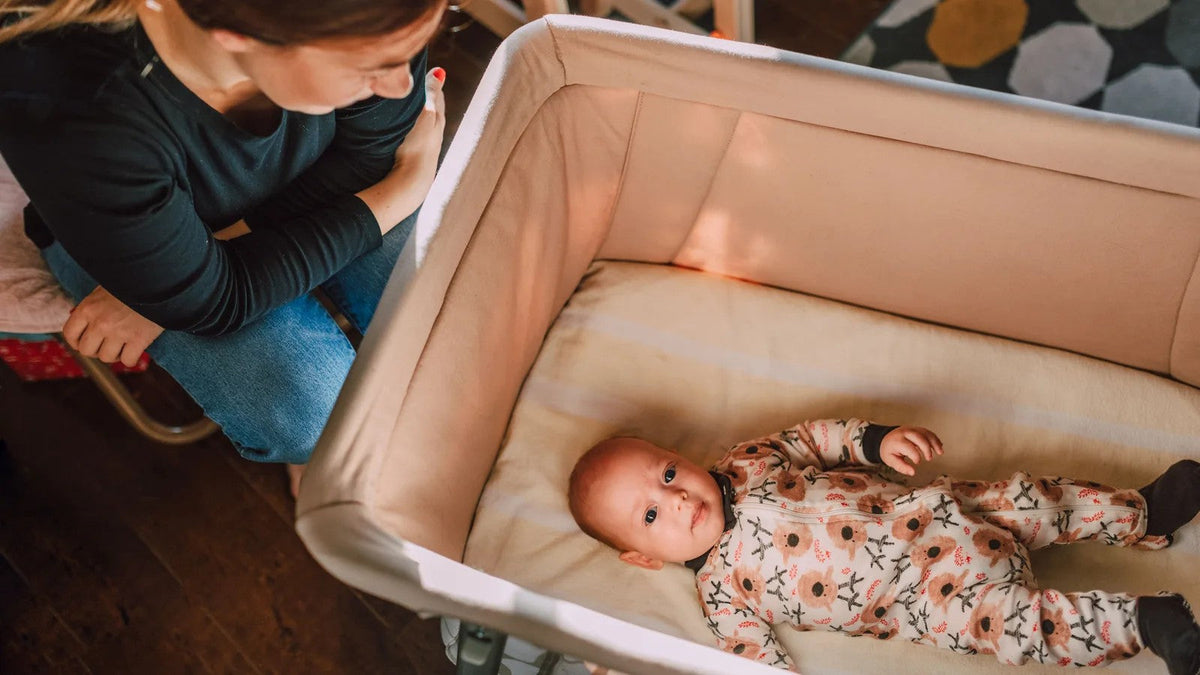

Are Bedside Sleepers and Co-Sleeper Bassinets Safe? Gaps, Straps and the Federal Bassinet Rule
What the federal bassinet and bedside sleeper rules cover, what the AAP and CDC say about sleep surfaces, and what to check on the label.

Are bedside sleepers safe? A bedside sleeper has to meet one federal CPSC rule, and a bassinet has to meet another. The label on each product shows when it was made, and the maker’s instructions for that model show how to set it up. The AAP is direct: "If a product doesn’t meet federal safety standards, don’t use it."
Are Bedside Sleepers Safe? The Federal Rules That Apply
Bedside sleepers have their own rule. The CPSC points to 16 CFR part 1222, titled "Safety Standard for Bedside Sleepers." It requires each bedside sleeper to comply with ASTM F2906-23. The CPSC adds changes to that standard, and those changes point back to the part 1218 bassinet rule.
The CPSC defines a bedside sleeper as "a rigid frame assembly that may be combined with a fabric or mesh assembly." It is "intended to provide a sleeping environment for infants and is secured to an adult bed." That last phrase separates it from a freestanding bassinet.
Bassinets and cradles fall under 16 CFR part 1218. The CPSC says that part codifies the regulation and incorporates ASTM F2194. The federal rule that applies depends on how the product is built, not on its marketing name.
Parents weighing bassinet versus crib safety will find both named in one AAP line. The AAP tells parents to use a crib, bassinet, portable crib or play yard "that meets the safety standards of the Consumer Product Safety Commission (CPSC)." It also says alternative sleep surfaces are "only considered a safe option IF they comply with the June 2021 CPSC rule" that "all infant sleep products meet existing federal safety standards for cribs, bassinets, portable cribs or play yards."
No product removes the need for the AAP’s safe sleep steps. Meeting the federal rule is the entry requirement.


Bedside Sleeper Safety Straps and Gaps: Follow the Maker’s Instructions
The CPSC is specific about what it lists. Its bedside sleeper page names "attachment to adult bed" and "maximum separation from the bed" among the standard’s performance requirements. It also lists the minimum height of the barrier around the entire perimeter and drop-down side engagement.
The CPSC page gives no numeric gap limit. It does not mention straps at all.
So for the number and the attachment method, go to the maker’s instructions for that model. Follow them for your sleeper, not for a similar one.
Picture this: you unbox a sleeper and wonder how it should attach to the bed frame. A forum post gives one answer and a friend gives another. The CPSC page gives neither. The instruction manual for your exact model is the place to look.
The permanent label, covered below, must name the manufacturer or importer and give US contact information.
The Federal Bassinet Rule: What It Covers and When It Applies
The CPSC defines a bassinet or cradle as "a small bed designed primarily to provide sleeping accommodations for infants." Bedside bassinet safety begins with this rule. The CPSC says the standard covers general items, such as lead in paint, sharp edges, small parts and labeling. It also covers performance items, such as stability, static load, mattress and side height.
The sleep surface gets a numeric limit. The CPSC says a bassinet or cradle is intended to have a head-to-toe sleep surface less than or equal to 10° from horizontal in a rest position. Rest means non-rocking or non-swinging.
The CPSC dates each version of the standard by manufacture or import date.
Bassinets and cradles:
- Products manufactured or imported on or after February 21, 2026 must meet ASTM F2194-25.
- Products on or after April 23, 2014 must meet ASTM F2194-13 with modification.
- To give makers time to fully comply with the revised standard, the CPSC used enforcement discretion until June 30, 2026. It says "products manufactured on or after this date must fully comply with the mandatory standard."
Bedside sleepers:
- Sleepers manufactured after August 5, 2023 must meet ASTM F2906-23 with modification.
- Sleepers manufactured after July 15, 2014 must meet ASTM F2906-13 with modification.
What to Find on the Label and Why the Date Matters
The CPSC requires bassinet and bedside sleeper makers to permanently affix certain details, in English. Look for these four items:
- The manufacturer or importer name
- US contact information
- The model name or number
- The date of manufacture, at least month and year
The date does the most work. Because the CPSC dates each standard version by manufacture date, the label tells you which version of the rule the sleeper was built under. A sleeper with no readable date leaves you guessing.
Registration matters too. The CPSC says "Product registration forms are required for all durable infant and toddler products." Their purpose is "to enable the manufacturer or retailer of the product to contact consumers with recall or other safety information." If you want a recall notice to reach you, the form is how the maker or retailer finds you.
If you are looking for a safe co sleeper, start with this label.
Safe Sleep Basics for Any Bassinet or Bedside Sleeper
A federal label does not replace the daily steps. These come from the AAP safe sleep guidelines and from the CDC, and they apply to every sleep product.
Back for all sleep. The CDC says: "Place your baby on his or her back for all sleep times." For a newborn, the AAP says that after the first skin-to-skin time after birth, "the baby should be placed on their back in a bassinet with no incline."
Firm and flat. The CDC says to "Use a firm, flat (not at an angle or inclined) sleep surface." The AAP explains that "A firm surface means that it shouldn’t indent when your baby is lying on it." It adds that any surface that inclines more than 10° isn’t safe for your baby to sleep on. The CPSC bassinet rule uses the same 10-degree figure for the sleep surface in the rest position.
Bare sleep area. The AAP says "Soft objects and loose bedding can increase your baby’s risk of entrapment, suffocation or strangulation." It names pillows and pillow-like toys, quilts, comforters, mattress toppers, non-fitted sheets, blankets, toys, bumper pads and related products that attach to crib slats or sides. The CDC likewise says to keep blankets, pillows, bumper pads and soft toys out of the sleep area.
A bare sleep surface is also the foundation of a safe nursery setup. The same AAP and CDC list applies whether the sleeper sits beside your bed or across the room.
Room Sharing Without Bed Sharing
The AAP says to "share a room with your baby for at least the first 6 months of life." It describes the sleep area as in the same room, close to your bed but "not in the same bed." The AAP also recommends that parents "avoid bed sharing with their baby under any circumstances."
The CDC gives a matching line. It says to keep your baby’s sleep area, for example a crib or bassinet, in the same room where you sleep. The CDC’s timing: "ideally until your baby is at least 6 months old."
Notice what neither group says. Neither the AAP nor the CDC names a bedside sleeper as the way to room share. A bedside sleeper is one product that has to meet the federal rule. It is not a safe sleep fix on its own.
Parents who want the wider picture on co-sleeping risks and safer alternatives can read the AAP’s full guide to safe sleep at HealthyChildren.org.
Second-Hand Sleepers: What the AAP’s Crib Advice Says
Used sleepers raise the same questions as new ones. The AAP’s advice here is written for cribs, not for bassinets or bedside sleepers.
In that crib advice, the AAP says: "Check the CPSC website to make sure your crib hasn’t been recalled, especially if it’s not new." It also says not to use a crib "that doesn’t have instructions, is missing hardware or that’s broken."
Picture this: a used bedside sleeper is listed online at a good price. The photos show the frame but not the label, and the seller says the manual was lost. The CPSC label rule names the details the label must carry: maker, contact information, model and manufacture date. Without a photo of that label, you have none of them in hand.
The instructions matter for a second reason. As covered above, the gap and attachment details come from the maker’s instructions for that model.
Quick Checklist Before You Use a Sleeper
Use this table as a last pass before the first night.
Before the First Night
| Check | What to look for | Source |
|---|---|---|
| Federal rule | Sleeper 1222, bassinet 1218 | CPSC |
| Label | Name, contact, model, date | CPSC |
| Version by date | Match manufacture date to version | CPSC |
| Gap and attachment | Maker’s instructions for model | CPSC, maker |
| Sleep surface | Firm, flat, not inclined | AAP, CDC |
| Sleep area | Bare, no soft items | AAP, CDC |
| Position | Back for all sleep | CDC |
| Room | Same room, not same bed | AAP, CDC |
The product, the label and the instructions work together. If the label is missing, you cannot read the manufacture date. If the instructions are missing, you lose the maker’s gap and attachment details.