
How to Change a Diaper Step by Step: Newborn Boys and Girls, the Umbilical Cord, and Keeping One Hand on Baby
Every step of a diaper change from AAP and CDC guidance, with diapering around the umbilical cord stump, boys and girls, poopy diapers and one hand on your baby throughout.

Picture this: your newborn is on the changing pad, the diaper is open, and the wipes are in the other room. You take one step to grab them. That one step is a way a routine change can turn risky, and a few minutes of setup removes the reason to take it.
Set Up Before Your Baby Goes Down
Before you lay your baby on the surface, gather what you need. The AAP says to prepare the area so everything is accessible, and at a minimum that means a diaper and something to wipe with. It also says to keep diapering supplies within your reach but out of your baby’s reach, so you don’t have to leave your baby’s side to get them.
If you use a changing table, the AAP recommends a sturdy, stable one with a 2-inch (5 cm) guardrail on all four sides and a concave top, slightly lower in the middle than at the sides.
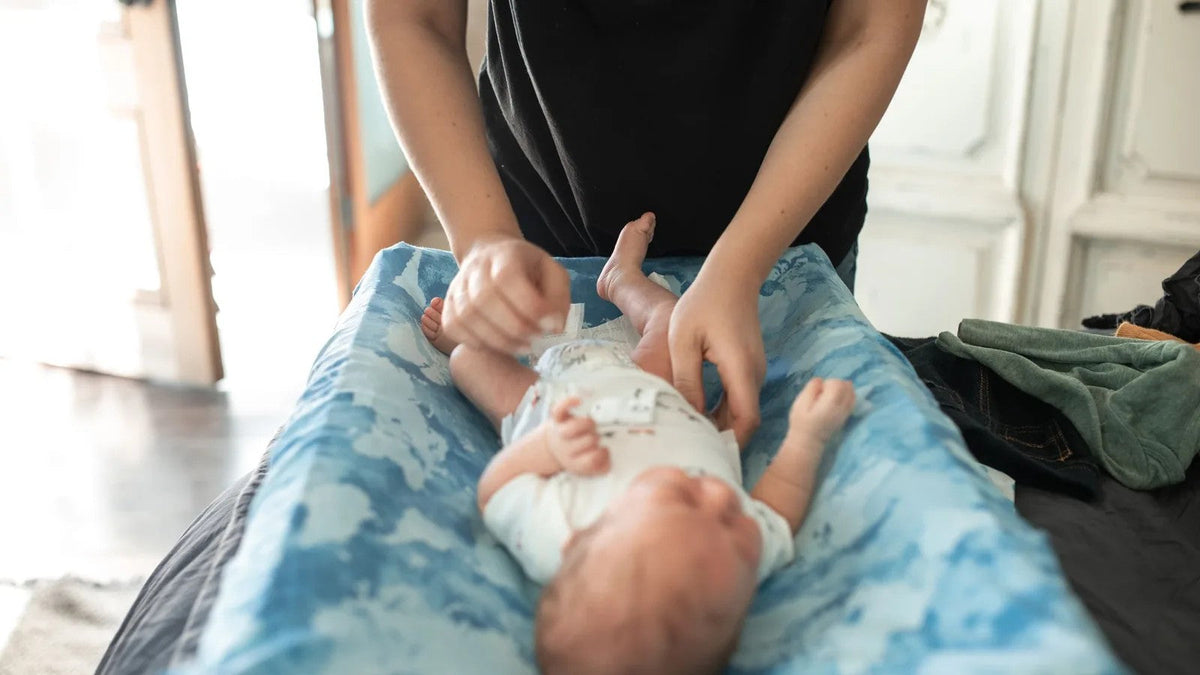
Once you have the basics, changing a diaper on a changing table comes down to order. Everything is in reach, your baby goes down, and your hand goes on your baby before anything else happens.
Keep One Hand on Your Baby for the Whole Change
CDC’s home diaper-changing steps open with this line: "Keep a hand on the child for safety at all times." Treat that line as the starting point for diaper changing safety. The AAP says never to leave a baby unattended on a changing table, even for a moment, even when strapped in.
That includes the "quick" reasons: a ringing phone, a doorbell, a wipe that rolled out of reach. If you need something, bring your baby with you.
If your table or pad has a belt, buckle it. Treat it as a backup, though. The AAP says not to depend on the strap alone.
Plan ahead for the stretch when babies start rolling over. The AAP notes that most babies are cooperative at least until they learn to roll, somewhere around four months of age. Until then, a newborn on their back can seem to stay put. That is not a reason to loosen your grip.


How to Change a Diaper Step by Step, in One Order
The order below follows the AAP’s technique for the change itself and CDC’s home steps for hygiene. If you are learning how to change a newborn diaper, run through it a few times and it becomes routine. Your free hand does the work at every step, and the other stays on your baby.
- Lay your baby down and set the clean diaper first. The AAP describes lifting your baby’s legs with one hand and, with your other hand, placing an opened clean diaper under the still-diapered bottom. Slide it under with the picture side in front, face down; tab side under your baby.
- Unfasten the old diaper. The AAP says to wipe your baby’s bottom with the front (inner side) of the old diaper as you take it off. It calls this first wipe optional, but says it often removes a significant amount of poop before you reach for a baby wipe.
- Wipe. Use a baby wipe, a moist tissue or a washcloth on your baby’s bottom and the surrounding dirty areas, per the AAP. CDC’s steps say to always wipe from front to back.
- Remove the old diaper and used wipes. The AAP says to pull them out from under your baby and set them somewhere safe. That way your baby’s foot doesn’t end up in poop and nothing gets knocked onto the floor.
- Fasten the new diaper. The AAP says to center the front between the legs and pull it up to at least the same level in back as in front, usually around the belly button. For a newborn with a cord stump, the AAP says to keep it folded below the stump. Secure the tabs evenly in front so there are no gaps around the hips. Per the AAP, don’t tuck the fringe around the legs into the diaper’s elastic edges, which helps prevent leaks.
- Finish in CDC’s order. Wash your baby’s hands with soap and water, and put your baby somewhere safe and supervised. Clean the changing surface. Then wash your own hands thoroughly with soap and water.
CDC’s handwashing guidance lists changing diapers as a time to wash your hands and says to scrub for at least 20 seconds. Your baby stays on the surface under your hand until step 6 starts.
Poopy Diapers and How Often to Change
How to change a poopy diaper uses the same steps, with a few extra decisions. The optional first wipe with the front of the old diaper is one. Another is the AAP’s fold-under tip.
If the old diaper isn’t overwhelmingly messy, the AAP suggests leaving it folded over on itself under your baby’s bottom while you clean. It says this can help keep the new diaper from getting soiled and absorb any new pee. If it is overwhelmingly messy, skip the tip and take it out.
Where the dirty diaper goes matters too. CDC says to keep it away from surfaces that cannot be easily cleaned. For a disposable diaper, CDC says to set the used wipes in it and put both in a plastic-lined, lidded trash can.
As for timing, the AAP’s HealthyChildren.org says changing diapers every three to four hours, or anytime you notice the diaper is soiled, can help prevent most diaper rashes. So a poopy diaper comes off whenever you notice it.
Newborns and the Umbilical Cord Stump
Learning how to change a newborn diaper with an umbilical cord stump comes down to one adjustment. The AAP’s umbilical cord care guidance says to keep the diaper folded below the cord so urine doesn’t soak it. See the AAP’s guidance at HealthyChildren.org for umbilical cord care.
For many families, the stump is one more detail to manage during the first 30 days at home. The AAP says the stump should dry and fall off by the time your baby is 3 weeks old. If it is still there beyond that time, the AAP says a doctor’s visit is needed.
The AAP’s guidance also lists reasons to act. If the cord actively bleeds, the AAP says to call your baby’s doctor immediately. The AAP says to contact your pediatrician if you notice any of these:
- Foul-smelling yellowish discharge from the cord
- Red skin around its base
- Crying when you touch the cord or the skin next to it
Don’t try to sort out what any of these might mean. Contact your pediatrician and let them take it from there.
Boys and Girls: Small Differences in the Same Routine
Boys. If you’re wondering how to change a boy diaper without getting peed on, the AAP has tips to try. It notes that some babies tend to pee as soon as they are exposed to open air. It suggests holding your hand, a diaper or a tissue over a boy’s penis during the change. Keep your other hand on your baby while you do it.
If urine keeps sneaking out of his diapers, the AAP suggests aiming his penis downward before covering it with the new diaper. Say the old diaper is off, the air hits, and you are already reaching with a tissue because you planned for it.
For an uncircumcised boy, see the AAP’s guidance at HealthyChildren.org. If he is circumcised, follow your pediatrician’s care instructions until it heals.
Girls. How to change a girl diaper follows the same steps, with one habit built into every wipe. CDC’s diapering steps say to always wipe from front to back. The AAP lists wiping from front to back after bowel movements among the bathroom-hygiene habits that can help lower a child’s risk of urinary tract infections. It calls this "especially important for girls."
Never a Nap Spot
A changing surface is for changing. In its 2018 release on the federal standard for baby changing products, CPSC reported that the fatal incidents in the reports it had received primarily involved suffocation or asphyxia when babies were sleeping on baby changing products.
Picture this: the last tab is fastened, your baby’s eyes are drooping, and the pad is right there. Finish the change, then move your baby. The AAP says to place babies on their back for all naps and at night, in a crib, bassinet, portable crib or play yard. It also says not to use products for sleep that aren’t specifically marketed for infant sleep.
A baby who dozes off mid-change is still a baby on a surface that was never made for sleep. Lift your baby while the diaper is fresh and the room is quiet, and get them to a proper sleep space.
Where a Pad Fits
A pad adds a layer to the changing surface. It never replaces your hand. If you are comparing contoured, flat and portable changing pads, the Nest Eva Diaper Changing Pad is one option. Its EVA foam surface is waterproof and wipes clean with no cover or liner. It also has raised sidewalls, a non-slip base and an adjustable safety belt.
Its product page warns that it is not a substitute for adult supervision. That matches what CDC says (one hand on your baby) and what the AAP says (supplies within reach, never leaving your baby unattended). Whatever surface you use, your hand stays on your baby until the change is finished and your baby is somewhere safe.